Bill Timmerman
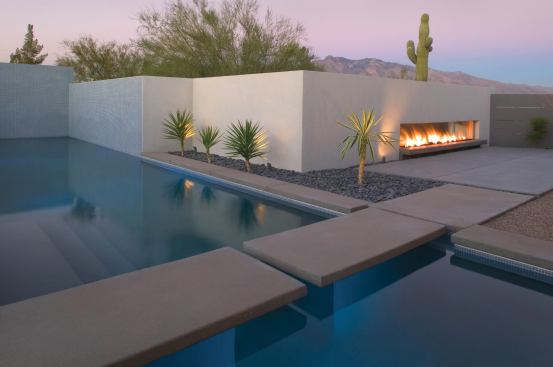
The long, lean shape of the fireplace emphasizes the home’s ho…
“It was an unusual setting,” says architect Teresa Rosano about the original condition of this Tucson, Ariz., property. When she first saw the site she was struck by how little vegetation remained because of corrosion and clutter on the 3-acre patch of desert. To top it off, this piece of wasteland occupied a rise in the midst of commercial and multi-family buildings. Still, Rosano and her partner, Luis Ibarra, saw potential. “It’s a pocket of desert within the city, so a lot of interesting wildlife hangs out here,” says Rosano. “We were dealing with a blank slate, so we were able to use architectural elements to define usable exterior spaces.”
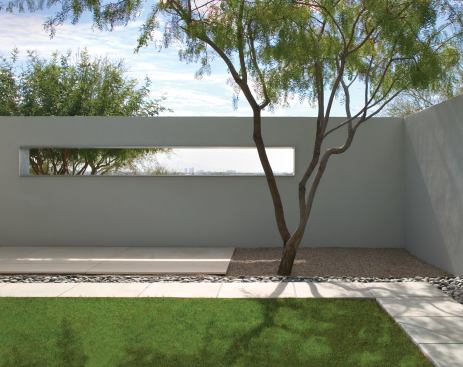
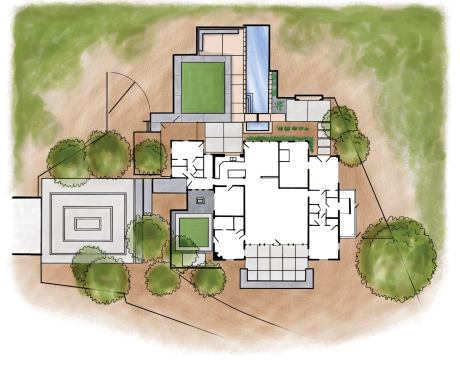
The architects enclosed the property with pale gray stucco walls that crop nearby buildings from view, while precise wall openings frame a mountain panorama along the western horizon and downtown’s skyline to the south. “The walls themselves become part of the view,” explains Rosano. “They eliminate less desirable angles and create focal points of distant mountains and city lights.” The husband-and-wife team, who designed both the house and the landscaping, used built structures to enclose a series of courtyards that are seamless extensions of the home’s interior.
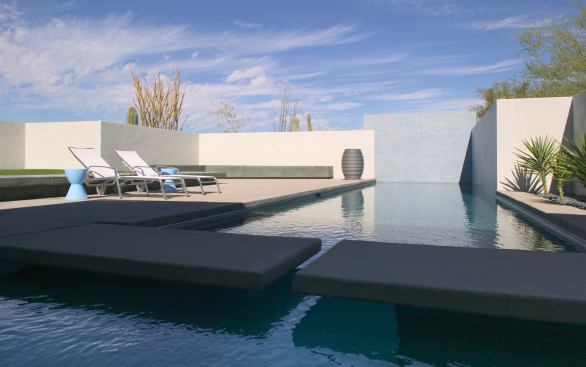
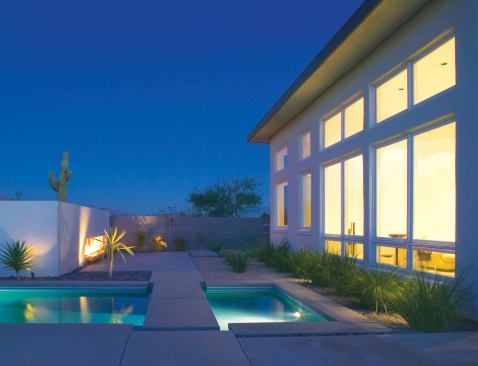
Planned as an outdoor room, each courtyard has a distinct character, specific interaction with adjacent rooms, and materials that enhance function as well as aesthetics. A slender lap pool, on a direct axis with family and dining rooms, occupies the primary courtyard. The water physically divides it into public and private sections connected by a concrete bridge. The public zone offers outdoor dining with direct access to the kitchen, plus a slice of grassy lawn for softer lounging. The private side features a slim fireplace that can be seen from the master bathtub. A quiet walkway sheltered by the bath leads to the master bedroom. “The whole living area looks through to the pool area,” says Rosano. “And from the pool you can see through the house to distant skyline views opposite.”
Another calm courtyard surrounds a guest bedroom and home office. A rectilinear slice of wall has been removed to give a glimpse of distant skyscrapers. The meditative focus of this courtyard is a solitary tree and a fountain that splashes away distracting urban noise. The spa devotees who own the home asked for soothing environments inside and out. “A lot of the material choices were made for their clean feel that relates to spa serenity,” says Rosano.
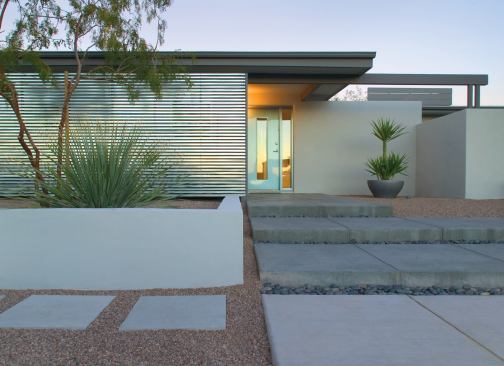
Though Rosano speced basic stone and concrete, the hardscape materials transform the once desolate ground into an elegant topography. Expanses of pale gold pea gravel follow the courtyard perimeters and go beyond the walls to blend with the desert sand. Black Mexican beach stone borders the gravel in contrasting color and texture. Squares of dark gray and natural concrete are used for walkways, shallow stairs, and pool decking. The extensive use of hardscaping “gives order to a landscape that didn’t have a natural order” as it minimizes water consumption in this arid climate.
Project Credits:
Builder: Repp Design + Construction, Tucson, Ariz.
Architect/landscape designer: Ibarra Rosano Design Architects, Tucson
Fireplace: Jasmine Gas, Tucson
Tile installer: Dante Rosano Tile, Tucson
Photographer: Bill Timmerman
Illustration: Charles Lockhart