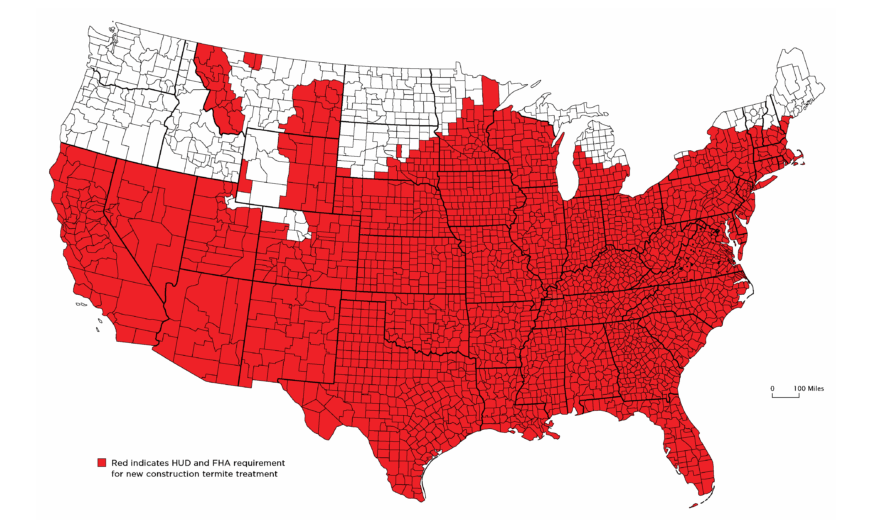
Termites have been marching north. Typically, the further south you go, the more common the destructive pests are; however, in recent years more areas of the country are requiring termite treatments for new homes.
Scientists attribute this termite expansion to rising global temperatures. While most termites die off during the winter in areas where the ground freezes, as winter temperatures warm, termites are better able to survive in more northern climates.
My company, termiticide manufacturer Nisus, has created an interactive termite map to represent termite treatment requirements for new construction FHA home loans, and VA housing typically follows the same requirements. According to HUD standards, red areas on the map are where termite treatments are needed in order to secure a government guaranteed loan for new construction. Most conventional lenders follow the same HUD guidelines, meaning they may require termite treatments as a requirement for their mortgages.
Wood-destroying insects can easily go undetected and cause major damage to a home, and if you are in an area where termites weren’t previously a problem, you might not be looking for them. Termites are responsible for approximately $5 billion worth of damage to wood structures in the U.S. and Canada annually, according to the National Pest Management Association (NPMA). Because termite repairs are not covered by homeowner insurance, homeowners are responsible for any repair costs of infested homes. The average expense ranges from $3,000 to $5,000; however, in many cases the cost can be $40,000-$50,000 if structural beams are impacted.
Obviously, the best way to deal with termites is to prevent them. A new construction termite treatment expense is insignificant compared to the cost of damage repair. Three types of termite treatments–soil treatments, bait stations and wood treatments–satisfy HUD, FHA and VA requirements, according to Greg Baumann, vice president of technical services and regulatory affairs at Nisus Corporation.
Soil treatments have been the traditional method of controlling subterranean termites since the 1950s. Typically, 200 to 400 gallons of liquid termiticide are pumped into the ground around the foundation and under the slab of the new home to create a chemical treated area to repel or kill the termites. This type of treatment potentially lasts at least five years; however, it is easily disrupted by adding landscaping. In fact, the actual chemical barrier that is left on the soil is only about 1/25th of an inch thick. The thinness of this barrier means that something as simple as walking over the dirt foundation after treatment can destroy the barrier. In addition, many customers don’t want to pump chemicals into the ground around their homes.
Bait stations are another type of accepted termite treatment and are placed directly into the ground surrounding a structure. Introduced in 2005, these stations contain cellulose that has been laced with an insecticide to kill the termites as they run across one of the stations. The stations are placed about 10 feet apart. This method is considered environmentally friendly because there is little to no risk of soil contamination and the chemical is specific to termites, but there is no guarantee termites will intercept the station on their way to infest the home. Furthermore, if the homeowner does not renew the service, the bait stations are removed, leaving the home with no termite protection at all.
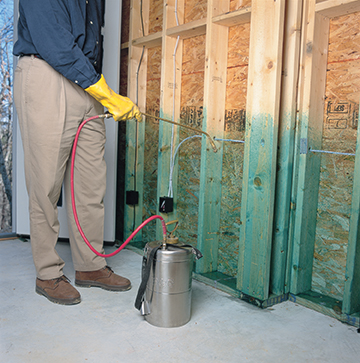
Courtesy Nisus Corp.
Wood treatments are applied during the dried-in phase of construction and have been in use in the United States since 1999. The active ingredient is borate, a natural inorganic mineral salt that has a toxicity similar to table salt. Borates are considered a green treatment method, allowing builders to earn points in several green building programs. This pretreatment is applied directly to the wood by the pest management company. Depending on the product used, these treatments last for the life of the wood, providing long-term residual protection.
All three termite treatments can provide effective control against termites. You many not be in an area that has a history of treating for termites, but it is becoming more evident with damages reported by pest control companies that termites are steadily infesting homes further north than ever. Using the Nisus interactive termite map is the first step in determining if offering a termite treatment for your homeowners is a decision that could affect customers, your business and your reputation for years to come.