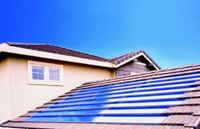
Solar power generation—or photovoltaics (PV)—has been around for decades, but only in the past few years have homeowners and builders begun to seriously consider it on a wide scale as a way to reduce energy costs. Soaring gas and electricity costs are driving the home building segment’s interest in PV systems while state and federal tax credits as well as utility rebates are fueling the market’s growth.
But unless they are staunch greenies, most custom clients don’t want to compromise the aesthetics of their home for solar power. Luckily, several PV system manufacturers now offer modules that integrate with roofing materials so that they sit flush with the roof’s profile and are fairly unobtrusive.
These building-integrated PV (BIPV) panels actually do double duty as electricity-generating systems and as roof coverings by taking the place of a portion of the roofing material. “Building-integrated photovoltaics become part of the roof; it looks like it was designed as part of the building as opposed to being an afterthought,” says Mark Farber, founder and vice president of strategic planning for Evergreen Solar.
BIPV panels are sized similarly to shake- and shingle-style concrete roof tiles, but also can integrate with wood shakes, slate shingles, and Spanish-style tiles. In most cases the panels blend nearly seamlessly with the roof material, but with curved Spanish-style tiles the PV panels look more like a flush-mounted skylight.
According to industry experts, BIPV overcome the aesthetic drawbacks of standard PV systems. As the industry develops and grows, manufacturers will turn their focus to subtleties like texture and color. This will move BIPV away from a utilitarian, high-tech appearance toward a sleeker, more stylish look, predicts Vic Abate, vice president of renewables for GE Energy. Also, solar cell efficiencies will increase so that less roof area will have to be taken up by PV panels.
The key to successfully incorporating BIPV into a home is designing for it from the beginning, says Mark Cortez, director of marketing for Sharp Solar. Trying to add BIPV systems after roofing has been installed requires removing a significant portion of that roof, increasing waste and costs.
Currently, BIPV products are offered by six manufacturers, but experts predict that more players are likely to enter the field in coming years.
Evergreen Solar: www.evergreensolar.com
GE Energy: www.gepower.com
Kyocera Solar: www.kyocerasolar.com
PowerLight Corp.: www.powerlight.com
Sharp Solar: www.sharpusa.com
United Solar Ovonic: www.uni-solar.com