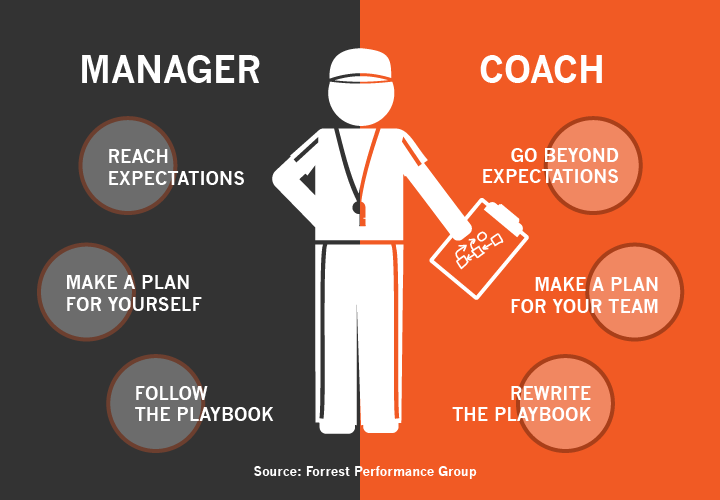
In your mind’s eye right now, I want you to picture the best manager you’ve ever had. What made them great? Was it how invested they were in your success? Was it how much they pushed you to be great? Or was it about how they held you accountable to your process?
The positive intention of every manager is to constantly drive their people to be better than they were yesterday. Whether they succeed or not is one thing, but no manager thinks, “I want my people to be worse tomorrow than they were today.” Chances are, you’ve had at least one manager who you’d consider great.
But what if every manager you had was great? In that instance, you’d need every manager to follow a proven process that drives results. You’d need The 4 Stages of Sales Coaching.
Even though their positive intention is good, the reason why some managers succeed where others fail is because, consciously or unconsciously, they’re using one or more of these stages to coach their people through problems, setbacks and initiatives and into breakthroughs. The key to true behavior change runs through conscious competence, and that’s what this series will teach you. When you follow this proven process, you’ll have guaranteed results. And we don’t just teach it to out clients either – we eat our own dog food. This is the same coaching formula that turned FPG into an Inc. 5000 Fastest Growing Private Company and an award-winning best place to work.
Here are those four stages, which you’ll learn over the course of this four-article series.
Stage 1: Position of Strength
Stage 2: Gain Rapport
Stage 3: The 8 Objectives of Coaching
Stage 4: Follow Up
Today is all about the first stage, which is where you gain position of strength to set up the final three stages.
The purpose of the first stage is to gain buy-in around what you’re trying to coach. And the way you gain buy-in is to use something I call The Four Questions to Change Your Life.
Sounds pretty lofty, right? We developed the four questions in our Goal Addiction program, a year-long commitment that helps clients set and achieve their goals. The core of that goal-setting is based around the following four questions, which is also the core of your buy-in as a coach with your people.
What do you need to accomplish by when?
This is the first step you’ll take with your people. You want them to identify what they need to accomplish, and then set a deadline to accomplish it. Multiple studies have shown that deadlines actually increase our brainpower, so you want them to establish a deadline for what they need to accomplish. If they need to sell a certain number of homes by the end of the month, then you need to collaborate with them on the number and establish that before you do anything else.
Why do you want to accomplish this?
Think of this like the emotional fuel to get them to achieve their goals. If you think about it, we all have three types of employees: work-focused, career-focused and mission-focused. Work-focused employees do what’s asked but not much more than that – they show up, do their job, and go home. Career-focused employees have more ambition, but their motivations are mostly focused on themselves. It’s the mission-focused employees we all want in our office – they view their work as their life’s mission.
To move your employee from work-focused to mission-focused, there’s only one way to do it – connect their work to their why. The most important thing a coach can do is to show their employee that their why must be greater than the sacrifice they need to make in order to achieve their new goal. So for instance, you need to coach them to see that while selling that number of homes per month may require sacrifices, it’ll also lead to more sales and more ways to provide for themselves and their family.
How will you accomplish this?
The how is nothing more than the process, pattern and strategy they need to follow to achieve their goals. Process-oriented sales professionals always outperform salespeople who just focus on the art and do it differently each time. So they need to have a process, pattern and strategy in place to achieve their goals.
The strategy is the milestones along the way. If the goal is to sell four homes by the end of the month, then the milestones might be things like demanding coaching and establishing position of strength in the first two minutes. The process is the steps they need to achieve those milestones. So if you need to demand more coaching, then the process would be to schedule a time and talk to your coach. And the pattern is the frequency and duration of those steps. So it might look like a 30-minute coaching session once a week on Thursdays at 9 a.m.
Who will help you accomplish this?
As a coach, you’re the “who” for your employees. You’re their primary helper, and they need to know that. But they also need more help besides you to become more and contribute more every single day.
When you’re working with your employee, make sure they have an entire group of “who’s” besides you constantly coaching them to achieve their goal. This can be anything from family and friends to inspirational videos to books to podcasts. So while you’re the primary source of confidence, hope, motivation and certainty in your people, you also want to encourage them to find as many helpers as possible so they can be fully unleashed.
Position of Strength from Forrest Performance Group on Vimeo.