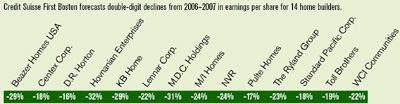
In late May, we lowered our earnings expectations for home builders across the board for 2007. Our previous downward estimates did not go far enough in light of the earlier than expected deterioration in operating profits. In mid-March, we stated that our company forecasts depended on a soft landing scenario for the top-line, while earnings were pressured by a prevailing unfavorable home price vs. land cost dynamic. However, at that time, we also highlighted a downside risk to our estimates. If builders continued to force supply on the market—which appears to be the case—inventory was headed for new records.
And here we are. As a result, we no longer believe that the home builders can grow revenues in 2007. Combined with higher cost burdens, we now expect operating profits for the group we follow to decline 23 percent, down from our initial estimated decline of 14 percent. The expected decreases range from 15 percent for D.R. Horton to 32 percent for Beazer Homes USA.
Our assumptions include a 6 percent decrease in closings (for the 14 companies), and a more modest 2 percent increase in average price. A 5 percent decline forecast for 2007 revenues compares with our prior estimate of 7 percent growth. Our estimates include an operating margin of 12.1 percent, which is down from our previous estimate of roughly 13.1 percent. At 12.1 percent, margins would decline 290 basis points from 2006. That’s a 270 basis point decrease in gross margin, worsened by a 20 basis point increase in total SG&A—corporate overheads—as a percent of sales. Our cost assumptions include a low double-digit increase in land, labor, and material expenses up about 2 percent (flat with prior assumptions), and incentives at around 4.5 percent of sales price, offset in part by reduction in overhead that would come as the industry responds with layoffs.
We modified several target prices for the group. Our target prices are based on normalized earnings and price-to-book multiples. In total, our normalized valuation assumes long-term home building profit growth of 8.5 percent, down from 9.5 percent. This follows, as builders appear to be suffering in-line with the broader market, more than expected. In addition, we are modeling normalized operating margin of 10 percent, lower than 10.5 percent previously, given the sooner-than-anticipated pressure on margin. For comparison, the 10 percent margin would be on par with levels achieved in 2000–2001, prior to the vast run-up in prices.
On a book basis, we value the group at 1.2 x 2007 year-end book, which compares with the range of from 0.8 to 2.4 during the period from 1996 to the present. Although we do not expect the group to fall below current book, we do believe that investors are questioning book more carefully today, given the increasing prevalence of charges related to walking from option contracts. For the group, deposits represent 9 percent of equity and range from 3 percent to 80 percent. We note that this excludes acquisition and development costs related to lots under option. We have imbedded greater risk for builders with a higher percentage of deposits relative to book.
Based on our valuation work, the group is slightly overvalued with 2 percent downside on average from the current levels. Looking at P/Es, the stocks are trading at about seven times the 2007 earnings and, if earnings fell an incremental 25–30 percent in 2008, it would be trading at about 10 times, a multiple that we believe is fair for a cyclical, capital intensive business.
We continue to highlight Centex Corp., D.R. Horton, and Lennar Corp., from a valuation and strategic standpoint, and M/I Homes as a pure, value play. We are more concerned with builders that are not adjusting to a more incentive-driven market or those that lack geographic diversity from a profit standpoint.