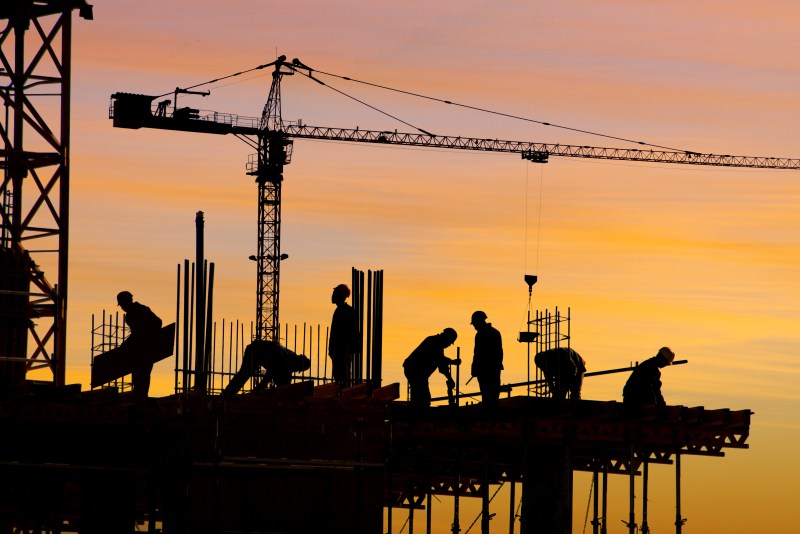
The U.S. construction industry spent $1.2 trillion on goods and services in 2017 and employed more than 10 million workers. But even though these numbers are impressive, the industry has a productivity problem.
Some say the industry is ripe for a robotic and drone takeover, but I believe home builders can realize greater productivity and its accompanying benefits–like cost reduction and producing more homes with the same resources–through best practices and automating their supply chain.
A recent McKinsey report illustrated how construction greatly lags manufacturing, retail, and agriculture, as well as the majority of other industries, in moving the needle on productivity. In fact, Paul Teicholz, a professor at Stanford University, also studied the total economic output per worker in the construction industry and found productivity to be dropping slightly each year, while it seems the rest of industrialized world leaps ahead.
This may seem surprising when a builder or owner thinks about all of the new tools and equipment they have invested in over the years, along with the on-the-job training they have offered to bring workers up to speed. But where builders are missing the opportunity is in how to deploy their teams, weed out inefficiencies to cut costs in their day to day operations, and plug into a network that allows communications and collaboration with suppliers, trade partners, and manufacturers. Technology is the key to achieving this, though unfortunately experts say home builders rank dead last in using it to unleash their business.
The Construction Industry Institute studied the impact of technology on key trades within the construction industry and found that labor productivity was about 30% higher for projects with high levels of automation. The difference in labor productivity was about 45% between projects with different levels of tech integration across the trades.
So why does productivity matter so much to the home builder? The Bureau of Labor Statistics reported early this year that nearly 200,000 construction jobs still are unfilled across the U.S. I have spoken with many builders recently, who have told me they are trying to fight back to a normal production of 1.66 million homes per year, but they have found the lack of skilled labor to be a big hurdle to that goal. Add that to the growing demand for housing starts this year and you have a perfect storm that is sapping builders’ precious resources and growth momentum.
It is important to note that not only is access to skilled labor critical, but the management of it is an essential key to keeping good relationships with your best trades to continue to achieve greater productivity. Here are some additional benefits of automation that ensure that builders get the best talent available:
- The ability to pay key trades on time, every time. This one should be obvious. If, for example, you are continually delayed in adjusting purchase orders when changes occur, the time it takes to re-issue a corrected purchase order is costing both parties money. Over time, those little things can add up to real dollars. I believe the ability to pay on time is increasingly becoming a make or break factor for builders.
- The ability to understand your trades’ work capacity. Your trade partners need to know as early as possible which jobs and how many will be coming up. This forces the builder and their partners to communicate at a high level and create a realistic plan for what can be accomplished.
- Achieving a state of job readiness. Consistently having the jobsite prepped and the materials ready in advance will give your trades the confidence to send their best crews. It also allows them to do their job more efficiently, and helps to ensure the project — and the others that are currently or soon to be underway — stay on schedule.
At my firm, Hyphen Solutions, we are seeing the greatest impact among builders with SAAS-based platforms that drive process efficiencies and automated connectivity and collaboration between the various participants of its end-to-end supply chain. Specifically, these platforms offer real time communications, a comprehensive scheduling and supply chain management system for the builders of homes, and order management solutions for all their suppliers and trade partners. ERP technology in the cloud allows builders to integrate even tighter with their entire supply chains, including workforces, suppliers, and every piece of building material that they use from lumber and windows to cabinet handles and shower fixtures.
This integrated network allows builders and suppliers to manage precious resources together. One example is how builders can improve the utilization of teams and move them around with precision where the job sites are ready or where the weather permits. The other benefit is access to a system with full and updated supplier catalogs, which are broken down by pricing and product SKUs, providing granular details of every product or package. Currently, there are systems online featuring more than 1.5 million SKUs. This allows the builder and supplier to process orders quickly with greater accuracy and less returns.
In the case where builders are pushing more than 80% of their purchase orders through electronic processing and settling, we have seen the total costs of managing each purchase order drop by up to $10. That’s a terrific savings considering that even mid-sized builders processes 100 or more P.O.’s per home they complete.
In addition to reducing the costs of creating and processing orders, we have seen even more dazzling productivity leaps among builders that utilize technology. Builders have been able to handle up to twice the average load of homes with the same resources, compared to manual methods, when plugged into integrated networks where electronic management, communications, and processing is possible.
With this technology adoption accelerating, I see a big divide developing among builders who can keep all of their crews working at maximum productivity, while selling what they build at a maximum profit, and those that cannot. This will take a total focus on quality over quantity and keeping level absorption rates, while values remain high. The only way to do that is to automate the supply chain and connect the manufacturers and suppliers all the way through to the builder and their workforce at the jobsite.