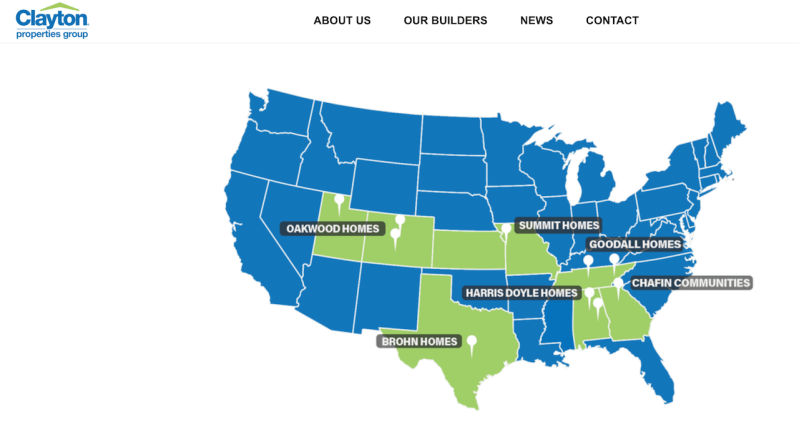
After an 18-month courtship, Maryville, Tenn-based Clayton Properties Group closed on the acquisition of Indianapolis’ No. 1-ranked home building firm, Arbor Homes, adding to its 8-state map a 24-year old private builder whose signature stock in trade is a rarity these days: the profitable below-$200,000 site-built home.
The 7th regional site-build jewel in the Clayton crown adds to its suddenly hefty portfolio of regional firms–on pace to deliver as many as 4,500 homes in 2018–gives the Berkshire Hathaway unit fresh headway and a platform to launch further inroads in its goal to provide people priced out of many housing markets with an attainable path to homeownership. Just this past April, Clayton added Austin, Texas-based Brohn Homes to its ever-more-powerful heartland footprint.
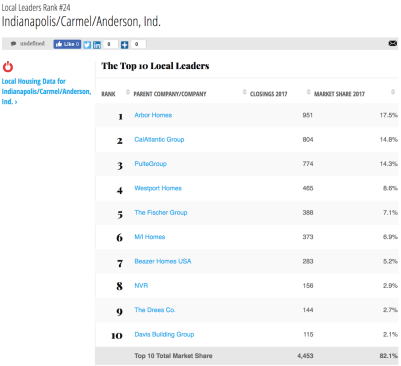
Arbor–founded by Curtis Rector in 1994 and led by Rector and his team to a ranking of No. 55 on the Builder 100, with 2017 revenues of $225 million–commands better than 17% of the volume in the nation’s 24th most-active home building market, and achieves a profitable average selling price in Indianapolis of $199,000, a full $100,000 below the ASPs of other builders–like Lennar/CalAtlantiic and Pulte. Arbor is on pace to close 1,200 homes in 2018.
“It was love at first sight,” Clayton Home Building Group president Keith Holdbrooks said, noting that Arbor’s team member- and customer-centric culture matched to a tee criteria Clayton regards as table stakes in a grand plan. Starting in to assemble a stable of kindred, entrepreneurial site-build firms, and then explore new ways to vertically-integrate their operations with the Clayton mothership, its sprawling infrastructure of manufactured home facilities. “We’re delighted that after getting out to their sites, and getting to know the Arbor team, stars finally aligned. Curtis and his team bring a remarkable dimension to this plan–they’ve figured out how you can be profitable–with processes, and systems, and a great culture–building homes at prices less than $200,000.”
Although Rector’s firm also builds higher-end custom homes under the sister-brand Silverthorne Homes, the Arbor point of distinction and “secret sauce” is its capacity to build homes that are attainably-priced for buyers who might otherwise be sidelined in an increasingly robust Indianapolis economy.

Arbor Homes founder and president Curtis Rector
“I’m proud of what we’ve been able to do to remain committed to this affordable price point since 1994,” Rector told us. “And now, to be able to add Clayton’s horsepower, their systems, their innovations and put them together with our processes and systems will allow us to dream big, do what we love to do making homeownership attainable, and build on our competitive advantage price point.”
Here’s a few recent take-aways on the market from BUILDER’s sibling-firm Metrostudy regional director Mark Gianopulos, commenting on dynamics in Indianapolis:
- Annual New Home Starts are up just 0.5% through 1Q18, while Quarterly Starts are down 12.8% from 1Q17 levels
- As job growth pushes the creation of new households higher, the tight supply of resale listings and new lots are keeping housing activity artificially low, increasing the already significant pent-up demand in this market.
- Vacant developed lots (VDL) are the single most important influence on this housing market. Developers and builders are finding it difficult to keep up with the demand for new lots as annual lot delivery has trailed annual starts four of the last six quarters.
In other words, Indianapolis is a city with a thriving local economy whose continued momentum may rely on its ability to grow its housing stock, and make homeownership a more–not less–attainable goal for young, start-up families. More and more American cities–many of them in America’s heartland, “fly-over” counties, states, and cities are experiencing a similar renaissance, and affordable new homes and communities will be either a make or break point in their economic trajectories.
“We have a real footprint now,” Holdbrooks tells BUILDER. “We’ll do as many as 6,500 single-family site-build homes in 2019, and when you can settle in now and really explore the vertical distribution and integration opportunities, as we expand beyond purchasing and fabricating our own products, panelization, systems, and leverage both what we buy with what we produce in our factories, it’s going to be truly exciting. Curtis and his team at Arbor give us the kind of platform–building affordably on site–that we can see taking into other markets, even as we learn from those site builders how to upgrade our manufactured home standards and pricing to the higher tiers of $150,000 and $175,000. There’s a big market out there for us.”
And, fact is, the Arbor cultural emphasis on its team members as key to driving a better customer experience was a priority factor in the 18-month-long courtship process with Clayton, according to Mike Rutherford, president of Clayton Properties.
“Those two prime characteristics–team member focus and customer care–were what jumped out quickly as we entered the ‘dating process’ with Arbor’s team,” said Rutherford. “Then, it was all about their disciplines, commitment to, and embrace of the entry-level market, so much so that we can see a future of bringing what they do to other markets.
In a housing and economic environment whose defining traits right now are volatility, spiking prices, and unpredictable costs–land, labor, and materials prices are all heading upward, outpacing incomes–affordability and attainability are constants in the challenge department.
“We’re trying to figure out what we look like five years from now,” says Holdbrooks. “We know, no matter what, affordability is one of the keys to what and where we’ll need to be.”