Housing isn’t just about shelter anymore – it’s a health tool, a financial strategy, and a reflection of deeply held personal values.
The fourth wave of the America at Home Study, conducted earlier this year, reveals a nationally diverse consumer base that’s informed and emotionally engaged with what they need and want from their homes and communities. Affordability, wellness, and flexibility are reshaping buyer expectations in ways that challenge how homebuilding professionals have operated for decades.
Here are 10 of the most compelling takeaways from this year’s study that prove it’s no longer just about delivering more product, but about developing entirely new mindsets and approaches.
1. Americans Are Redefining Affordability
For today’s buyers, affordability goes beyond the sticker price. It now includes long-term operational costs, energy usage, maintenance, and even emotional return on investment. A home that doesn’t support financial and lifestyle wellness is seen as a poor investment, no matter the square footage or price tag. This broader definition of affordability is pushing the industry to rethink how it talks about value.
2. 30% of Consumers Say They Can’t Find the Right Home at the Right Price
Despite strong interest in homeownership, nearly one-third of Americans say the housing market isn’t meeting their needs. This data underscores a growing disconnect between what the industry is producing and what today’s buyers actually want and can afford. Developers like Red Oak Development Group in Lockhart, Texas are taking bold steps with programs that expand access to ownership. Through its TEACH initiative, Red Oak is helping hundreds of local educators in Central Texas become homeowners in the communities they serve, creating more housing attainability and community stability.
3. Wellness Is a Top Driver, but Satisfaction Lags
Wellness remains a leading priority in housing decisions. However, the study uncovered a consistent and widening gap between the high importance of wellness and the low satisfaction people experience in every wellness domain. For example, while 87% of respondents say financial wellness is important, only 45% are satisfied with that area of wellness in their life. These gaps have grown over the past several waves of the study, reinforcing that homes must actively support holistic well-being to motivate buyers.
4. Massive Demand for Whole-Home Wellness Features
Some of the most sought-after features are those that promote health and wellness. Demand for whole-home water filtration rose to 70% (up from 43% in the previous wave), and indoor air purification jumped to 69% (up from 48%). These features have gone from niche amenities to purchase-driving essentials.
5. “Walkability to Coffee Shops” Surpasses “Trails” as a Top Community Feature
For the first time in the study’s history, walkability to casual dining and coffee shops ranked higher than trails as a top desired community feature. This reflects a growing desire for informal, everyday social spaces that foster low-effort connections and contribute to emotional wellness, especially for the increasing number of people who live alone or work from home. Austin Point in Fort Bend County, Texas is one community echoing this shift. The community is centered around The 1824, a social hub that will feature a café, gathering spaces, and pedestrian connections to homes. This model demonstrates how walkable access to everyday destinations can anchor a more vibrant, human‑scaled community.
6. The Kitchen Tops Wish Lists
When asked how they would spend a $50,000 improvement budget, more people chose a better equipped and more modern kitchen for cooking than any other option. This aligns with another key finding: cooking and baking ranked as the top activity people say they’re doing more of today than they were five years ago. But the kitchen’s role has also evolved. More than just a cooking space, it now serves as a hub for health, connection, and multifunctional living.
7. 50% of Consumers Are Open to Rent-to-Own Models
Half of respondents say they would now consider a rent-to-own arrangement to achieve homeownership, up significantly from 33% in the previous wave. This signals a significant turning point in attitudes toward ownership models, reflecting increased flexibility and financial caution, especially among younger buyers.
8. Consumers Want Smaller, Smarter Homes
Many Americans are willing to compromise in order to purchase a home. Forty percent of respondents said they would accept a smaller home (up from 21%), while 33% indicated they would be fine with no garage, and 25% said they would be comfortable with smaller room sizes. Demand for modular or manufactured homes also increased to 32% (up from 22%). People want homes that work harder, not just take up more space. Planned communities like Braden in Sacramento County, California are responding with a more design-driven approach to attainability, with plans to include a diverse mix of smaller, smarter homes that maximize livability, energy efficiency, and neighborhood connection without increasing cost or footprint.
9. Consumers Are Willing to Trade Yard Size for Community Spaces
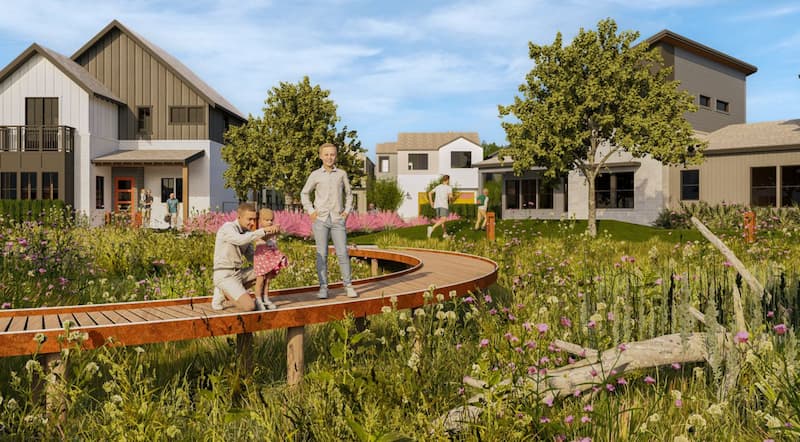
Respondents showed interest in accepting smaller yards if it means they’d have access to shared amenities. The top community features respondents want include access to nature for outdoor activities (54%), walkability to coffee shops and casual eateries (49%), trails (48%), small neighborhood parks with seating and shade (45%), and large parks and event spaces with open fields and green areas (44%). At Indigo, a new neighborhood in Richmond, Texas, roughly 60% of the 235-acre plan is dedicated to open space. Mews, pocket parks, and greenways create multipurpose gathering spots, and the neighborhood even includes a walkable, bespoke game – IndiGolf – woven throughout the community’s diverse amenities for people of all ages and abilities to participate in.
10. 30% Feel Less Comfortable Making Housing Decisions Than in 2022
Consumer uncertainty is on the rise. Compared to the previous wave, 30% of respondents say they now feel less confident making housing decisions. Even as demand remains high, so does consumer anxiety around issues like affordability, availability, and lifestyle fit. This hesitation raises the stakes for builders to design homes that truly meet people where they are now.
Taken together, these findings show us a paradigm shift that must be tended to by the industry. If we want to keep pace with the future of housing, we need to design for people’s lives as they currently are, not as they once were. We owe it to today’s consumers – and to future generations – to listen more closely, build more boldly, and design with more intention.