The team at Bates Masi + Architects faced the challenge of building an aesthetically pleasing, design-forward home in the difficult building environment of a coastal area.
“Typically, the solution is a home that was designed to be on a ground plane but since it is located in a flood zone, the home would be elevated on pilings that are meant to be ignored,” says Paul Masi, partner at Bates Masi + Architects. “However, these are parts of the structure, and it is important for us that the design is cohesive and these parts aren’t just ignored.”
Bates Masi + Architects
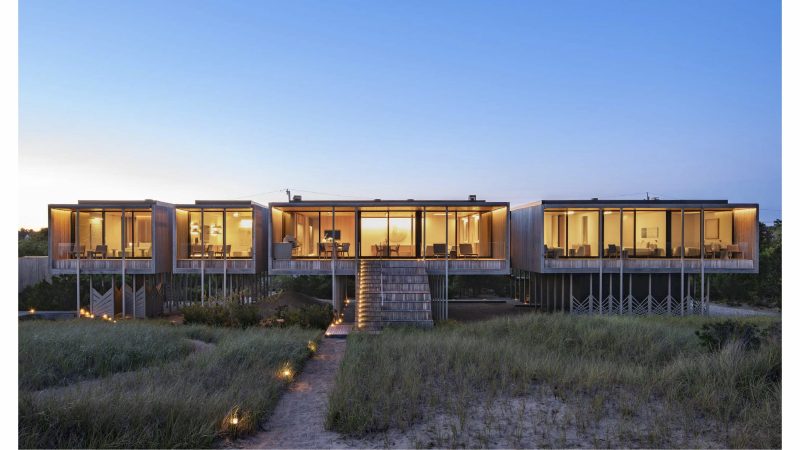
Built on sand dunes in the coastal town of Amagansett, New York, the Walking Dunes project is elevated nine feet above grade on slender steel columns for flood protection and to provide ample height below for outdoor living areas.
Bates Masi + Architects
Steel bars in radial arrays between the vertical steel columns provide lateral support, while the density of their pattern is calibrated to collect sand in the manner of a sand fence. As a result, sand gathers as needed to protect the structure while other areas remain open for living areas. The density of the braces is increased to create privacy walls around the outdoor shower, mechanical chases, and carport.
“My favorite design element is the expressive cross bracing that captures the sand,” says Masi. “I enjoyed artfully adapting this concept into something that is functional and has various uses by changing the width.”
The Walking Dunes home is arranged in four volumes. Glass connections between the volumes are set back from the facades and reduce the perceived size of the home while also allowing more daylight to reach the outdoor spaces below.
Project Details
Location: Amagansett, New York
Architect: Bates Masi + Architects
Size: 3,995 square feet
Builder: Men at Work Construction Corp
Interior Designer: Thomas Pheasant
Landscape Architect: STIMSON
Structural Engineer: Maresca and Associates
“The series of volumes were broken up programmatically into guest rooms, public spaces, and primary spaces,” says Masi. “Breaking the overall façade into volumes also gave a bit of relief and allowed vignettes to see through the house and look out toward the ocean. Naturally, one of these vignettes became the entry so your first experience upon arrival is the ocean view.”
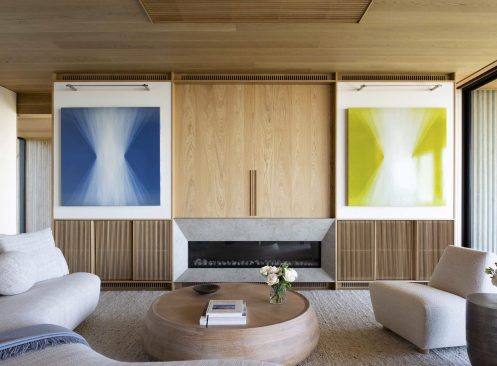
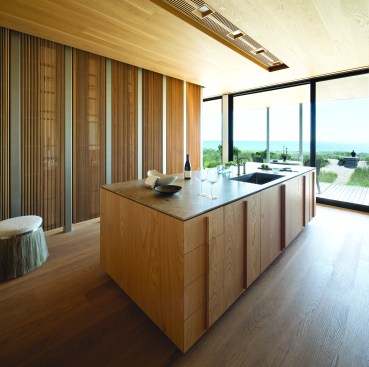
The grid of columns at the ground level continues into the primary living spaces as an organizing and aesthetic feature, supporting cabinetry, custom lighting details, and tambour screens. Through its innovative adaptation of a common structural system, the Walking Dunes project turns the necessities of a coastal building into advantages.