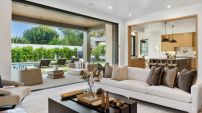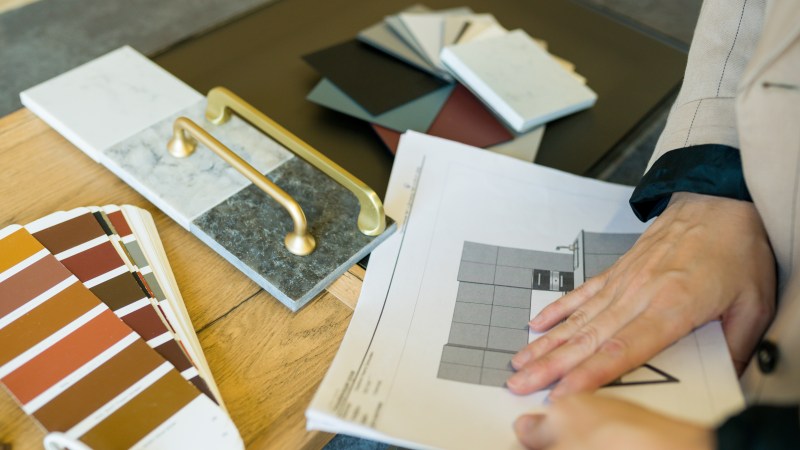
At the outset of 2025, industry experts made clear predictions on what would shape new home design in the months to come. According to the experts, here is how some of these forecasted trends appeared in new-build homes, what to watch for in 2026, and some trends that were unexpected.
The Kitchen’s Role is Changing
Despite home sizes shrinking in general in 2025, kitchens grew bigger and more important.
Layouts moved away from the traditional kitchen triangle (where fridge, stove, and sink are located within steps from each other), to linear or zone-style design to support changing workflow.
Kitchen islands became a natural gathering spot for entertaining and built-in dining, as well as for prep and cooking, explains Gladys Schanstra, owner/creative director of Drury Design.
“This is revolutionizing the way we use islands because homeowners are now equipped to be able to perform all those tasks in one place,” she says.
In addition to enhanced function, islands are now focal points, with stunning designs. “I’m seeing a lot of sculptural islands, almost like a piece of art, whether in wood or engineered stone,” says Schanstra.
Looking ahead: In 2026, expect to see more personalization in the kitchen, a return to warm minimalism, and a shift from kitchen as a workspace to a living space.
Timeless Took Off in 2025
Lee Crowder, senior director, national design and model operations for Taylor Morrison, says timeless style led new home trends in 2025 and is expected to continue in 2026.
“The trend started with neutral wood tones dominating furniture, cabinets, and flooring, then moved into warmer tones in leathers and fabrics for furniture and paired with golds, blacks, and polished nickel plumbing and lighting.”
Timeless style appeared in paint colors too, according to Sue Wadden, director of color marketing at Sherwin-Williams. “We saw builders increasingly rely on warm, approachable neutrals as a foundation, using colors that feel livable, timeless, and easy to personalize.”
Looking ahead: Homeowners saw timeless, traditional style as a more affordable choice in 2025, which will continue to be a factor in 2026.
“As designers, our goal is to help clients spend their money in a way that will best suit their design aesthetic and budget while ensuring their homes are beautiful for years to come,” says Crowder.
Wellness Design Became Mainstream in 2025 Home Design
Health and wellness heavily shaped new home trends in 2025, including biophilic design, neuroaesthetics and neuro-inclusive design, wellness kitchens, spa-like bathrooms, saunas, and wellness-focused spaces. It’s expected that health and wellness will be a strong influence again in 2026.
Homeowners are increasingly prioritizing health and wellness at home, so wellness design and products are now mainstream.
“For years, wellness was defined primarily by fitness. Today, people are embracing a more holistic approach that supports both mind and body, prioritizing spaces that address their 360-degree wellbeing,” says Emily Stubler, marketing director, Kohler Wellness Products.
“We’re seeing spaces once dedicated solely to entertainment or exercise being reimagined as multifunctional wellness rooms.”
Meanwhile, Kohler’s ice bath, named one of Time Magazine’s Best Inventions of 2025, has a bespoke design and resembles a piece of furniture, demonstrating how wellness can now be a style choice too.
“Rather than hiding an ice bath in a corner or basement, we designed a version that can serve as a centerpiece in your wellness space,” she says.
Designing for Joy
Homeowners tapped into the emotional benefits of curated, colorful aesthetics in 2025, including nostalgia-inspired interiors, Art Deco, and dopamine decor.
This “allowed homeowners to feel something strong. Big, bold colors and layered patterns created physical, emotional, and mental responses that an all-white or heavily muted palette couldn’t, and still won’t, provide,” says color psychologist Michelle Lewis of the Color Institute.
Homeowners gained confidence with color in 2025, seeing the emotional opportunities and ways to be creative in new builds.
At the same time, homeowners are also still leaning into timeless, natural tones as backgrounds.
“Instead of cooler grays, palettes leaned into warmer whites, soft greiges, and earthy mid-tones that create an immediate sense of comfort. Homeowners then layered onto those builder bases with personal touches,” says Wadden. “Paint became a tool for grounding space emotionally, not just visually, and homeowners felt more confident using color to make new builds feel lived-in rather than overly pristine.”
Looking ahead: All signs point to these trends continuing in the new year.
“Even as some segments of design, kitchens especially, start to tilt back toward minimalist aesthetics in 2026, that sense of empowerment people found in self-expression absolutely will continue,” says Lewis.
“That return to essentials is at the heart of our 2026 Color of the Year, Universal Khaki,” a sign of things to come in 2026, says Wadden.
Is Farmhouse Really Fading?
Experts predicted that modern farmhouse style would be on its way out in 2025. While several of the interior decor choices associated with farmhouse style fell out of favor, such as white kitchens, shiplap, distressed finishes, and barn doors, new build house plans told a different story.
“Farmhouse is still very much alive,” says Aurora Zeledon, vice president of product marketing for Zonda, including Houseplans.com, noting that the modern farmhouse has been the best seller since 2019. In 2025 alone, it accounted for a third of sales.