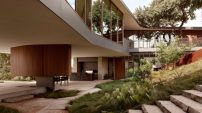
With 13 homes under their belts, the owners of this house in the western hills of South Carolina had lived just about everywhere. So when it came time to build their almost-retirement home, they wanted it to reflect the particular place they chose to settle. They asked architect Jeremiah Eck to design a house that would respond to the specifics of their site—its region, topography, views, vegetation, and climate. Luckily, Eck had a lot to work with. Located at The Cliffs, a master-planned golf community near the Sumpter National Forest, the ridgetop site offered abundant natural beauty, including panoramic views of valley lakes and neighboring mountains.
When presented with a hilltop lot like this one, the temptation is to site the house right on the ridge. Instead, Eck and his clients chose a subtler, and more successful, approach that ultimately shaped the home’s indoor/outdoor experience. They nestled the house into the side of the hill just shy of the crest, where “the owners dragged a chair over, sat down, and said, ‘This is where we want our living room and terrace to be,’” Eck says. That decision allowed the house to capture sun to the east, south, and west. It created an area for a protected entry and car court. It determined to a large extent the L-shaped house plan that gives all the major rooms access to the terrace. And it captured the best views. From that vantage one can look down to a series of lakes rolling off into the distance in one direction and to a chain of mountains in the other.
Eck thinks of the house as a giant umbrella over a big screened porch and terrace. The house sits on a massive concrete plinth that serves as the wraparound terrace and pool deck. Twin 20-foot-wide mahogany folding-door systems on the east and west walls of the grand living space open the interior to the terrace. The Quantum system has a screen that runs up into the soffit when not in use, and when it’s down it makes the living space feel like an enormous screened porch. The great, overhanging roof protects the interior from the warm southern summer sun and provides, Eck says, “shelter that lets you sit outside” most of the year to enjoy the region’s moderate climate. Interior and exterior spaces share the imposing stone chimney with Rumford fireplaces on either side. It’s the focus of the outdoor gathering space and extends the outdoor season well into the cooler part of the year. There’s also an outdoor kitchen conveniently situated for entertaining just steps from the indoor kitchen and near the pool.
Eck chose the local rock, a type of sandstone, for the plinth’s rough stone base, the porch columns, and chimney. The plinth “seems to grow out of the site,” he says. The stone is one of the elements in a materials palette designed to blend the house with its setting. That palette includes the soft brown roof shingles, mahogany windows and trim, and limestone terrace deck. He took the more refined limestone pavers into the house, where they scribe the window walls as a symbolic extension of the outside.
“Simple principles generated the design of the house,” Eck explains. “It’s about topography, sun, weather, simple stuff.” The result is a house that is both casual and refined and that looks totally at home in its setting at the southern edge of the Blue Ridge Mountains.
Project Credits: Builder: Scott Vik, Seneca, S.C.; Architect: Eck MacNeely Architects Inc., Boston; Photographer: Tim Buchman; Illustrator: Harry Whitver.