Architect David Coleman gutted this 1907 Dutch Colonial in Seattle, replacing its dated interiors with a quietly sophisticated floor plan and materials. Two of the project’s biggest beneficiaries were the kitchen and bath. Coleman designed the galley kitchen with a 5-by-8-foot pivot window at either end, providing views and cross-ventilation. On the room’s street-facing side, one step up from the rest of the kitchen, he placed a small study space with a desk and plenty of built-in storage. An open dining area lies two steps down from the kitchen. “The steps create a little bit of separation and a little bit of a procession of movement up from one space to another,” says Coleman.
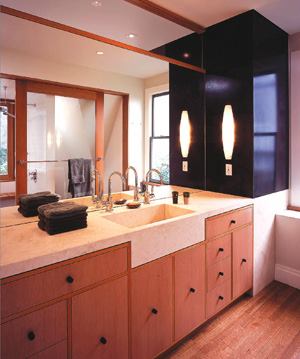
One of the kitchen’s most unusual details—its fossilized French limestone counters—is repeated in the master bath, where the same surface covers the vanity and part of the wall. The off-white, delicately patterned stone folds around both rooms’ sinks and cabinetry like thick slabs of icing. “It requires joining pieces in a way that creates a seamless look,” explains Coleman. “It looks simple, but it’s not very simple to design and build.” A custom, 5-by-8-foot shower door slides over to give privacy to the lavatory area. As with the pivoting windows downstairs, the door consists of mahogany-framed glass.
Like many top residential architects, Coleman encourages clients to think carefully about how much square footage they really need. He often employs tactics that make small rooms seem larger, such as installing a band of clear glass atop the vanity mirrors in this bath. “Using things like freestanding walls, glass panels, and movable panels is a way to visually make a space feel bigger,” he says.
Builder: Bellan Construction, Seattle; Architect: David Coleman/Architecture, Seattle; Photographer: James F. Housel.