Steve Keating
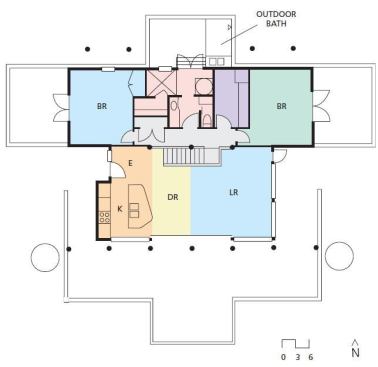
Architect Tom Lenchek has a particular attachment to this 1,420-square-foot cabin he designed in Washington State’s Methow Valley: It’s his own house. He and his wife spend weekends there, driving 200 miles from their primary home in Seattle. And now that more than half his firm’s jobs are east of the Cascade Mountains, he often turns the guest bedroom into an office by folding up its Murphy bed. “I’ll work there for as much as a week at a time,” he says.
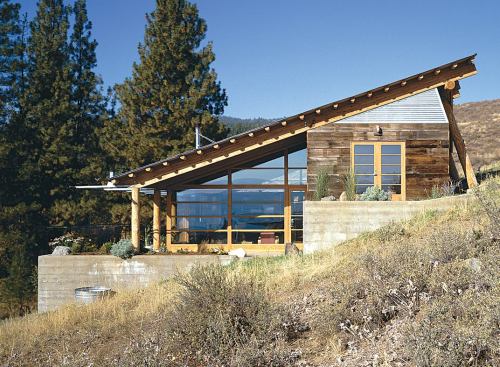
The valley experiences extremes of heat and cold, and the house had to be able to function well in both. But that was just one of the obstacles facing builder Mark Rhinehart. “There’s really nothing conventional about the house,” he says. “All the framing interfaces with posts and beams or something else. You really had to think ahead about how everything fit together.” A two-tiered concrete retaining wall was poured on site into rough-sawn 1×12 forms, and the floors consist of poured concrete as well. Other elements in the smorgasbord of materials are Trex decking; peeled logs for structural support; and acid-etched, corrugated metal roofs. “You add muratic acid to water and paint it onto the roof,” he explains. “Otherwise, the metal can be too bright and reflective.”
Rhinehart has noticed a few trends in the many second houses he’s built locally—including Lenchek’s. “Call-in systems to turn the heat on are popular, particularly in homes with radiant heat, which takes a little more time to warm up,” he says. “People phone in and adjust their thermostats two days before they arrive.” Natural vegetation is gaining on grass as the preferred ground cover, since it requires no mowing. Timed watering systems and drain-down plumbing valves are also commonplace. Energy-efficiency, of course, takes top priority in such a severe climate. At the cabin, a custom-designed stop keeps a heat-retaining blanket of snow on the roof during winter, supplementing polyurethane foam insulation.
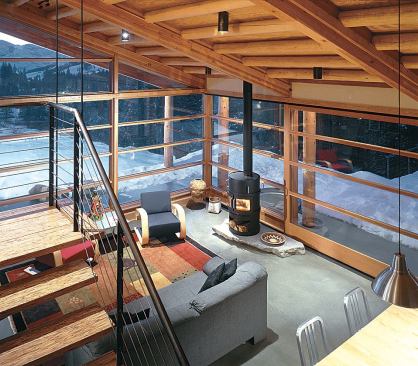
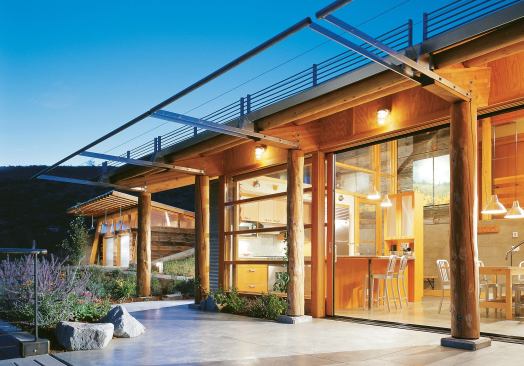
Vacation homes tend to interact more with their environments than full-time residences do, and the cabin is no exception. In mild weather, 8-by-8-foot lift-glide doors open almost the entire south façade to a generously sized deck. Handy storage for skis, bikes, and other sports equipment is located in a detached garage. When the couple and their guests have had enough of the great outdoors, they can warm themselves in front of the living room’s woodburning stove or hop in the upstairs sauna.
Project Credits
Builder: Rhinehart Construction, Winthrop, Wash.
Architect: Balance Associates, Seattle
Landscape architect: Windy Valley Landscape, Brewster, Wash.
Structural engineer: Magnusson Klemecic Associates, Seattle
Living space: 1,420 square feet
Site size: 18 acres
Construction cost: Withheld
Photographer: Steve Keating
Resources: Bathroom plumbing fittings/fixtures: American Standard, Americh, Chicago Faucet, and Kohler; Dishwasher: Bosch; Entry door: Simpson; Fireplace: Rais; Hardware: Sargent; HVAC equipment: Buderus, Techmar, and Wirsbo; Kitchen plumbing fittings/fixtures: Arwa and Kohler; Lift/glide door: Quantum; Lighting fixtures: Ikea; Oven: Dacor; Refrigerator: Sub-Zero; Windows: Window Visions.