
This has been a frustrating year for home building volume, looking like it will be up only a few percentage points above 2013. Meanwhile, 2015 is expected to be better (+15 percent)—still not what I’d call robust—and it should feel a lot better than 2014 did.
The past year suffered from problems that had their roots in 2013. In the first half of 2013, there was frenzied buyer behavior as home prices began to go higher, and in the second half, “taper talk” happened, and home sales took a prolonged pause. That pause continued into 2014, keeping sales low even when mortgage rates came back down. Certain markets started to once again find pricing power in the first half of the year, but by the second half, consumers started to again get sticker shock.
The main problem for 2014 was that household formations remained low. Millennials continued to live with their parents or roommates rather than forming their own households. There is evidence that they’re moving out in larger numbers now, but the majority are taking roommates and renting. At some point in the not-so-distant future, millennials will be a large source of new-home demand.
Volume also has remained low because builders have been concentrating mostly on the move-up niche, paying less attention than normal to entry-level buyers. This partly relates to the above problem with millennials, but it’s also because profit margins are higher in the move-up segment. Also, builders were determined to stay in the “core” areas because it was difficult to prove demand in the periphery to investment committees and Wall Street because there were no new comps (publics D.R. Horton and LGI are fixing that now).
It’s going to be necessary to take home building into the more peripheral submarkets to meet growing demand and to find land that is priced in such a way as to allow builders to serve the entry-level market. We are building only 1 million homes a year, and a normal pace would be 1.6 million. Mind you, household formation rates do not have to get back to “normal” to achieve this; normal would be 1.4 million, but a move from today’s rate (under 1 million) to 1.1 or 1.2 million would stimulate a huge increase in housing demand. A lot of those incremental households will go to rentals, but as rents rise further, more people will look at ownership as a better alternative.
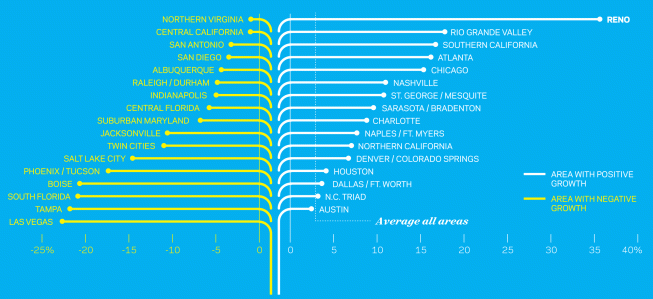
Another note of caution for 2015: don’t panic if you see certain measures of home prices decline. The ‘mix’ of sales will shift toward the periphery and lower-priced homes, and that will pull down the average, but prices still will be going up for most individual projects. Click here for additional housing analysis on 2015 from Metrostudy.