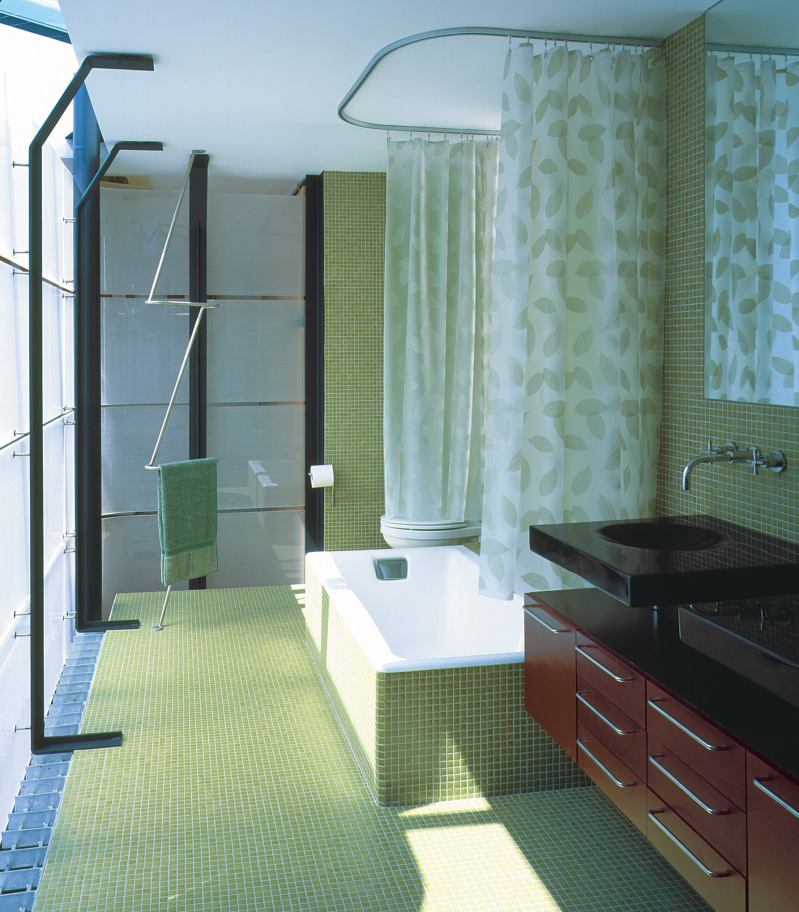
Architect Whitney Sander admires the way the Japanese elevate bathing into a celebrated ritual, and he used that idea when he designed the master bath of his Venice, Calif., home. The room crowns a barrier-free floor plan that enfolds a glass-fronted atrium topped by a 9-foot-by-13-foot skylight. “The beginning and ending of each day takes place in the bath, so this space is a terminus and a beginning,” says Sander. The tub takes center stage and is open on all sides to emphasize the ceremony of cleansing body and soul. Four sections of 2-foot-wide sand-blasted acrylic strips form curvilinear walls in the bath and then morph into a sinuous line of one or two sections that snake their way through the home. “These ribbons wrap around the space and under themselves sort of like a Mobius strip,” explains Sander. In addition to diffused light bleeding through the acrylic panels, direct sun streams through gaps in the steel-framed wall. These crevices allow for ample ventilation, which is the home’s sole cooling method.Glass tiles and twin translucent resin sinks in deep amber (designed by Sander) glow in the abundant light. Radiant heat produced by a 92 percent energy-efficient boiler keeps the 7-foot-by-13-foot space warm. Sander admits that his bachelor’s bath doesn’t afford much privacy. “I’m not a big fan of barriers. That’s what the best architecture should do—reinforce the things that help clarify who your clients are and the ways they like to relax.”
Contractor: Ruiz Brothers Construction, City of Industry, Calif.; Architect: Sander Architects, Venice, Calif.; Structural engineer: Oxford Engineering, Woodland Hills, Calif.; Plastic fabricator: J.F. Novel, Sante Fe Springs, Calif.; Custom sinks: Sander Architects; Photographer: Sharon Risedorph Photography. Resources: Plumbing fittings: Duravit and Kohler; Plumbing fixtures: Dornbracht and Newport Brass.