Existing-home sales grew in December, bouncing back from a modest drop in November, the National Association of Realtors reported Wednesday. Although the Midwest saw sales decline, the other three major U.S. regions reported growth last month.
Total existing-home sales increased 3.6% from November to a seasonally-adjusted annual rate of 5.54 million in December. Additionally, overall sales took a significant bounce, up 10.8% from a year ago (5.00 million in December 2018).
On a full-year basis, total existing-home sales ended at 5.34 million, the same level as in 2018, as sales in the South region (+2.2%) offset declines in the West (-1.8%) and Midwest (-1.6%), as the Northeast remained unchanged.
Lawrence Yun, NAR’s chief economist, said home sales fluctuated a great deal last year. “I view 2019 as a neutral year for housing in terms of sales,” Yun said. “Home sellers are positioned well, but prospective buyers aren’t as fortunate. Low inventory remains a problem, with first-time buyers affected the most.”
The median existing-home price for all housing types in December was $274,500, up 7.8% from December 2018 ($254,700), as prices rose in every region. November’s price increase marks 94 straight months of year-over-year gains.
“Price appreciation has rapidly accelerated, and areas that are relatively unaffordable or declining in affordability are starting to experience slower job growth,” Yun said. “The hope is for price appreciation to slow in line with wage growth, which is about 3%.”
Total housing inventory at the end of December totaled 1.40 million units, down 14.6% from November and 8.5% from one year ago (1.53 million). Unsold inventory sits at a 3.0-month supply at the current sales pace, down from the 3.7-month figure recorded in both November and December 2018. Unsold inventory totals have dropped for seven consecutive months from year-ago levels, taking a toll on home sales.
Properties typically remained on the market for 41 days in December, seasonally up from 38 days in November, but down from 46 days in December 2018. Forty-three percent of homes sold in December 2019 were on the market for less than a month.
First-time buyers were responsible for 31% of sales in December, moderately down from the 32% seen in both November and in December 2018.
Individual investors or second-home buyers, who account for many cash sales, purchased 17% of homes in December 2019, up from both 16% in November and 15% in December 2018. All-cash sales accounted for 20% of transactions in December, unchanged from November and down slightly from 22% in December 2018.
Distressed sales – foreclosures and short sales – represented 2% of sales in December, unchanged from both November 2019 and December 2018.
Yun said conditions for buying are favorable and will likely continue in 2020. “We saw the year come to a close with the economy churning out 2.3 million jobs, mortgage rates below 4% and housing starts ramp up to 1.6 million on an annual basis,” he said. “If these factors are sustained in 2020, we will see a notable pickup in home sales in 2020.”
“NAR is expecting 2020 to be a great year for housing,” said NAR President Vince Malta, broker at Malta & Co., Inc., in San Francisco, California. “Our leadership team is hard at work to secure policies that will keep our housing market moving in the right direction, like promoting infrastructure reform, strengthening fair housing protections and ensuring mortgage capital remains available to responsible, mortgage-ready Americans.
Single-family home sales sat at a seasonally-adjusted annual rate of 4.92 million in December, up from 4.79 million in November, and up 10.6% from a year ago. The median existing single-family home price was $276,900 in December 2019, up 8.0% from December 2018.
Existing condominium and co-op sales were recorded at a seasonally adjusted annual rate of 620,000 units in December, up 10.7% from November and 12.7% higher than a year ago. The median existing condo price was $255,400 in December, which is an increase of 6.0% from a year ago.
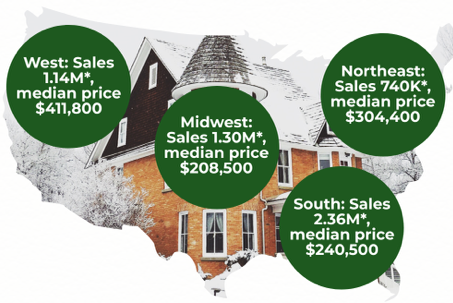
December 2019 existing-home sales in the Northeast grew 5.7% to an annual rate of 740,000, up 8.8% from a year ago. The median price in the Northeast was $304,400, up 7.4% from December 2018. Existing-home sales decreased 1.5% in the Midwest to an annual rate of 1.30 million, which is up 9.2% from a year ago. The median price in the Midwest was $208,500, a 9.2% jump from last December. Existing-home sales in the South grew 5.4% to an annual rate of 2.36 million in December, up 12.4% from a year ago. The median price in the South was $240,500, a 6.7% increase from this time last year. Existing-home sales in the West rose 4.6% to an annual rate of 1.14 million in December, a 10.7% increase from a year ago. The median price in the West was $411,800, up 8.1% from December 2018.
Mike Fratantoni, chief economist at the Mortgage Banker’s Association, sized up the Realtors’ report: “Home sales increased at the end of 2019 on both an unadjusted basis and a seasonally adjusted basis, with the gain being particularly large in the South. We expect that home sales will rise in 2020, as additional new housing construction has come onto the market, and the job market remains strong and mortgage rates are low. Typically, the inventory of homes on the market drops at the end of the year. However, the supply of existing homes is now at a record low, and this will constrain the pace of sales this spring from being even stronger. However, the recent gains in new home construction is a positive, as the total inventory on the market will allow prospective buyers to find properties.”