
What can be said in the wake of the York County, S.C., Judge William McKinnon ruling this past Thursday ?
Our own colleague, Metrostudy regional director for the Charlotte, N.C. area Jenifer Gooch, writes on LinkedIn:
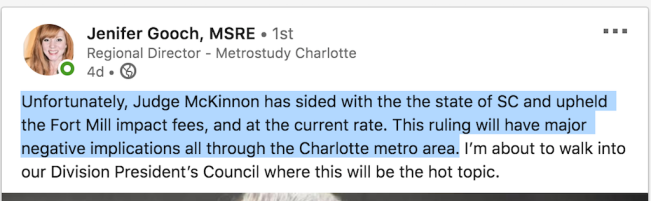
Unfortunately, Judge McKinnon has sided with the the state of SC and upheld the Fort Mill impact fees, and at the current rate. This ruling will have major negative implications all through the Charlotte metro area.
The ruling, which finds that the York County municipality of Fort Mill is safely within state of South Carolina constitutional bounds to impose what amounts to a 726% increase in impact fees for each newly constructed home–from $2,500 per dwelling to $18,158–changes the calculus of land acquisition and development in one fell swoop.
And not just in Fort Mill, which we originally commented on here in July 2018, when the town council locked arms on a new, draconian impact fee. We wrote then:
And with one swift rap of York County Council chairman J. Britt Blackwell’s gavel, it is done. Every newly permitted single-family home will carry an additional $15,000-plus in its price tag, or the builder/ developer will get to eat the added cost. And on and on, in town and city and county and metro area, in an increasing number of jurisdictions around the country, the rap of the chairperson’s gavel signals the same conclusion: new homes and new people bear the burden of upgrading and improving a town’s infrastructure and services.
Since, the York County Council, has gone a quantum leap further in its bid to halt growth. Wall Street Journal staffer Valerie Bauerlein writes:
“The York County Council, which is led by Republicans, put a 16-month moratorium on commercial and residential rezoning requests and consideration of any new apartment complexes or subdivisions. It is the most comprehensive ban so far in a state where fast-growing cities are temporarily blocking everything from dollar stores to student housing, the Municipal Association of South Carolina said.”
Bauerlein’s analysis notes that towns throughout the fast-growing Sun Belt, like [York County’s] Lake Wylie and Fort Mill, S.C., are in a fix. Growth–i.e. more kids for schools, more traffic, more stress on infrastructure and services like water and trash removal, more crime, more noise, … and more strangers–is outrunning plans and other means to keep up with it, with policy, with tax structures, with expansion programs.
So, towns and counties resort to the switches and levers they have at their disposal: like jacking up local entitlement and hook-up fees to astonishing, show-stopper levels, and, failing that, a moratorium.
Two problems with that tack.
- One goes by the name of moral hazard.
- The other goes by another, albeit more tortured term, unaffordability.
Let’s unpack them for what you need to know, what it means, and why it matters.
Take moral hazard, which occurs when one party tells another, “the terms of your investment here that we previously agreed on do not apply any more. Because we can, we’re changing those terms so that the calculus of your costs–for example, the added land costs for each of your planned new units will go up by $15,000–suddenly changes.
Builders, developers, land banks, etc., who anted up big-time acquisition and development capital for a lot pipeline for 2019, 2020, and beyond?
SOL. The WSJ‘s Bauerlein writes:
The Home Builders Association of South Carolina and a coalition of other builders are challenging the Fort Mill school fee in a lawsuit, saying it is so “excessive it shocks the conscience” and four times the national average of $4,700. The median list price for a home in Lake Wylie is $344,000, according to Realtor.com.
John Marks, who reports for local news outlet, Rock Hill Herald, gives more detail into the math in Fort Mill:
“Meeting minutes from the Dec. 10 school board meeting in Fort Mill show, as of that date, the district had collected a $70.9 million in impact fees. Since the higher fees began in mid-2018, the district collected $18.6 million on more than 1,100 new residences — 788 homes and 361 apartments.”
When a locality–town or county–shakes down builders and developers who’ve already sunk too much into their acquisition and development commitments there to simply back out and walk away, who loses?
New people, that’s who. They’re the ones who have to have to absorb the sudden impact of the draconian new fee, or now, the suspension of all new building and development, on their household expenses. They, too, are SOL.
We’ve noted earlier on this issue:
Now, if men and women get votes and win elections based on their activist advocacy of slow-growth or no-growth local policies, do you think anybody would win an election based on solid planning that would result in a really good teacher’s ability to afford to buy a home in the district?
In communities all over the United States, local policy–the single biggest influence on residential development and home building’s enormous regulatory burden–homeowners mostly win, while renters mostly lose.
And would-be new homeowners always pay more.
Here’s where we hope the 2020s change the dynamic, one that’s punishing, destructive, and ultimately a big “lose” for all–including these localities, who, with moves like this, choke off the fresh new blood of young community-members they need to sustain vitality.
The dynamic can be characterized simply: Us Vs. Them.
We see it in relationships between builders, developers, community planners, and investors all over the country now, in what should be regarded as “good times” for expanding opportunities for people and their choices on housing.
The National Association of Home Builders notes in its blog feed:
“Despite improved conditions in the housing industry, a recent episode from The Hill.TV highlights how communities are still grappling with how to overcome the challenges of housing affordability for many of their residents. Cities such as Washington, D.C., have seen housing prices vastly outgrow household income gains, putting homeownership increasingly out of reach. One of the issues facing some of these areas are single-family zoning restrictions that restrict the types of housing developers can produce to help make homes more affordable in this area.”
A rule, identical to a rule in corporate performance objectives that insists that shareholder and stakeholder value are two separate and discrete–and often conflicting–goals, is at work. Zoning, land use, planning, development. These don’t necessarily have to be mutually exclusive, oppositional forces. They just are, now, more often than not.
The Us Vs. Them battle can only change when all interests engage as “stakeholders” in commonly-sought outcomes: like well-planned, diverse, and mindful expansion of attainable housing for economically vibrant communities, sustainable livelihoods, and thriving companies.
It’s the local policy, regulatory, and real estate business challenge of the 2020s: getting to Us.