Share Buyback Whys and Wherefores

As big builders moderate outlays for land in a slower market, capital is freed up for stock repurchases.

3 MIN READ

Having doubled in the past three years, the average lot supply among the top 10 builders relative to forecasted home sale trends is 5.8 years, close to an all-time high. This represents more than 2 million lots, which are in various stages of the entitlement and development process. The market share of these top 10 builders surged from 7 percent in 1990 to 23 percent today. In the same period, margins and returns doubled. We expect market share gains to continue for the next five years. By 2010, we believe 10 builders will control 50 percent of the single-family U.S. housing market. On the other hand, we believe margins and returns are likely to plateau in the next two years.

While above-average home price appreciation lifts margins, slow demand and lengthy entitlement periods negatively affect asset turns. So, builders incur higher carrying costs on their land. In light of this enormous lot supply and the higher costs of holding land, combined with slowing demand and near peak margins, capital expenditures on land purchase will likely ease in the next two years. In 2005, on average, leading builders allocated 90 percent of their capital to buy land. However, this slowed in the third quarter, as Centex and Pulte held their lot positions flat. In total, the top 10 builders spent some $20 billion on land in 2005. As they curb their land purchase consumption, prices should moderate and their dollars should go further. This, in turn, will free up capital for share repurchasing.

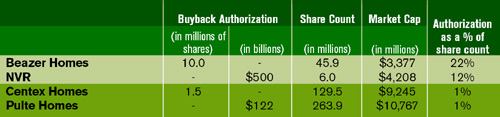
Since early November, 10 builders have announced share buyback programs for an average of 8 percent of their share counts. Among this group, Beazer Homes’ recent authorization of 10 million shares was the largest, representing some 22 percent of its total outstanding shares. The bears may argue that this is indicative of the slowing demand environment. But we believe the move stems more from depressed valuations than it does from a market turn. Smart builders know they can grow through a slowdown, and that they’ll come out stronger at the other end. As such, we believe focusing on buybacks at this moment is the best use of capital. Repurchases send a message of management’s confidence in their business models, rather than a desire to meet short-term goals or to go private.

We support accelerating repurchases as a way to return capital to shareholders. Let’s see how—and count the benefits.

  • Place a floor on valuations. An aggressive repurchase plan would likely put a floor on stock prices, which remain lower due to overblown concerns about the bubble.
  • Attract new capital. Putting a floor on valuations should attract capital, further supporting increased stock prices. This makes equity more valuable, offsetting the cost of capital from stock declines.
  • Signal management’s confidence. While repurchases and increased dividends underscore management’s confidence in the sustainability of cash flow, buybacks are more tax-efficient than dividend income, which is fully taxable for shareholders. Dividends are not awarded to option holders, so insiders lose out.
  • Realize moderate land price appreciation may happen. Postponing land purchases until demand stabilizes—which we forecast will happen once unit home sales decline 15 percent nationally—will result in the big builders gaining leverage over land sellers. This could mean lower deposits and fewer demands by land sellers for profit-sharing arrangements.
  • Contribute to growth in earnings per share. A sizable number of share buy-backs would contribute to EPS growth. (On average, the builders could have used 34 percent of net income to reduce their share counts by 5 percent in 2005.) Forecasting sales growth is elusive, as demand trends and land prices are difficult to quantify. However, earnings growth is more certain with a substantial repurchase program.
  • Margaret Whelan is an analyst with UBS Investment Bank.

    BUYBACK TICKER Share buyback plans differ widely among publics. Beazer and NVR are aggressively committing capital to share repurchases, while Centex and Pulte are not budging on ongoing opportunism in the land game.

    About the Author

    Margaret Whelan

    Margaret is the CEO and Founder of Whelan Advisory LLC, a boutique investment bank dedicated to providing a highly tailored level of service to housing companies that are interested in raising capital or pursuing an M&A transaction. Recently her firm has advised several of the more innovative companies in the industry, including Entekra, RCI, Trumark, ResiBuilt and Innovative Construction Group. She is frequently featured as a key note speaker on this topic at industry events. She also serves on four boards: Mattamy Homes, PropTech Acquisition Corp, John Burns Real Estate Consulting, and the Housing Innovation Alliance. Prior to forming Whelan Advisory, Margaret worked for 20 years on Wall Street.

    Upcoming Events

    • Sales is a Sport: These Tactics Are the Winning Play

      Webinar

      Register for Free
    • Dispelling Myths and Maximizing Value: Unlock the Potential of Open Web Floor Trusses

      Webinar

      Register for Free
    • Building Future-ready Communities for Less

      Webinar

      Register for Free
    All Events