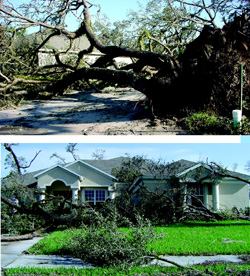
WELL, WE ALL SAW IT COMING,” SAYS PAT PETERSEN, senior vice president and general counsel of “Technical Olympic USA, headquartered in Holiday, Fla. Starting August 10, as Hurricane Charley gathered force and speed and barreled into the Sunshine State, builders in central and southwestern Florida swung into action, putting their storm survival strategies to the test of a Category 4 hurricane, whose winds can blow up to 155 miles an hour and bring waves surging up to 18 feet above normal.
Few builders would have imagined, however, that they would be contending with two more Category 4 hurricanes within weeks of one another. Hurricane Frances was the worst hurricane since Hurricane Andrew, a Category 5 catastrophe, hit the state in 1992. Two Category 4 storms had never struck the United States in the same year in the 133 years that Miami’s National Hurricane Center had been collecting data. Then came the wrath of Ivan.
That was all in addition to a variety of measures taken during recent years to fortify the construction of new homes. After Hurricane Andrew, a disaster that left much of southern Florida looking like a war zone, building codes were significantly strengthened, inspections tightened, and construction standards raised to endure hurricane-force wind shears. And it was clear the new standards adopted by the state three years ago made a difference: Hurricane Charley flattened more than 12,000 homes, according to early estimates, but hardly any were among those built under the new codes.
But for businesses—especially those in the business of building houses—the need to implement clear action plans prior to, during, and following a major storm have been just as important. Many aspects of storm preparation and response strategies have to be automatic. Communication channels can quickly become inoperative during and immediately after the hurricane. And unlike an earthquake fault, no one ever really knows where a hurricane, particularly a fast-moving storm like Charley, will hit land or head next. Frances, a storm as big as Texas, was not as localized as Charley, and warnings and flooding affected the entire state. “We framed up everything,” says TOUSA’s Petersen.
The greatest damage was to landscaping and roof tiles. “It’s amazing how little damage we suffered” after the first two storms, marvels Ashton Young, area construction vice president for the state of Florida and Texas for Pulte Homes, which builds between 6,400 and 6,600 homes a year in its six Florida markets. Most trees blew over because, in many cases, they hadn’t had years to put down roots, he says. As Young drove through Orlando and Fort Myers, however, he says he saw many affected homes. “Older homes were completely denuded of roof shingles,” he says. On newer homes, perhaps 5 percent had lost shingles, he adds. Young, who has lived in Florida for 42 years, credits the new building codes and a rigorous inspection system for the sturdier houses. “They don’t build ‘em like they used to,” he says. “And thank God for that.”
WCI Communities, headquartered in Bonita Springs, Fla., also suffered “minimal damage,” says its general counsel, Michael Greenberg. The damage suffered primarily concerned aspects of structures that couldn’t be anchored tightly enough, such as swimming pool cages or screen enclosures around pools. There were also some leaks in houses under construction as the rains poured in from unusual angles, he notes.
For the first time, the company chose to shut down its entire information technology system, adds Pam Cox, WCI’s public relations director, to protect the builder’s computer infrastructure if the power went out, which it did. When power was restored on Monday, Aug. 15, the staff re-booted the entire system without a hitch.
Melbourne, Fla.-based Holiday Builders’ biggest challenge after the storms was getting materials, labor, and permitting to complete reconstruction, particularly landscaping repairs. “I think the greatest impact on builders is having their cash flow. The overall damage was minimal, but trying to get business back to normal will take months,” says Richard Hawkes, Holiday Builders’ president.
The upshot for many builders, however, was the fact that the vast majority of the homes they did construct in recent years weathered the hurricanes with little damage.
Upgrading The Code In Florida, houses can be divided into either “pre-Andrew” or “post-Andrew” construction, observes Jim Walter Homes’ Southeast division president Craig Calhoun, who has been building in Florida since 1989. Pre-Andrew codes, which were developed in the 1970s as Florida was beginning to boom, imposed bare minimums. Some mobile homes had nothing holding them down except their own weight, Calhoun recalls.
The post-Andrew building standards added $5,000 to $15,000 to the price of building a home, depending on the size of the residence. The new building requirements were detailed, specifying the number of nails and the nail patterns allowed, Calhoun says.
In March 2002, a new statewide building code imposed even tougher requirements for roofing and siding to reduce flying debris. New buildings must withstand wind speeds that vary by region, from 100 miles an hour inland to 150 miles an hour in Key West.
Future Foundations In January 2005, the state will implement the International Building Code. But the code allows approximately one-fourth of the state—the middle and upper portions—to build according to less wind-resistant construction than does the current 2002 code. Pulte’s Young is not concerned. “The state building department will not allow standards lower than those we have in place. We’ll keep what we have. I do not believe we will go backwards.”
Young says he thinks a new focus for builders should be power lines. “Frances has caused us almost zero damage from the wind,” he says. But the power outages due to downed trees are a serious issue. “One lesson learned is that power lines run underground do not get damaged during wind storms, so they save a lot of money and aggravation in the long run. All new communities should make underground power lines a priority,” he says.
Parks, of Jim Walter Homes, says he thinks building codes should be upgraded further. “There should be even tougher standards for new construction, particularly for mobile homes,” he says. Jim Walter does not build manufactured housing, he adds, but markets to people who might not be aware of the difference between mobile and stick-built houses. Parks’ colleague, Craig Calhoun, agrees. “Every aspect of every home in Florida should be built with hurricanes in mind,” he says.
In addition to tougher codes, communications could be strengthened. The day after Hurricane Charley hit, “I couldn’t reach anyone,” says TOUSA’s Petersen. “I was particularly worried about a construction guy who lived in Porta Gorda,” one of the hardest-hit areas.
But by that afternoon, TOUSA’s two-person risk management team arrived from the home-base in Texas. The team contacted TOUSA personnel in person and tracked down insurance adjusters. Together with response teams of five or six trained individuals in each division, they drove to and walked through each community, checking on every lot and home.
Handling the recovery is as important as preparation. The effective response to the disaster by insurance companies, the Federal Emergency Management Association, government officials, and builders might have created a good impression on prospective home buyers, says Jon Fels, president of Avatar Properties, which is based in Coral Gables. “We addressed the needs of the resident population first, and then the prospective buyers,” he says. “We’re quickly getting back to speed. In a couple of weeks, you won’t know the storm passed directly over our communities.”
One thing’s for sure: Builders will be taking a lot of postmortem notes on ways to improve their building techniques as well as their disaster preparation and recovery plans.
Learn more about markets featured in this article: Orlando, FL.