Pending home sales rose 1.6% in December, boosted by gains in the South and West, according to the National Association of Realtors Pending Home Sales Index. The index stood at a reading of 109, up from 108.7 in December and 107.3 in November.
The PHSI in the Northeast declined 1.6% to 96.4 in December and is now 1.2% below a year ago. In the Midwest the index decreased 0.8% to 102.7 in December and is now 3.4% lower than December 2015. Pending home sales in the South rose 2.4% to an index of 121.3 in December and are now 0.5% above last December. The index in the West jumped 5.0% in December to 106.1 and is now 5.0% higher than a year ago.
Lawrence Yun, NAR chief economist, says contract activity was mixed throughout the country in December but ultimately ended on a high note to close out 2016. “Pending sales rebounded last month as enough buyers fended off rising mortgage rates and alarmingly low inventory levels to sign a contract,” he said. “The main storyline in the early months of 2017 will be if supply can meaningfully increase to keep price growth at a moderate enough level for households to absorb higher borrowing costs. Sales will struggle to build on last year’s strong pace if inventory conditions don’t improve.”
Yun said a large portion of overall supply right now is at the upper end of the market. Last month, sales were up around 10% compared to December 2015 for homes sold at or above $250,000, while homes sold between $100,000 and $250,000 only increased 2.3%. Meanwhile, sales of homes under $100,000 were down 11.6% compared to a year ago.
“The dismal number of listings in the affordable price range is squeezing prospective first-time buyers the most,” said Yun. “As a result, young households are missing out on the wealth gains most homeowners have accrued from the 41% cumulative rise in existing home prices since 2011.”
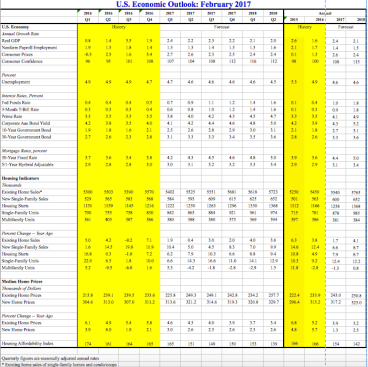
Existing-home sales are forecast to be around 5.54 million this year, an increase of 1.7% from 2016, which was the best year of sales since 2006. The national median existing-home price in 2017 is expected to increase around 4%. In 2016, existing sales increased 3.8% and prices rose 5.2%.
Yun expects housing starts – which for another year undershot overall demand – to jump to around 1.26 million units, an increase of 7.9% from 2016 (1.16 million).
“Especially if construction-related regulations are relaxed, all eyes will be on the home-building industry this year to see if they can finally start making up lost ground on the severe housing shortages impacting much of the country,” said Yun.