Just when it seemed there was reason to hope policy and regulations’ stranglehold on building more affordable homes might be loosened, this.
A California state assemblyman, Kansen Chu (D-San Jose), and the California Building and Construction Trades Council have proposed legislation that could be sitting on Governor Jerry Brown’s desk by Sept. 15, that could intensify that grip exponentially.
The new piece of legislation, Assembly Bill 199, would alter language from current laws to ensure–its authors and supporters say–that construction workers laboring on single- and multifamily communities where the government support is involved would earn “prevailing wages.”
Prevailing wages, of course, means telling employers of construction trade workers what they have to pay them.
What’s not so clear is which housing projects beyond the obvious low income tax credit and other public-private subsidies and financing for historic, special purpose, or populations in need qualify under the proposed AB 199 law.
Whereas law up to now spelled out distinct differences between publicly supported housing projects and those–including most of the work done by home builders and for-profit market-rate apartment development–which private financing exempted from prevailing wage coverage, this measure would end that clarity. Verbiage in the proposed legislation, writes, San Diego Times Union reporter Phillip Molnar, both pushes and blurs the boundaries between residential projects that do and do not receive public support. Molnar writes:
The bill requires workers to be paid “prevailing wage” on residential projects that have any agreement with “the state or a political subdivision” — a provision that extends the requirement beyond the redevelopment agencies, public agencies and low income housing projects covered under existing state law.
Home builders, housing economists, design, development, and manufacturing partners believe that ambiguity may be intentional. They also believe that if the measure goes into effect, signed into law by Gov. Brown sometime between Sept. 15 and Oct. 15, they’ll be paying as much as 40% more for construction labor costs on homes.
Pass those costs along to prospective home buyers, and you’re looking at a big problem in California, and very likely lots more migration to places like Texas. The squeeze of land use regulations and fees and home price tolerance points already suppress demand for what home builders do for a living in California. This measure, if it should pass through a state Assembly’s Appropriations Committee, go to a vote to the full Assembly, proceed to the California state Senate, etc., in tact, could end many companies’ ability to make a living building homes in the State.
An executive who asked for anonymity told us last week that homes his company is building in one of the municipalities that have already adopted “prevailing wages” laws has calculated construction labor costs on his sites of upwards of $70 per hour for labor.
This is insanity. The bill, as it may play out, would add tens of thousands of dollars to the cost of building and paying for a new home. This in a state where it’s been calculated that every $1,000 increase in home price effectively subtracts 15,000 people from the eligible buyer pool.
Builders, of course, are up in arms. Here’s an excerpt of a letter from TRI Pointe Group unit Pardee Homes division president Michael Taylor in Corona, Calif., to industry peers and colleagues.
Assembly Bill 199 is a new proposal in the State of California legislature that is sponsored by the State Building Trades Council. This newly proposed bill poses a GRAVE THREAT to the entire construction industry. THIS BILL WOULD MANDATE THE PAYMENT OF PREVAILING WAGES FOR ALL PRIVATE RESIDENTIAL PROJECTS IN CALIFORNIA. Currently, residential construction on private property has specifically been excluded from prevailing wage mandates. This exclusion is what we as homebuilders have worked under for decades. Such a requirement would effectively end the development of new communities in California, exacerbate the already serious housing shortage and destroy construction as we know it. Equally troubling is that this effort is being pushed by the unions in an effort to ultimately mandate the use of union-only labor for all residential construction in California. Time is of the essence as the AB199 bill is only weeks away from being heard by the State Assembly. We must educate the legislature to defeat this industry killing proposal and we need your help today. California’s leading builders and developers have launched a major effort to stop AB199 through an aggressive lobbying, media and strategic political program. Already, the 15 largest homebuilders in California, including the TRI Pointe Group, have contributed substantial resources to this critical fight. For additional information, attached above is an AB199 fact sheet and frequently asked questions sheet.
The California Building Industry Association has set up a link as an information and support resource for those who oppose AB 199. The link is here.
Meanwhile, here’s a statement from CBIA senior VP Frank de Lima, who’s leading the CBIA charge in Sacramento, the California capital.
We are building far too few houses in California to keep up with demand, with experts stating that we need to add 100,000 more units annually to the 80,000 we are already adding per year.
This housing shortage is causing a severe supply and demand imbalance which is skyrocketing housing costs.
Instead of finding solutions to make housing more affordable for all income levels, Assemblymember Kansen Chu has authored legislation that could significantly increase housing costs at a time when homeownership rates are at their lowest since the 1940s.
AB 199 could mandate prevailing wage on almost all new private residential construction, further increasing housing costs and adding yet another significant barrier to adding housing.
Specifically, AB 199 could eliminate a longstanding residential exemption and will redefine private market rate residential projects as ‘public works’, which will subject them to a prevailing wage mandate.
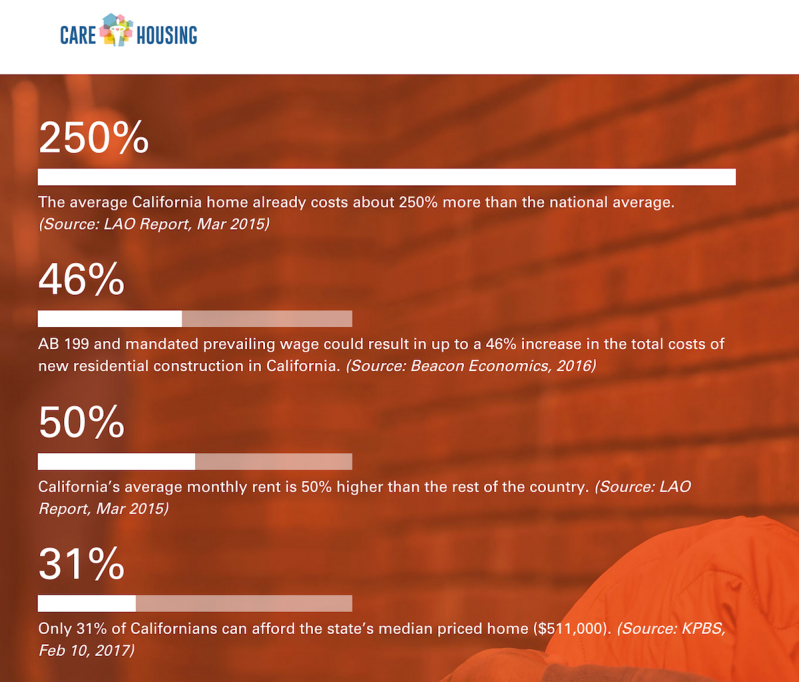
While the effects of this bill will vary regionally, a Beacon Economics study on a ballot measure in Los Angeles that included a prevailing wage mandate, estimated that the measure would increase projects’ labor costs by 95.3% and increase the total cost of a project by 45.8%.
Our builders who do both prevailing wage projects and non-prevailing wage projects have reported that prevailing wage adds $46-77 per square foot depending on the region.
Already, the Business Council of San Joaquin County says AB 199 would increase the cost of a 1,500 square foot single family house in the Central Valley by $75,000; and industry experts estimate that AB 199 could add approximately $90,000 to the cost of building a 2,000-square- foot house in San Diego County.
With research showing that for every $1,000 increase in the cost of a home, 15,000 California households are priced out of the market, AB 199 could have a dire effect on Californians entering the housing market.
In the last several years, policy makers have approved a $15 minimum wage, increased funding for individuals on social programs and other efforts to help Californians cope with the high cost of living. Should AB 199 pass, those recent efforts could be undermined by higher housing costs.
AB 199 may drive up the cost of housing – forcing millions who are living at or near poverty into an even more desperate situation. And, when housing costs rise, families are forced to shift their spending away from basic needs like food and health care.
AB 199 is a bad idea that is designed to help one special interest at the expense of all other Californians.
With the bottom 25% of income earners in the state spending 67% of their income on housing, legislators should be focused on making housing more accessible to all hardworking families.
Again, go to the https://careabouthousing.org/ link here.