The good news for those invested or poised to invest in housing’s workman-like recovery is that it’s got about two to five years of structural headroom to continue its plodding progress.
The bad news is that cost impact on home prices could either mute or derail that progress by stressing the limits of tolerance balancing monthly housing payments and people’s more modest increases in their household incomes.
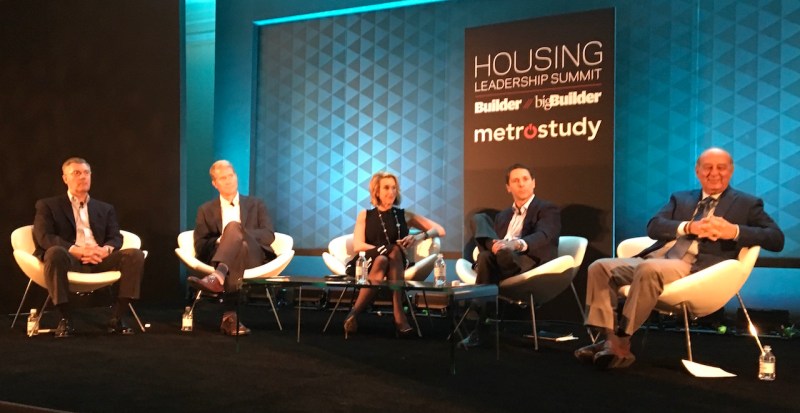
This was the consensus yesterday among four CEOs from among the top 25 ranking Builder 100 organizations, offering their views on the pulse of the housing recovery during a keynote session at our Housing Leadership Summit in Dana Point, Calif.
The four executives–Doug Bauer, ceo of TRI Pointe Group, Roger Cregg, president and CEO of AV Homes, Sheryl Palmer, president, CEO and Chairman of the Board of Taylor Morrison, and Scott Stowell, executive Chairman of the Board at CalAtlantic–represented 2016 home deliveries totaling 28,274 homes, with aggregate revenues of $13.1 billion, across a wide geographical footprint and a diverse set of customer segments and price tiers in their respective market arenas.
The four company chiefs, from the No. 5, No. 7, No. 12, and No. 24-ranked companies in this year’s Builder 100, spoke candidly with Hanley Wood vice chairman emeritus Frank Anton about challenges and opportunities among home building organizations to leverage ever greater access to data and technologies to improve the productivity and performance of their respective organizations, their complex decision chains, management, and workflows, and their ability to plan better for what’s next.
Anton asked each of the four his or her thoughts on where in the cycle housing currently functions, given that the current recovery is entering a historically protracted stage, six or seven years since it began after the Great Recession.
CalAtlantic’s Stowell reflected that Anton’s question is a critical one, given that its answer impacts large capital allocation and deployment decisions that occur now in order to plan for future inflections, either in the broader economy or more housing focused.
Stowell’s “established view” next two to three years ahead, leading into 2019 and 2020, look as if the slow, choppy recovery path housing’s been on will continue to offer “opportunities to grow,” with a scenario for a “modest” housing recession occurring as a speed bump just beyond that period.
Palmer considered the question through three lenses–starts, land prices, and home prices–noting that from the vantage point of housing starts, the housing recovery has lots of headroom for growth, and might be considered in its “early innings.” The big caveats, however, start kicking in when you look through the lens of land costs, which Palmer asserts are overvalued right now and need to reset to link back up to economic and financial reality.
So, from a land cost standpoint, the cycle has entered the “late innings.” On house prices, different geographies have reached different points in their cycle, says Palmer, but on a national average–“which may be an unhelpful way to look at this”–prices are probably beyond the midpoint in the cycle.
Roger Cregg–who’s been working to diversify AV Homes customer segment mix beyond its legacy 55+ focus, and has made strategic acquisitions that expose AV to the high-momentum entry-level markets in the Southeast–believes fundamental demographics of demand are solid, stretching well into the next several years.
“The headwinds are on the supply side, but we’ve been dealing with those, and we’ll continue to, so with some puts and takes, I’d say we’re in the middle innings.”
Perhaps the most sanguine view on housing’s recovery trajectory came from TRI Pointe’s Doug Bauer, who may have a slightly different perspective based on his empire of six branded operator’s current land and lot pipeline.
“We look at housing as a demographic, household formation, family formation engine, and compare this time to what we saw occurring during the 1991 to 2006 period. Considering the pent-up demand that’s there, I think [the recovery’s] got a good 10 years to go. If you look at that 15-year period from 1991 to 2006, it’s not as if there weren’t some bumps. But I don’t think we’re going to get ‘the big dipper.'”
Driving that optimism in the nearer-term is the 55+ customer segment, where housing decisions, access to credit, and current incomes make for a stronger discretionary market place, the CEOs agreed. Meanwhile, Bauer notes, “kids are starting to crawl out of their parents’ basements, and crawl out of these little holes,” and are beginning to behave in their housing preferences more like prior generations regarding household and family formation, “with a lag.”
Palmer notes that Taylor Morrison has new research showing that young adults may be more willing to commit a greater share and percentage of their income to housing payments in order to attain the kind of home and community they want. This would be a turn in perspective on a cohort that has been regarded, for the past several years, as a question mark as regards their embrace of the American Dream of homeownership.
While Bauer’s view of housing economics is probably the most optimistic, he struck a cautionary note as well.
“If I was to say I have a big concern, the biggest concern is on an international stability level, where what you’ve got going on in Korea or the Middle East [or any number of other areas], the thought that somebody could do something crazy. That would put all of this into question.”