Apparently, “favoriting” is now a word. It’s what home shoppers do on Zillow. As bad as it is for the English language, it is good for home sellers. According to a new Zillow analysis, homes with more favorites sell faster and for more money, an indication of how competitive the housing market has become.
Homes across the U.S. that receive 30 or more favorites within their first week of hitting the market typically sell in under two weeks, says Zillow, with more than 40% selling above list price. But homes that get 10 or fewer favorites in their first week go for less money and take over a month to sell.
Favoriting a home on Zillow is a way for shoppers to save homes they’re interested in coming back to later, making it easy to show a friend, partner or real estate agent.
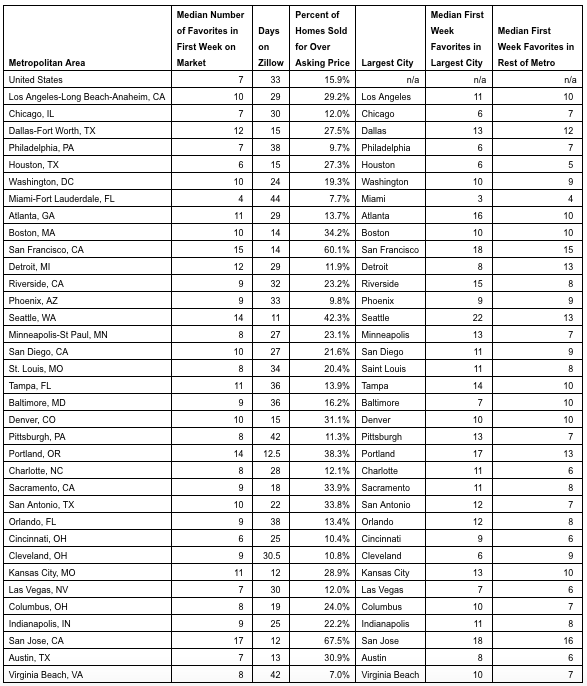
Homes in San Jose, San Francisco, Seattle and Portland, a few of the hottest markets in the country, get the most favorites within their first week on the market. In San Jose, the typical home gets 17 favorites in the first week and spends just 12 days on the market. About 65% of these homes sell above asking price.
As demand for homes skyrockets and the market becomes increasingly competitive, it’s not unusual for sellers to receive multiple offers and for bidding wars to ensue among buyers. Low inventory is one of the reasons competition is so high — there are 11% fewer homes on the market than a year ago, the greatest drop in inventory since July 2013.
In Seattle, the fastest growing metro in the country, the typical home gets favorited 14 times in its first week on the market, selling in just 11 days. Some homes in Seattle, however, get up to 40 favorites in the first week and typically sell in just seven days. Among these homes, 75% sell over asking price.
Zillow’s analysis used new data now available via its tool, Builder Inform™. Builder Inform was created to help residential builders make informed decisions about where and what types of homes to build based on consumer demand. Builder Inform is now available to builders who participate in Zillow Group’s Promoted Communities.
“When shoppers favorite a home on Zillow, they may be in the active home-shopping process and not just casually browsing,” said Zillow Chief Economist Dr. Svenja Gudell. “Shoppers may also favorite homes they want to keep checking in on or save to share later with a partner. Homes with built-up favorites often denote desirable homes in popular locations– a sure indicator that you’re not the only one eyeing the home of your dreams. If you’re a buyer interested in a home with many favorites, take immediate steps to view the home as soon as possible, and make sure you have pre-approved financing ready to go in case you want to make an offer then and there, especially in the country’s most competitive markets.”
Not all cities within a hot metro are equally competitive, however. In the majority of metros analyzed, homes listed for sale in the largest city in the metro get more favorites in its first week on the market than homes in other cities within the metro.
This trend is most pronounced in Seattle, where listings in the city itself get about 22 favorites in the first week, but listings in outlying cities get just 13. In Riverside, Calif., listings in the city itself get 15 favorites in the first week on the market, while listings in outlying cities get eight.
Knowing the number of favorites a home receives allows sellers to be up to speed on how popular their home is relative to others on the market and how much competition they can expect. A high number of favorites is a good indicator that a home may sell quicker than expected, and for more money.
According to the Zillow Group Consumer Housing Trends Reportv, almost 70 percent of sellers say seeing how well their home is performing compared to similar homes on the market is an important way for them to gauge interest. About 60 percent of sellers say an important way for them to gauge interest is to know how many people have looked at their home online.
The Builder Inform tool is now available to residential builders, with data down to the ZIP code level in all major housing markets throughout the country.