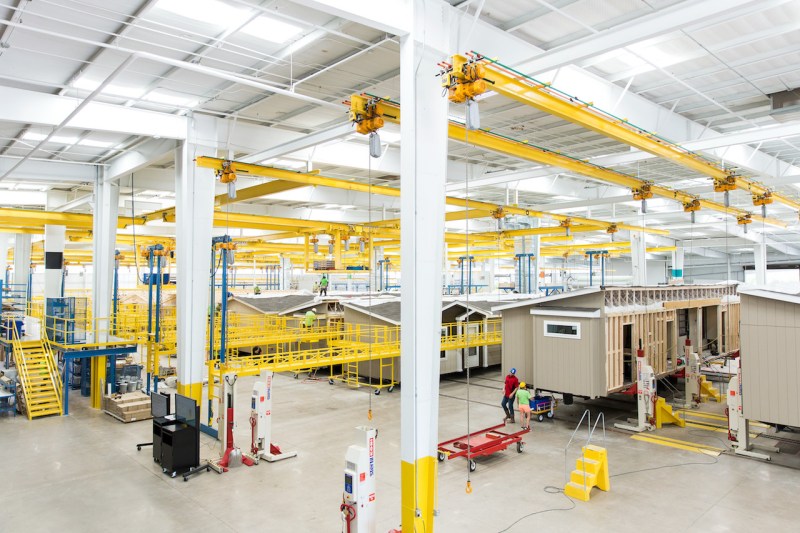
What does a $13 million investment in a 160,000-square foot manufacturing facility some 75 miles southeast of Dallas have to do with ending housing construction’s labor crisis?
Let me begin answering the question with a question.
If succeeding in the residential construction business is a blend of doing well and always improving what you can control and preparing well for what you can’t control, which bucket does the skilled labor capacity shortage fit into?
Many organizations, especially larger ones in the sector, look at those skill and productivity constraints–and the disturbance and unpredictability they cause to timelines, budgets, quality output, etc.–as an external issue. It’s the nature of the business that companies subcontract labor, so leaders regard the matter as one that’s outside their control.
Becoming “builder of choice” among subcontractors by paying promptly, scheduling accurately, and providing a reliable forward-cast outlook of demand for laborers’ services through the housing cycle has been the “best practice” of last resort.
Still, while “builder of choice” stature might be an enterprise’s best form of leverage among the current pool of skilled and semi-skilled workers in a submarket, the sense of assurance such practices bring a local supervisor that his or her crews will show loyalty and reliability are tenuous. What’s more, it doesn’t do much at all to get at the challenge of attracting human talent into home building.
That challenge remains an issue outside most of construction company leaders’ sense of what they control.
So, if home building companies don’t control the cost nor the time-value of their land basis, and they don’t control the prices of building materials, and they don’t control expenses and scheduling of labor inputs, where does that leave us?
Where we are, of course. Paying so dearly for what’s needed to develop and build homes that we can only serve a small, and shrinking market of buyers and would-be buyers. Meanwhile, the economy’s creating a bigger and bigger universe of households that dwell outside the province of new residential construction altogether.
If anything can change where we are, and reset the direction from an expanding universe of unmet need to an expanding marketplace of opportunity for housing’s businesses, including more people, not fewer, under new construction’s tent is the one and only path forward.
That means lowering the barrier-to-entry costs to be included, and the only way to do that is to bring new, smarter, more purpose-driven, more tech-enabled people into the midst of the challenge.
Which brings us back to the $13-million investment in the 160,000 sq ft facility in Athens, Texas, that Clayton home building group has made as part of a system-wide capital improvement strategy among its 40 manufacturing facilities and 17 component manufacturers nationwide.
“We have the highest demand for our product that we’ve had in 20 years,” says Keith Holdbrooks, president of manufacturing for Clayton Homes. “And yet, despite the labor crunch, we’ve reduced turnover among our plant team members this year. We find that it’s simple: To create a world-class customer experience, you have to have a world-class team member experience. Then you can aspire to be a world-class company.”
To that end, senior strategists at Clayton started their nationwide capital improvement journey by surveying construction facility associates on what environmental conditions matter most to them–pay, dust, unbearably hot temperatures, noise, and other workplace issues.
Then, top executives toured facilities, ranging from Google headquarters to European offsite construction plants, to Freightliner assembly factories, to Yale (forklifts) to learn and absorb, not only how to bring better technology to bear on people’s productivity, but how to bring more enthusiastic and engaged people into an automated but humane environment.
“In today’s very competitive labor environment, we believe that it gives us a competitive advantage to improve the physical environment, to make it so that each person’s output can increase, and so that we take care of each person working for us to a greater degree.”
Here’s some fun facts about the Athens, Tx., facility, purchased for $3 million in 2014, and renovated during a nine-month period in 2015, opening in November of that year.
With permission from Clayton Homes.
About Clayton Athens
- This new 160,000-plus-square-foot home building facility was designed with a focus on team member experience, sustainability and innovation.
- Employee feedback inspired the design of the facility, which helped Clayton hone new features to support team member experience.
- Clayton Athens is transforming industry standards.
- It features modern amenities including:
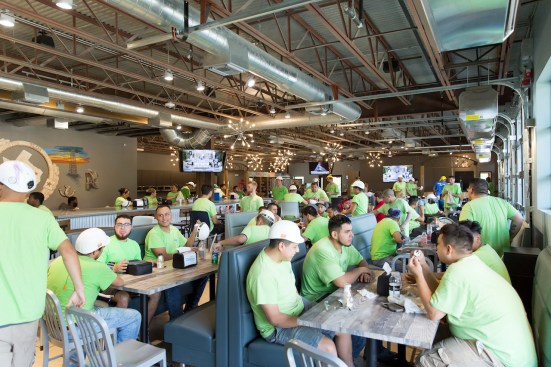
- An expansive dining area featuring a complimentary salad bar with a “restaurant feel” to give team members a place to relax and rejuvenate
- Open office floor plans in a casual, aesthetically pleasing, informal environment designed to inspire creativity
- Automated processes creating a more efficient, less labor-intensive work environment
- Air conditioned areas dubbed “cool zones,” that provide a space for team members to cool off and also improved air quality within the facility through the elimination of large amounts of dust
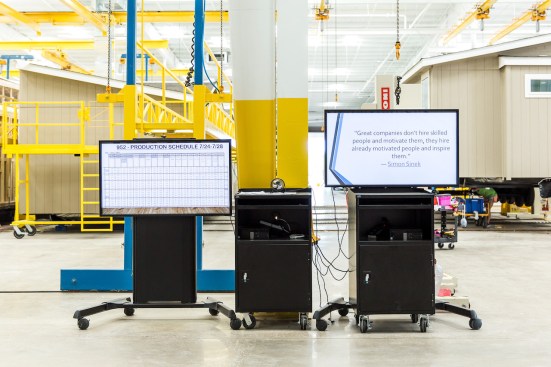
- Interactive touch-screen monitors and tablets to eliminate paper waste
- Clayton Athens is implementing measures to become the first paperless home building facility in the company.
- Clayton Athens is in the process of becoming ISO 14001 registered by following sustainability guidelines and implementing green building practices. It will be Clayton’s 40th ISO 14001 registered facility.
About the Bistro
Provides a sense of place for team members that is inspiring, motivating, invigorating and imaginative by utilizing color, light, sound, textures, materials and nature. It allows team members to re-energize, connect and relax which will ultimately promote an exciting and positive work experience improving quality of life, attitude and work ethic.
With permission from Clayton Homes.
Features
- Restaurant style and atmosphere.
- Interior lighting that is unique, dynamic and visually interesting. The design statement defines the space and promotes human connection, comfort and spatial connectivity.
- Complimentary fruit and salad bar for team members.
- Includes a central stage with lighting, television and jukebox. The stage is a platform for team members, administrative staff, managers and guests to address the group or allow for public speaking, karaoke and other entertainment opportunities.
- Walls feature corrugated metal panels and western red cedar.
- Diverse seating areas of booths, tables, café tables and bars that feature colorful, multiple textures with added comfort.
- Exposed ceilings to maximize height.
- Garage doors open to outdoor seating area with a park setting featuring landscaping, trees, fragrant plantings, natural fencing and diverse seating.
Facility Updates
- Dust collection systems: reduce debris, increase air quality and overall work environment.
- “Cool zones”: Air conditioned area for Team Members to cool down and refresh throughout the work day
- Large wall fans: strategically located to maximize air flow and increase fresh air.
- Vertical increase: creates extra height clearances and provides vertical material storage and work areas.
- Streamlined production process locations: maximizes storage and minimizes travel distances to production stations to keep materials close at hand during the construction process.
- Updated restrooms: low flow light fixtures to promote environmental stewardship. They include modern amenities with decorative tile and bright lighting.
- Paperless environment: Reduce excess printing by providing tablets and interactive monitors for product info, data and announcements.
Now, why does all of this matter?
First, consider the impact on Clayton’s business.
“We’ve been able to raise our team members pay per hour, and reduce our overtime pay, and still produce more homes,” says Holdbrooks, who notes that Clayton has completed a similar overhaul in its Wakarusa, Indiana, plant. “This way we have a team member who’s making more money, spending more time at home with his or her family, and contributing to greater productivity as we cut down on our overtime and the cost of turnover. Everybody wins.”
And the big difference here is that a company seizes control of what most other companies regard as an external issue they’re not in control of. We look at the next couple of years as a tipping point period on the labor shortage issue.