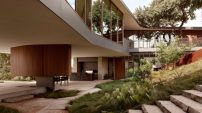
As the market rebounds, the second-home business is coming back. Infamous for being sensitive to every spike and tumble in the market, second-home starts are picking up. Most builders and architects you talk to say that second homes are some of the most interesting and rewarding projects to come their way. We thought it was a good time to explore them.
If you’re used to doing infill houses in first-ring suburbs, a house on an ocean cliff is exciting work. Clients tend to be more adventurous with a second home, opting for unconventional layouts, unexpected forms, and connectedness to the surroundings, whether it’s a compound-style family retreat deep in the woods or a net-zero house on a working goat farm. Architect Rich Bubnowski, principal of Richard Bubnowski Design in Point Pleasant, N.J., notices that resale value of a second home can be less pressing because it is intended to be passed down for generations to come. “It’s idealistic, and whether or not it actually happens, people still want to think this way,” he says.
Second homes carry their own set of challenges, including sites that are in remote or unfamiliar locations. Architect Jonathan Feldman, principal of Feldman Architecture in San Francisco, recently designed a house in Martha’s Vineyard and admits that it was complicated. “If I lived in Boston, it wouldn’t be a problem,” Feldman says. In a faraway place, there’s the additional work of getting to know the local jurisdiction and finding just the right team. FaceTime may be great for walk-arounds and progress reports, but Feldman stresses that technology goes only so far when it comes to grasping the subtleties of a site and testing out ideas on the land once you’ve drawn them up. Many times clients don’t know the property that well. “More often than not, they haven’t seen it in all its seasons; they don’t know where to build, how hot it is in the summer, or where the best views are,” he says.
Cross-ventilation in summer is a crucial concern, but so is passive solar gain in winter. That’s because one of the many changes taking place in home building is that the house formerly known as the summer home is becoming a year-round home—a second home.