“Do no harm” is a phrase that’s normally associated with doctors, but it’s a directive that was eagerly appropriated by a couple in Arlington, Texas, when they set out to build on a suburban, 1.37-acre site. “We had this really phenomenal lot, just 15 minutes from the airport, that had a dry creek bed and a ravine that drops off about 80 feet into the woods,” says the wife. “We knew we’d never find another property like this so the last thing we wanted to do was mess it up.”
If anything, the couple ended up improving it. They resisted the common urge to flatten out a difficult site, got that dry creek up and running, and organically amended the soil. They were careful when it came to adding the kinds of amenities that often harm a landscape more than improve it. Privacy concerns, for example, led them to erect a wall of bamboo along one side of the lot, but they made sure to imbed the often invasive tropical grass in an 80-foot-long underground concrete container. “We basically built a swimming pool that holds the bamboo and contains its roots,” says builder Michael Wood of Providence Homes in Arlington. “We did that early on in the construction process so that the bamboo could be established by the time we finished the house.”
Wood built a real swimming pool, too, but even this Texas staple has an environmentally friendly twist to it. It uses an ozone system—basically copper and oxygen—to purify the water instead of chemicals. “In the summertime, it’s where our kids bathe,” says the wife.
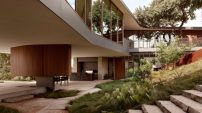
Of course, the house itself was the trickiest design challenge when it came to using the site to its best advantage. “This is a beautiful, hilly neighborhood so it’s common for people to flatten out the lots to build a home,” says the wife. “But we wanted the house to have different levels to reflect the different levels of the land. It really nestles into the lot.”
The couple was partial to a Mediterranean look, but knew that a huge Tuscan wonder wouldn’t be appropriate. Instead, Arlington architect Don Wheaton took their desire for a home that would blend in with its surroundings and designed a 7,494-square-foot family-friendly structure that conforms to the existing topography. He managed to come up with a plan that gives every major room, even the round dining room off the entry, a view of the spectacular terrain.
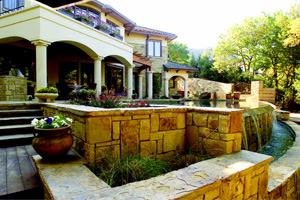
The materials all reflect a natural earth-tone palette: a dark, concrete-tile roof that looks like shake; stucco and natural stone on the exterior elevation with cast-stone detailing and columns; flagstone for the patio decks and in the colored-concrete driveway. “The whole idea, even with the interior, was that the house would never compete with the outside,” says the wife. ”We wanted to live outdoors as much as possible, which is how the outdoor kitchen came about.”
It’s a kitchen that the family uses year-round for grilling and stir-frying, where “I can walk right out and put those BTUs up as high as they’ll go,” says the wife. An irrigated raised herb garden and a compost area are located nearby. And scattered throughout the patio are a number of pots that hold flowering plants and more herbs. Even something as simple as a flowering pot was given plenty of thought. The couple figured out where each and every plant would go before construction started and had irrigation tubes installed that run up through the bottom of each pot. At this house, plants thrive even at the height of a Texas summer.
“The whole house revolves around the outdoor area so it had to be functional,” says the wife.
Project Credits: Builder/Pool builder: Providence Homes, Arlington, Texas; Architectural design: Don Wheaton, Arlington; Landscape architect: Oliver Windham, Arlington; Interior designer: Stephanie Vasso, Tyler, Texas; Photographer: John Wehlage; Illustration: Rick Vitullo.