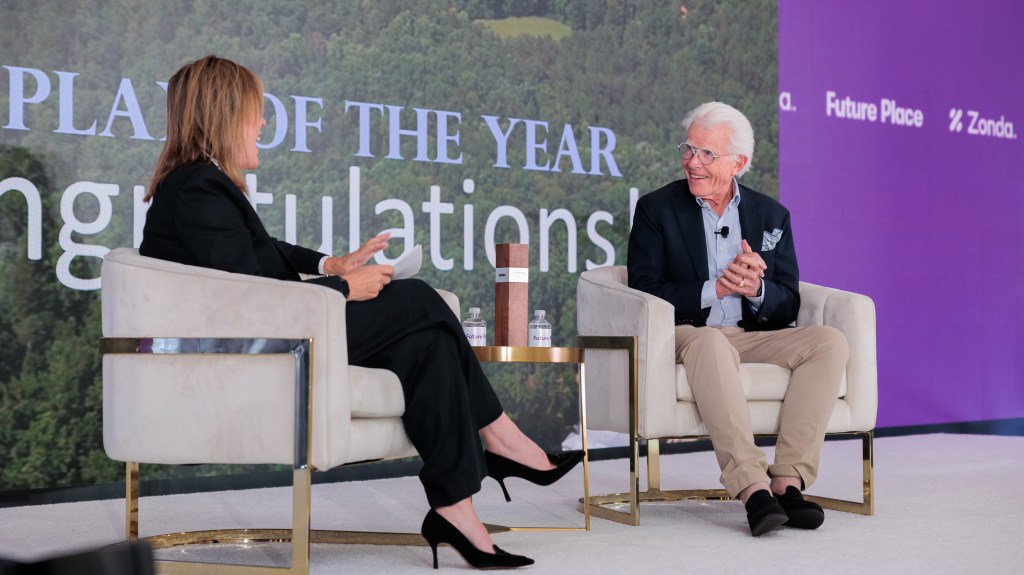
The industry’s forward-thinking developers, builders, investors, and planners came together on day two of Future Place to discuss what’s next for community development.
From creative capital strategies and home builder self-development to wellness design and surf-park amenities, this year’s trends revolved around connection to nature and neighbors, walkability, a lifestyle away from screens, beneficial municipality relationships, and segmentation.
MPC Valuation Trends
Greg Vogel, CEO of Land Advisors Organization, dived into the data and deals shaping master-planned community (MPC) valuations today. He shared that the top seven lot bankers now control more than 500,000 lots. While horizontal development costs have stabilized but are high, vertical costs are trending down 7 to 12%, a hopeful relief for builders. He’s hopeful that move-up product demand is going to be fruitful if interest rates lower and attainability will drive multifamily and the build-to-rent (BTR) sector.
Risks and Readiness in a Shifting Economy
Randy Teteak, chief investment officer and EVP of Freehold Capital Management; Graig Bantle, director of Kennedy Lewis Land and Residential Advisors; Andrew Brausa, CEO ofOlympus Housing Capital; and Brendan Bosman, managing director of Real Estate Pretium, joined Tim Sullivan on stage to talk about what they’re seeing across investments, capital, and land posture.
Teteak said that finished lots in California are gold and the Charleston, South Carolina, market is also bright. He believes public builders are going back to ‘home manufacturing’ as many shift to a land light model. He’s hopeful that buyer confidence will come back next year.
Bantle said that extreme discipline in underwriting has to be done across the board. “This is the time when operational effectiveness and efficiency is key,” Balte said.
“Two is the new three” for absorption rates, according to Brausa. He thinks there will be lot shortages as confidence rebounds next year and Bosman said, “There’s a new normal right now. It’s not that bad” as builder margins are relatively strong.
2025 Builder Masterpiece Award
Celebrating innovation and functional excellent, the Builder Masterpiece Award, presented by Zonda’s Mollie Carmichael, recognized Kim Adams of Brambleton and Don Knutson of Knutson Companies for outstanding contributions in design and livability for Birchwood at Brambleton.
Home Builders Turn Developers
A trend that is gaining traction, home builders are self-developing communities. Moderated by Bryan Glasshagel, the panel of Dan Grosswald, division president of SE Florida Mattamy Homes; April Whitaker, regional president Austin of Taylor Morrison; and David Vitek, president of Candlelight Homes discussed how self-developing can change the game.
“You certainly gain some leverage. You’re able to do some things that you wouldn’t normally be able to do as a builder, especially things that add value,” said Grosswald.
Whitaker said that being able to control the design and development creative financing strategies with joint development agreements, land banking, and more. She said the right team is vital for self-developing success, but also that customers expect a lifestyle. “Amenities up front help drive returns faster,” she said.
Similarly, Vitek said that being able to control the details is a perk of self-development, but that builders must know their costs. “Make sure that your development budgets are really understood, scrubbed, and accurate. Knowing your costs and controlling those costs are really critical,” he added. He said that self-developing also gives the opportunity to form better relationships with municipalities from the start.
Resilience and Financial Sustainability Are Necessary in MPC Development
Laura Cole, SVP of Lakewood Ranch, and Kate Kaminski, COO Arizona region of Howard Hughs Holdings, shared insight into planning and executing two very different projects. Cole discussed the final stages of developing Lakewood Ranch and how they want to set the stage for maximum returns for the future. She believes that Lakewood’s brand from the beginning has carried trust with both homeowners and builders. “Our first builders are still in our last section,” she said.
In Arizona, Kaminski is preparing for the grand opening of Teravalis. In its first phases of 3,000 acres, there will be 1,100 lots, seven builders, and a plan to create a resilient community with a draw of creating jobs for the remote, mountainside area. “In the next 12 months, we’re focused on getting the right builders,” she said.
Both agreed that staying nimble plus strong relationships with municipalities, builders, homeowners, and public-private partnerships can be ingredients for enduring success.
Build-to-Rent and Segmentation
Taking a look at trends in multifamily in MPCs, Zonda’s Kimberly Byrum found that larger MPCs (like Lakewood Ranch) can support over 3,000 rental units. From 2024 to 2025, over 5,200 units were added to MPC inventory.
Looking at BTR versus garden-style apartments, Byrum said that BTR effective rents are stronger and two-story units with a primary bedroom downstairs, deliver 11% higher rents versus a primary upstairs.
“BTR is becoming the new bridge between renting and ownership,” she said. “It’s bringing families into MPCs that could potentially be your future owners one day.”
She recommends considering future demographics when it comes to unit design and limiting niche inventory to under 30 units.
Adventure Amenities, Authentic Placemaking, and Walkability
Several panels of industry leaders, planners, designers, and developers put on their ‘vision goggles’ to discuss what’s on the horizon for MPCs and what’s currently thriving. Budding surf parks, established and new agrihoods, and a variety of outdoor experiences—whether naturally part of the land or manmade—all have their unique place in community planning.
“It all starts with the land,” said Diana Carroll, marketing director of Hillwood Communities, “Is there something there we can activate naturally? Use the best of what is available to you. We know you must have amenities from day one. When we are thinking about amenities, are there places to make natural places to gather?”
Carroll said that lifestyle managers are key to building culture within communities like Harvest in Texas. “Our lifestyle managers build a culture. It’s really about connecting people. That all starts with the person you hire to create that lifestyle,” she added.
In Austin, Andy Bilger and Shawn Breedlove of SonWest Co. are developing Pura Vida, a surf-centered MPC with sustainability in mind. It will become one of the largest rainwater harvesting projects in the state of Texas.
Projects like Braden in Sacramento and Serenbe in Georgia (which one this year’s Master Plan of the Year award) center around connect living, sustainability, agrarian character, and social design that allows for walkability. While receiving his award, Steve Nygren of Serenbe, said, “If you’re going to be a placemaker, lead with hospitality.”
Seabrook founder and CEO Casey Roloff echoed the same fundamentals of walkable, communal, connected living for his New Urbanism town in Washington. Working with a ‘shoestring budget’ Roloff has slowly phased in amenities and adaptable retail and commercial offerings. He said their pedestrian-first streets are their best amenity.
When speaking on Braden which will ultimately have 8,000 residences and 48 miles of trails, Rachel Bardis, COO of Somers West Development, challenged the audience, “It’s fun to have vision goggles but take the time to do something different.”