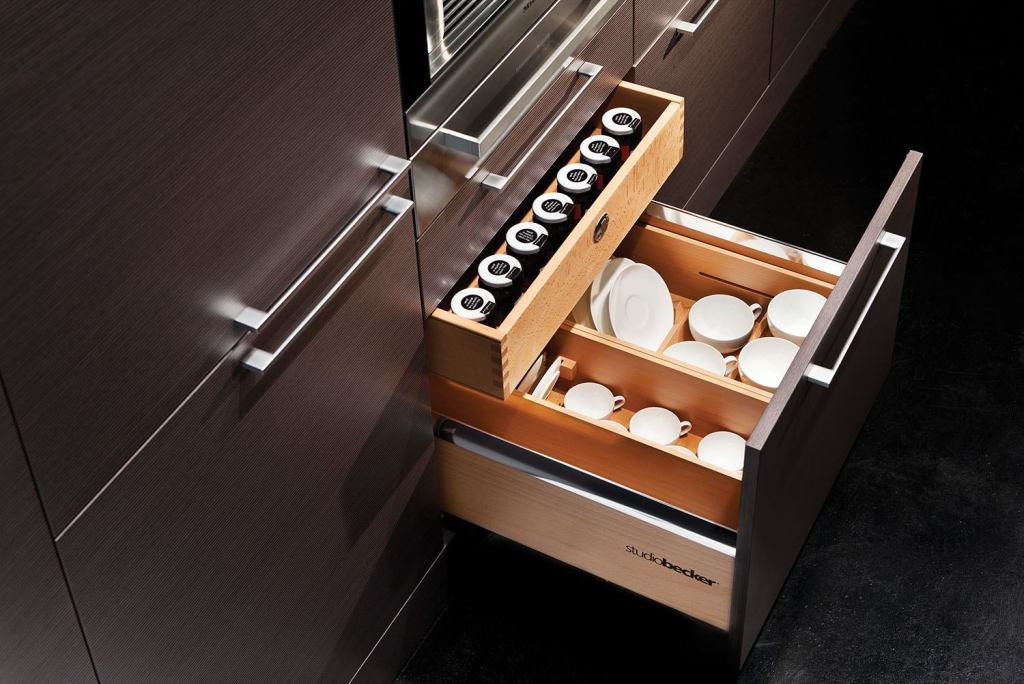
Considering that Troy Adams’ work has graced homes in some of the world’s toniest neighborhoods—not to mention yachts and private jets—his career had surprisingly humble origins. “I grew up in the kitchen and bath business,” says Adams. “My grandfather was a cabinetmaker, and my father was a general contractor.” Adams started his own kitchen installation business in his hometown of Wasilla, Alaska, moving later to Honolulu, where he worked as a salesperson for a kitchen-and-bath dealer. But he was never satisfied with the field’s traditional business models: the craft-centered custom millwork shop and the volume-oriented stock cabinet dealer. So after founding his own design firm in 1987, he developed a different approach, partnering with a sophisticated German fabricator to produce custom kitchens—plus wardrobes, wine cellars, and complete interiors—that rival the work of the most highly regarded residential architects.
Unconventional sources yield fresh ideas.
“The kitchen and bath business has been so narrow, especially in America,” says Adams, who looked elsewhere for inspiration early in his career. “I started going to Europe 25 years ago, to the international design shows. I learned design on my own—studying the work of architects I admired, looking through design magazines, and traveling.” He looked to fashion for its interplay of shape, texture, and color, and to yacht interiors for their space efficiency and integration of high technology. “These things really lend themselves to the most used spaces in the house,” he says.
Today, the projects that emerge from Adams’ Los Angeles studio and showroom—which focuses on millwork designed by Adams and fabricated in Germany by Studio Becker—combine exotic materials and sophisticated electronics with layouts that are both highly original and utterly practical. Kitchens are fitted down to the last whisk and spoon, with drawer-to-table dishware caddies, appliances that rise from countertops on motorized lifts, iPad controls for lighting and A/V equipment, and myriad other conveniences tailored to owners’ specific needs. A wardrobe might include refrigeration for fragile cosmetics, jewelry storage secured by an electronic fingerprint reader, and jewelry trays that transfer to specially fitted luggage pieces (also of Adams’ design). “Everything we do is completely custom,” he says, “and there are absolutely zero limitations.”
Kitchens are only the beginning.
Unlike most kitchen and bath designers, Adams and his staff don’t limit their work to fitting out existing or predefined spaces. By assembling teams of allied professionals, he says, “We can act like an architecture firm or an interior design firm, tearing walls down and integrating spaces.” The work typically centers on rooms with a lot of millwork—kitchens, baths, wardrobes, and wine cellars—“but if it involves the architecture around those spaces,” he says, “we’ll take on the whole project.”
To every room he designs, Adams brings a restless inventiveness bred in the intensely utilized spaces of kitchens and baths. A recent condo remodel in Los Angeles includes a master bedroom that dissolves, via sliding walls and a fold-away bed, into the living space, making the bedroom’s spectacular valley views available throughout the day. Adams hid the bed with a series of laminate panels imprinted with a photograph of the late rock musician Kurt Cobain.
A new business model combines high-style design with high-tech production.
What makes all this possible are the technical capabilities of German-based cabinetmaker Studio Becker, which has produced all of Adams’ millwork for more than 25 years. “You’re not allowed to work in a factory in Germany unless you have a five-year degree in cabinetry,” Adams says. “Those standards don’t exist here.” Along with the highest production quality, the relationship allows Adams complete creative freedom. “Everything we do is a prototype,” he says. “We ask things like, ‘Can we take salmon skin, sew it together, layer it like veneers, and use it on a cabinet? Can we take animal bones, crush them up, and use them [as the aggregate in a composite panel]?” In every case, the answer has been yes.
The result is a level of exclusivity that even the most respected brand-name cabinet manufacturers can’t match.
“If you want Bulthaup, you can walk into a Bulthaup showroom in any major city,” explains Adams, who adds that such convenience holds little appeal for his clients. “They’ve stayed in the most sophisticated hotels and spas. They don’t want a kitchen that was stamped out on a production line. We learn how they live, cook, entertain, shop. We’re starting with no catalog, no stock finishes, no stock anything. We’re designing everything.”