I awaken to three gifts each morning, five or six days a week.
A commercial grade treadmill, a Kindle reader, and an hour (albeit an early one).
These mornings, pages of Greg McKeown’s “Essentialism: The Disciplined Pursuit of Less,” make those hours fly. In this passage, he describes returning to his room after a full-day workshop, experiencing overwhelm, a “sudden pull in a million directions.”
Everything around me was a reminder of all the things I could be doing: check my e-mail, listen to messages, read a book I felt obligated to read, prepare the presentation for a few weeks from now, record interesting ideas that had grown out of the day’s experiences, and more. It wasn’t just the sheer number of things that felt overwhelming, it was that familiar stress of many tasks vying for top billing at the same time. As I felt the anxiety and tension rise I stopped. I knelt down. I closed my eyes and asked, ‘What’s important now?’ After a moment of reflection I realized that until I knew what was important right now, what was important right now was to figure out what was important right now!”
You might call this kind of reading a “self-help” genre for business managers, but I’m soaking it up these days, and McKeown’s prescriptive tactics and tips for creating distance between past failures and the “wreckage of the future” ring especially true now. Chapter 19 of his book–“What’s Important Now”–began this morning’s hour. Puzzlers among you will spot the acronym here immediately: WIN.
These days, the Futures are messing with our heads. Hysteria is growing exponentially, at rates that eclipse the actual spread of COVID-19’s public health menace.
What’s important now?
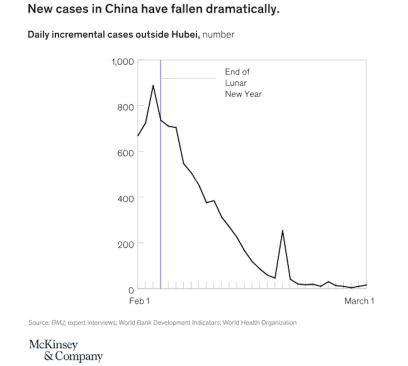
Is it recognition that in China’s Hubai province, “first-time epicenter of the pandemic,” new infections have reportedly shrunk to single-digits? That’s approximately 10 weeks from the earlier reports of the spread of the disease.
Is it recognition, as last year’s Builder 100 keynote speaker and author Joseph A. Michelli, so eloquently puts it, that today’s VUCA world [volatility, uncertainty, complexity, anxiety] fairly well characterizes every leader’s navigational challenge of the moment. Michelli draws on nuggets of insight from McKinsey & Co. management consultant Kayvan Kian‘s “What Is Water? How Young Leaders Thrive In An Uncertain Time.”
Lead in areas that represent the intersection of control (or high influence) and importance.
Is it recognition that–thanks to technology–we can track impacts, course-correct or hold course, mitigate further risk, and act opportunistically in real-time? Bill McBride, mastermind of the economics blog Calculated Risk points out several of the real-time, sensitive, and predictive indicators and trends he’s paying attention to here. The point is to pick up any material inflection point in consumer and customer behavior that may have implications on ultimate structural demand. Here’s some of the “indicators” McBride’s carefully monitoring.
High Frequency Data: Movie Box Office
US Hotel Results For Week Ending 29 February
Unemployment Insurance Weekly Claims
Is it recognition that, as stakeholders in building, real estate development and investment, housing, manufacturing, and distribution, as McKinsey & Co. briefs its clients, “A range of outcomes is possible. Decision makers should not assume the worst?”
In our analysis, three broad economic scenarios might unfold: a quick recovery, a global slowdown, and a pandemic-driven recession. Here, we outline all three (Exhibit 4). We believe that the prevalent pessimistic narrative (which both markets and policy makers seem to favor as they respond to the virus) underweights the possibility of a more optimistic outcome to COVID-19 evolution.
Is it recognition that we have a growing wealth of information, data, insight, and decision-support resources pouring forth even as people grapple with questions and challenges? Here, Deutsche Bank Securities chief economist Torsten Slok, Ph.D., offers a trove of them.
Leading Your Organization Through a Pandemic: Telling It Like It Is: Communicating With the Workforce
https://apps.dtic.mil/dtic/tr/fulltext/u2/a466801.pdf
Recognizing Normal Psychological Reactions to Disasters
https://www.paho.org/disasters/index.php?option=com_docman&view=download&category_slug=mental-health-powerpoints&alias=2352-chapter-7-recognizing-normal-psychological-reactions-to-disasters&Itemid=1179&lang=en
Finding the Right Words When Times Get Rough: How Commissions Can Address Difficult Communications
https://pubs.naruc.org/pub/FA86ABD5-DE27-B104-3EAF-B87DD95CBE9E
The Language of Fear: Pandemics and their Cultural Impact
https://aisberg.unibg.it/retrieve/handle/10446/48785/57794/CERLIS_SERIES_5_01_Loiacono.pdf
Pandemic Influenza Risk Communication: The Teachable Moment
http://www.ccqi.com/BCP/h5n1/the%20risk%20of%20an%20influenza%20pandemic.pdf
The Public’s Response to the 2009 H1N1 Influenza Pandemic
https://www.nejm.org/doi/full/10.1056/nejmp1005102
Social factors in the general public response to pandemic influenza
https://bmcpublichealth.biomedcentral.com/articles/10.1186/s12889-015-1756-8
Mental Health Consequences of Infectious Disease Outbreaks
https://www.urmc.rochester.edu/MediaLibraries/URMCMedia/flrtc/documents/Slides-MH-CONSEQUENCES-OF-ID-OUTBREAKSV2.pdf
CDC: Psychology of a Crisis
https://emergency.cdc.gov/cerc/ppt/CERC_Psychology_of_a_Crisis.pdf
FEMA: Disaster reactions and interventions
https://www.samhsa.gov/sites/default/files/dtac/ccptoolkit/handout-3-disaster-reactions-interventions.pdf
The concept of crisis
https://journals.sagepub.com/doi/pdf/10.1177/070674377001500508
The 1918 Flu Pandemic: The Public Health Response
https://virus.stanford.edu/uda/fluresponse.html
The Change Curve
https://www.exeter.ac.uk/media/universityofexeter/humanresources/documents/learningdevelopment/the_change_curve.pdf
Or is it ensuring that your team members stay safe and healthy? OSHA released guidance yesterday to employers on how to prepare for coronavirus. The news release includes a link to a more extensive document that provides practical guidance for preventing the spread of COVID-19.
Or, is it recognizing and appreciating, as the CEO of one of the top three U.S. home building enterprises in the nation told me the other day,?
“What a wonderful thing we get to do for a living! We and our partners get to play a major role in one of the most meaningful parts of people’s lives, their homes. We get to share in that unique excitement and feeling of accomplishment. So, as builders getting to do what we do for the benefits of people who need homes, need communities, need the kind of connections we’re good at, it adds a level of purpose and mission to our company.”
The hysteria will need to play out, and then it will. Then there’ll be the hard work, the inspiring work, the essential work you make your livelihoods, that we here at BUILDER and Hanley Wood and Meyers Research and Metrostudy are so grateful to you for doing.
So, stay healthy and safe out there.
That’s what’s important now to us.