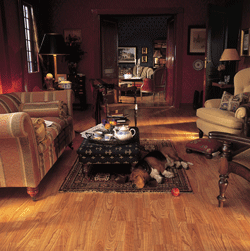
There’s a certain hierarchy inherent in outfitting a new home. When all those materials and products are ranked in order of impact, flooring is up near the top in consumers’ minds. According to a recent Big Builder study, flooring is the upgrade builders concentrate on the most. And rightly so. What’s on the floor must not only hold up to years of foot traffic, but it sets the tone of a house’s interior. The choice of flooring represents a sensory experience for buyers as well, whether it’s a glossy hardwood, the smooth coolness of ceramic tile in a hot climate, or the luxurious feel of plush pile on bare toes.
Brian Hutt, director of design studios for the Lennar Family of Builders, in Houston, says flooring is one of the company’s hot sellers, right behind structural options such as third garage bays and cabinetry. “Flooring is the second thing discussed, after cabinets,” he says. “We talk about how the whole palette will flow together in the home. We may offer four choices of light fixtures, but there are hundreds of samples of carpet colors and styles. And there continue to be innovations in all the products.”
U.S. Home’s design center in Phoenix is doubling its flooring display space to accommodate more sales consultants and expand its selection of natural stone. “Flooring is where the money volume is,” says Chris Swiss, manager of the design studio, which outfits homes ranging in price from $100,000 to $500,000.
Overwhelmingly, its buyers are upgrading to ceramic tile–92 percent, according to Swiss. Entry-level buyers typically take the first of 10 tile upgrade options the builder offers, at $5.50 a square foot, swapping tile out for vinyl in only the wet areas. Higher-end customers, however, go for 20-inch porcelain tiles, which cost $13 a square foot, and expand into major corridors and family rooms.
In New Jersey, it’s wood that’s gaining ground. “About 70 percent of our buyers upgrade to some type of flooring, and wood is leading,” says LuAnn Dunkinson, design studio manager for U.S. Home’s division in Freehold, a move-up, luxury, and active-adult market where the builder’s homes sell for $270,000 to $900,000. In the past three years, the design center has added exotic woods such as sakura and kempas to its standard line of oak. “The rustic look is big now,” she adds. “Distressed oak is doing very well.”
At Crosswinds Communities, in Novi, Mich., 75 percent of buyers in the move-up and luxury markets choose the one wood upgrade the company offers instead of carpet in the living room. And in the move-up segment, a strong second is Armstrong’s Urban Settings line of vinyl flooring, used primarily in the kitchen. “It has industrial-looking patterns that appeal to our buyers in metropolitan areas,” says Colette Scholten, vice president of sales and marketing at Crosswinds. Buyers shell out about $8 per square foot, the same as for hardwood.
Builders are rolling out the red carpet for flooring products, tweaking layouts, and expanding the choices to entice more buyers. “We’ve made that portion of our design center one of the largest, with the goal that we’ll be able to offer the latest technologies and trends,” says Christine Robbins, senior design center consultant at Davis Homes’ Custom Design Centre, in Indianapolis. Two years ago, it began offering a wood laminate floor by Alloc, based in Racine, Wis., that has caught on with buyers. It features an aluminum blocking system that prevents joints from shifting and protects against wear and water damage. At a dollar or two less per square foot than real wood, it’s a good substitute because most of the company’s homes are built on slab foundations, which preclude the use of nailed-down hardwood.
Wall-to-wall carpet, once associated with the 1960s and ’70s, is rolling back onto the design scene. Its virtues–comfort underfoot and good soundproofing–combined with today’s softer fibers and better performance, make it fashionable for bedrooms as well as show-off rooms. Last summer, Davis Homes changed its displays to make it easier for buyers to see the offerings and remove each sample from its mount to feel it and carry it around to pair with other items and view in different kinds of light. One of its hottest sellers is Shaw’s frieze-style carpet, a short shag that hides traffic and vacuum patterns.
Flooring innovations
The new softness of today’s carpet is helping to secure its future. Mark Tucker, national builder sales manager at Shaw Industries, in Dalton, Ga., says that a few years ago, the fear was that a soft product would wear out. “With today’s technology, they perform as well as the traditional fiber,” he says. “It started with Tactesse from DuPont. We have our own version called Ever Touch. Softness is certainly the hottest new trend. And patterns and different looks continue to be in vogue.”
“We tripled our demand forecast with retailers in the first three months,” Cubell says. “And we’re getting great feedback as we talk to builders. Their ability to sell a trade-up is very easy. We may include more tumbled marble looks and decorative visuals so people are willing to trade up, just like they do with real tile,” he says.
The manufacturer recently introduced 5-ply engineered wood floors in 3-inch and 5-inch widths and half-dozen colors. Product manager Dick Quinlan says the boards, which have a smooth, furniture-like finish, are more stable than solid wood and can be glued or stapled in place.
* Carpet: Five upgrades ranging from $900 to $3,315 (supplied by Shaw Industries). Each upgrade package includes a choice of saxony plush, textured plush, and berber, plus a frieze in the highest-level upgrade. With each upgrade, the weight, density, and number of twists increase, packing more fiber into the carpet and resisting wear.
* Vinyl: Three upgrades ranging from $690 to $2,500 (supplied by Armstrong). Upgrades add thickness, stain and wear resistance, more patterns and textures, and up to 10 years limited warranty against rips and gouges.
* Wood/Wood Laminate: Various packages (hardwood supplied by Robbins Hardwood and Armstrong; wood laminate supplied by Alloc). Buyers pay approximately $6,000 to replace all vinyl areas with hardwood. Two upgrades for wood laminate range from $3,975 to $5,000.
* Ceramic Tile: Various packages (supplied by Dal Tile). Offers include 8-inch-by-8 inch tiles: $5,675 to upgrade from vinyl in all standard areas; and 12-inch-by-12 inch tiles: $7,025 to upgrade.
Learn more about markets featured in this article: Phoenix, AZ.