When Mattamy Homes president Dan Grosswald first toured the 3,400-acre site in northern Martin County, Fla., he saw more than farmland and pine woods. He saw the chance to prove that wellness and sustainability could be the foundation of a profitable master-planned community.
That vision became Newfield, a decade-long buildout that blends a traditional neighborhood development (TND) town center with a 170-acre working farm and nearly 2,000 acres of preserved land. For Grosswald and his Southeast Florida team, it’s not just a project—it’s a new operating model for how large-scale, health-driven development can coexist with local skepticism and strict land-use codes.
Listen to the podcast here.
From farmland to form-based code

The property’s history runs deep. Once part of the Kiplinger family holdings—the same Kiplinger known for its financial newsletter—the land had been farmed and logged for nearly a century. Family patriarch Knight Kiplinger had long championed a TND vision for the site, spending years lobbying neighbors and county officials.
“Martin County hadn’t approved a major master plan since the 1980s,” Grosswald told Zonda’s Inspirational Leadership podcast with Zonda Advisory principal Mollie Carmichael. “It’s very ‘no-growth.’ But Knight got everyone talking about what smart growth could look like.”
In 2017 the county approved a form-based code—a major policy shift that opened the door for development. After another builder failed to move forward, Kiplinger turned to Mattamy. Grosswald kept Kiplinger on as an adviser and retained his original planning team—Marcela Camblor and Dover, Kohl & Partners—to ensure continuity.
That continuity, he said, was critical: “We weren’t just buying land. We were buying a vision people already trusted.”
Three pillars of planning—and marketing
Mattamy structured Newfield around three core pillars that now define its design, brand, and sales message:
- The Preserve – Nearly 2,000 acres of open space and trails set aside in perpetuity, including a 50-acre gopher tortoise preserve approved by Florida Fish and Wildlife.
- The Farm – 170 acres of active agriculture with cattle, community gardens, and a CSA membership model offering produce baskets and a U-pick strawberry field.
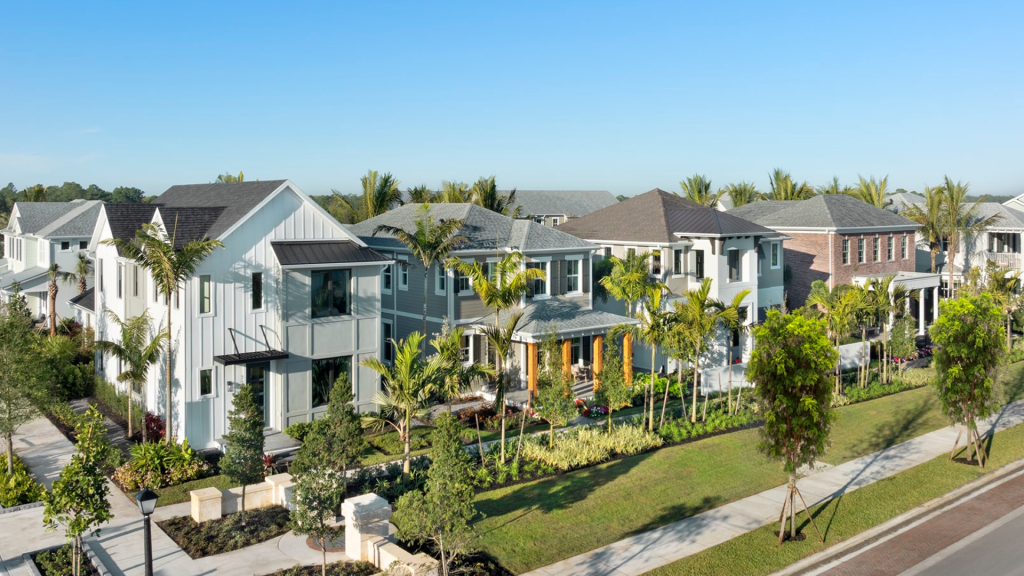
- The TND Core – A walkable town center, workplace district, and interconnected neighborhoods with alleys, pocket parks, and two school sites.
Each pillar carries its own sub-brand and marketing narrative centered on well-being and connection to nature.
Activation before construction
Instead of leading with rooftops, Mattamy led with activation. The team built the first trailhead and opened a small portion of the farm long before houses or roads were finished.
“We started farmers markets, concerts, even ‘meet-the-farmer’ events,” Grosswald said. “People could see we were keeping promises.”
The strategy paid off. County commissioners began attending community events, local nonprofits got involved, and once-skeptical officials became supporters. “When we go for approvals now, the votes are often unanimous,” Grosswald noted.
Financing community through a CDD
A Community Development District (CDD) funds much of Newfield’s infrastructure and amenity operations. Homeowners and local businesses pay assessments that support the farm, trails, and preserves. Revenue from farm sales and CSA memberships helps offset costs.
“The goal isn’t profit—it’s break-even,” Grosswald said. “The value is in the lifestyle. People pay premiums to live near the farm or a park.”
Those premiums are tangible. Homes fronting the farm command 20%–25% higher prices, and lots near trails or parks sell fastest.
Who’s buying—and what’s selling
So far, roughly 112 homes have sold since late 2023, with about 50 families already living on-site. The first of nine planned villages is 20% complete. Average selling prices hover around $750,000, higher than expected for Martin County.
“Eighty to eighty-five percent of buyers are families,” Grosswald said. “We thought we’d see more retirees, but the demand for larger, higher-end homes surprised us.”
Mattamy is learning quickly from buyer feedback: one-story plans are in high demand, alley layouts need longer driveways, and the division plans to refine its extensive 45-plan lineup to avoid overwhelming consumers.
Building for resilience and sustainability
Sustainability is one of Mattamy’s corporate cornerstones, and Newfield reflects it in both infrastructure and homes. The community uses pervious pavers, rain gardens, and low-carbon concrete, with building envelopes tightened for better energy performance.
A community app handles CSA pickups, clubhouse access, and bike-share rentals. The bike share—electric, app-based, and free for residents for the first hour—is funded through the CDD.
In a hurricane-prone state, durability is equally central. Homes are built to 180-mph wind standards with impact windows and reinforced concrete block walls. “It’s essentially commercial-grade construction,” Grosswald said.
Art, activation, and legacy
Public art weaves through the plan, from murals on mail kiosks to a future centerpiece sculpture in the town square. A 48-acre Central Park will anchor the community, while a repurposed barn near the farm doubles as an event venue and agricultural hub.
For Grosswald, Newfield’s legacy will go beyond its amenities. “It’s a model for how public and private can work together to build something sustainable, functional, and beautiful,” he said. “How many builders would take 3,400 acres and give away 2,000 of them as preserve?”
The project, he believes, will stand as a blueprint for the next generation of master-planned communities. “Maybe everything’s not perfect,” he said, “but it’s a community people will study for years—and one I’ll be proud to drive through 20 years from now.”