Seeing is believing.
A 2,700 square foot custom “idea” home, from bare slab to top plate level, ready for roof trusses at the first crack of dawn on the third day of construction–48 hours after site work began–is proof that one of housing’s biggest challenges, skilled labor, is solvable.
An Inspirada owner-to-be stopped by the KB Home model center in Henderson, Nev.’s Inspirada masterplannned community to check on the progress of his new home there, where he plans to move in later this year.
His remark, as he saw the velocity and precision at work on the KB Home Projekt, which will unveil to the public in January 2019 as a fully-realized house of a future centered on health, well-being, energy- and water-efficiency and performance, and connectivity to place, people, and prosperity, was simply this:
“Why isn’t my home being built that way?
How KB Home ProjeKt is built–using technology that flows design, engineering, materials and data into a construction system whose process resembles that of manufactured durable products–is a big part of its story.
Its story is about bringing people new homes and communities that are built to perform an ever more important role in their well-being and health, their safety, their ability to prosper, and their desire to connect to others, to nature, to resources of any kind.
And, importantly, to do produce these homes at prices that they can manage to pay, which, everybody knows, is hard to do these days, and getting harder.
Household finance and housing economics are–these days, to an increasing degree–at risk of parting ways, as cost and price inflation runs ahead of wage and income growth. Innovation, on the ground and not just talk in conferences and consultancies, is one of the only known ways to restore a balance between the two, what it costs to build and the price a household can and will pay to own.
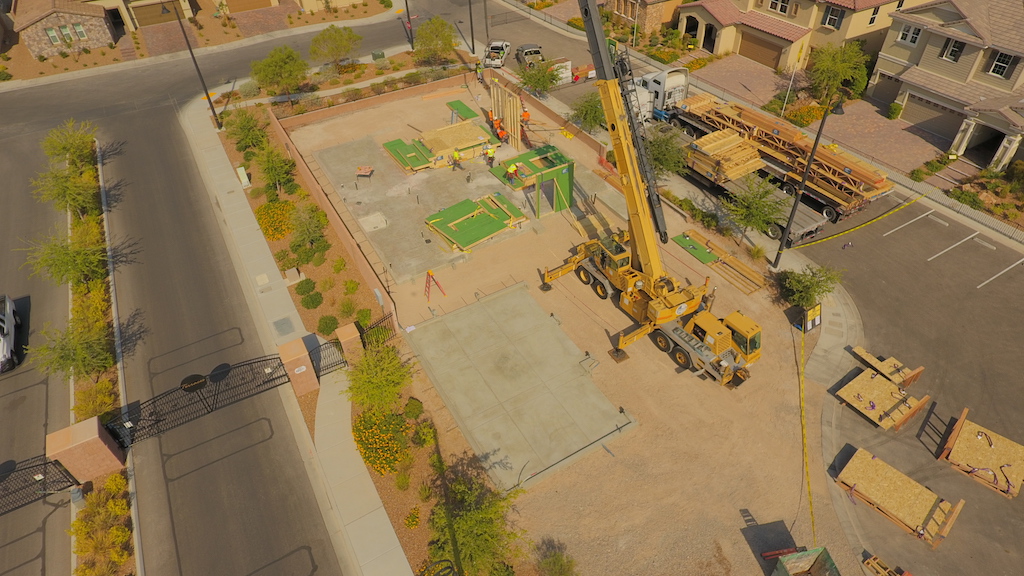
This is why how KB Home Projekt is built matters. The fact that the home started here Monday morning at 7 am, Las Vegas time, as Entekra team members William Kilpatrick and Patrick McErlain checked its level and smoothness, and that tie-down connection and penetration areas were precise. Here’s the “before” picture:
DCIM100MEDIADJI_0005.JPG
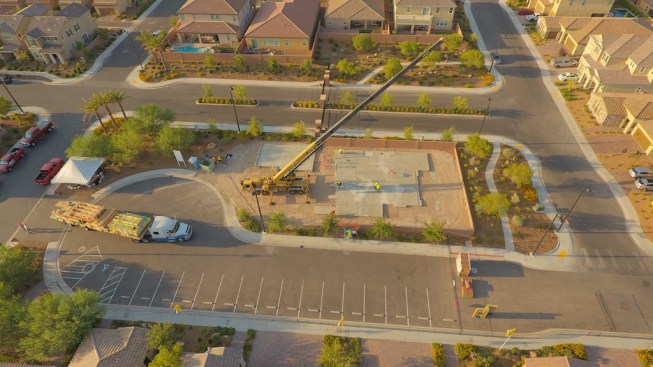
And then looked like this on Monday evening at 6 pm, as crew members set one of Weyerhaeuser’s Timberstrand LSL engineered lumber beams across what will be an indoor-outdoor paradise when complete.
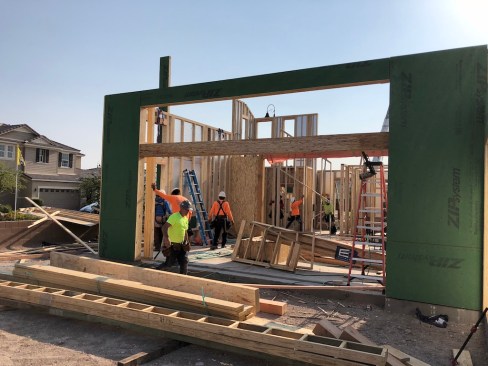
And looked like this on Tuesday evening at 5:45 pm, after the last of the exterior structural members was set in place, and the crew were finishing up the interior wall panels, readying the building for roof truss work on Day 3.
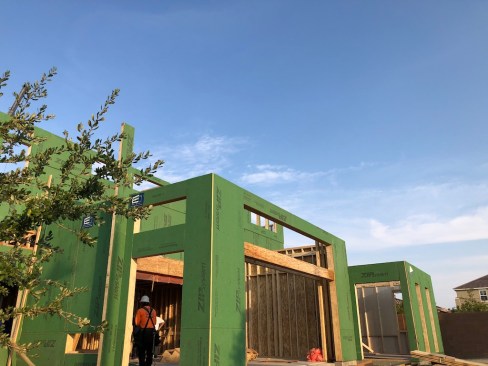
In this 48-hour period, the work accomplished included the LSL Engineered Studs, Huber’s Zip Wall System, pre-installed, and Kingspan 80mm Phenolic pre-fitted insulation, powered by MiTek collaborative software and connection systems, as done by a maximum of five crew members, a crane operator, and a whole village of team members in support, in 108-degree Las Vegas temperatures. The KB Home Las Vegas division team, top down, rocked their roles as game-changers when it counted most.
Here’s what reaching “plate level” in 48 hours begins to mean when you factor in both the upstream and downstream benefits of the process that begins with an integrated approach to the architecture, engineering, and construction of homes and communities.

Thoughts from Dan Bridleman, senior VP for sustainability, technology, and strategic sourcing, and chief product officer at KB Home, note the fact that calculations on a single, per-house basis, builders could not make offsite factory production work as a business model.
But, when a high-volume builder such as KB Home begins to perform the calculus across its enterprise, particularly in concentrated geographical markets, the math starts to make a lot of sense. Bridleman notes the following key benefits, based on ball-park estimates that direct costs and labor comprise between 25% and 35% of total expense on each home KB delivers.
- Velocity-related benefits are multi-fold. One is that start-to-completion cycle time velocity speeds inventory turns, reduces the land carry, allows for more sales and the ability to pull more volume through overheads, a major opportunity-cost benefit.
- Purchasing and procurement-related benefits work on multiple levels as well. An integrated-offsite system means that many direct input costs—including framing lumber, the single biggest ticket raw materials item of any new home—would funnel through the factory, which would buy materials directly at scale, saving builders the need to hedge and float commodities investments in hopes of locking prices based on projected volume. Not having to tie financial resources, not to mention inventories of materials like lumber, would be money saved.
- Quality-related benefits would carry a multiplier effect. The cost of on-site mistakes, and the value of right-the-first-time quality saves money not only in labor expense, but in time.
- Waste and materials efficiency-related benefits would allow for optimization of every item of lumber and other materials, with a minimum of loss from cutting and overage, thanks to the precision and flexibility of the factory-based code and cutting machines.
“When you think about, it’s not just getting to plate-level in 48 hours that’s amazing,” says Bridlemen. “What’s amazing is the number of ways things can to change in order to make this process make financial sense. And all of those ways things can change, they need to.”
Stay tuned tomorrow for a Day 3 update, with a focus on some of the “local heroes” on the ground, who sweated it out as KB Projekt got vertical.