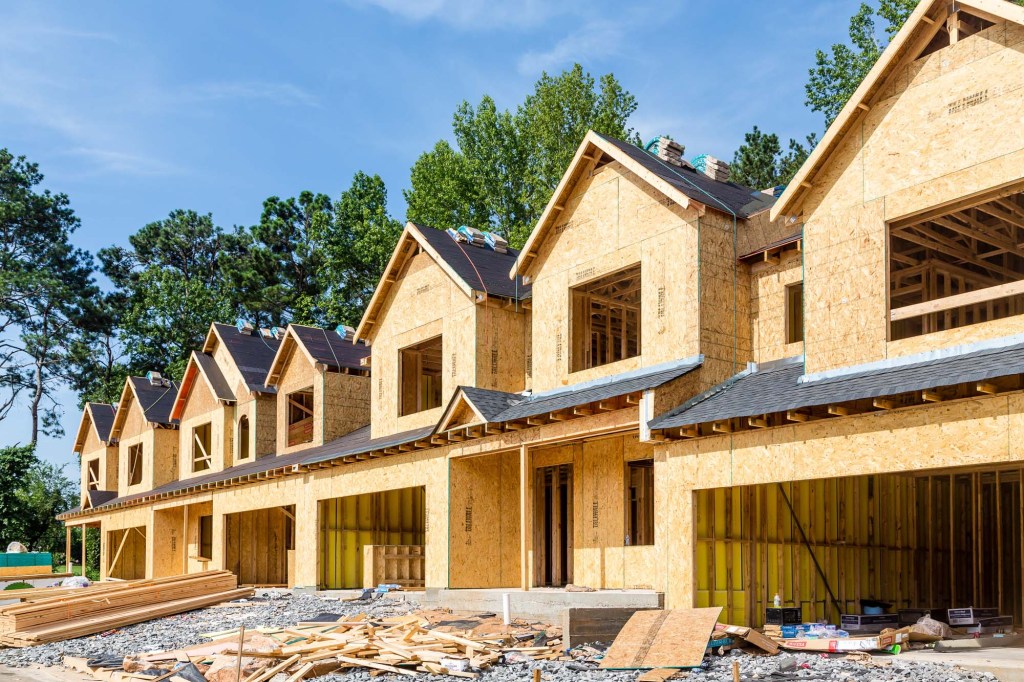
Builders, reckoning with selective weakness in price- and interest-rate sensitive segments of their business, are amping up the precision of their product offerings on price and value, and de-focusing on segments that have come up a bit lame of late.
One builder we chatted with last week has started to “check up” on price increases that ran dollar-for-dollar with cost-base spikes due to tariffs and other supply-related expense forces.
“We’ve encountered some price-raise fatigue, and now that interest rates are going up, we’re going to have to stop trying to pass along all our cost hikes to buyers, and find ways to protect our margins some other way,” the president of one of the nation’s top 20 privately held regional builders told me.
A tactic he was willing to share with other builders came out as we talked. He noted that the sudden weakness–where the sensitivity on price increases and the recent upward drift in interest rates lies–is in the middle of his product spectrum, from a lot size and home square footage standpoint.
“The very-large, quarter-acre or larger lot sizes with big homes are moving fine, and we’re doing well with a new line of much smaller cottages, very densely built, on tiny lots,” this executive said. “We’re finding that the younger home buyer is less concerned about lot size than prior first-time-buyers. It’s that middle range that we’ve seen a fall-off.”
Product offering, location, and price–assuming that the still-rising tide of demand is not one that will raise all ships–are going to need to be more skillfully managed to navigate the next stage of recovery. Many builders have focused redesign and value engineering efforts on the first-time Millennial buyer
This is is where BUILDER sister company Metrostudy excels, aligning product, land, and pricing to get the best absorption pace possible and preserve your margins.
Meanwhile, good news lay somewhat hidden in the latest Census Bureau Housing Vacancy Survey (HVS), whose headline data point showed a statistically insignificant increase in national homeownership rates in the second quarter 2018.
The bright spots in the release focus on household formations, which spiked in Q2, to 121 million vs. 119 million a year earlier, and younger home buyers.
National Association of Home Builders senior economist Na Zhao writes that the household formation “gains were predominantly driven by owner households, while renter households only increased 146,000.”
The data also suggests that major traction in homeownership trends shines through among millennial generation buyers, and in a segment of them you might not expect: 30 to 34 year olds.
According to New Strategist Press editorial director Cheryl Russell, homeownership growth in that age group stood out. Russell writes:
Their homeownership rate rose to 47.9 percent in the second quarter of 2018. This is up from 45.2 percent one year earlier, a statistically significant increase. Before the Great Recession, 30-to-34-year-olds were the nation’s first-time home buyers (the age at which the homeownership rate surpasses 50 percent). But their rate fell below 50 percent in 2011 and has been stuck there ever since. Perhaps this age group is on its way to reclaiming first-time homebuyer status.
This suggests that post-traumatic associations with homeownership in the wake of the decade-ago mortgage meltdown may be fading, and, at the same time, a growing economy has created brighter prospects for those earning their way out of college debt, etc.
Zillow economist Aaron Terrazas also took note of the action among the mid-range Millennial, up to now considered a non-factor in the current recovery. Terrazas writes:
The homeownership rate among those under the age of 35 jumped to 36.5 percent, the highest level since the end of 2013 and up strongly from 35.3 percent a quarter ago and at this time last year.
And remember, when we talk about “rates,” it’s the percentage of that particular age-band that we’re referring to. So, when the rate increases for young adults within the 22 to 37 year old Millennial generational range, it’s a larger universe of absolute individuals than prior generations.
So the homeownership “rate” might be less than what it was for earlier cohorts, but the absolute number of home buyers and household formation among owner households can reflect growth in that much larger pool of potential buyers.
Have a good week.