With so much still in limbo as the Harvey storm system continues to pour rain in buckets down on Houston, our thoughts and prayers are with all of those–and their families and friends–still in harm’s way.
It is still too soon to start talking about impacts and effects, as life and limb are still at such great risk, and the human toll and the human effect are our focus for the moment.
We recall that after Katrina roared into New Orleans almost the exact same dates in 2005, the after-effect on what was then a booming housing market was palpable.
Materials supply capacity, already stretched and strained by the sheer volume of building being done, came undone as needed resources diverted to people in want of basic shelter and baseline survival provisions.
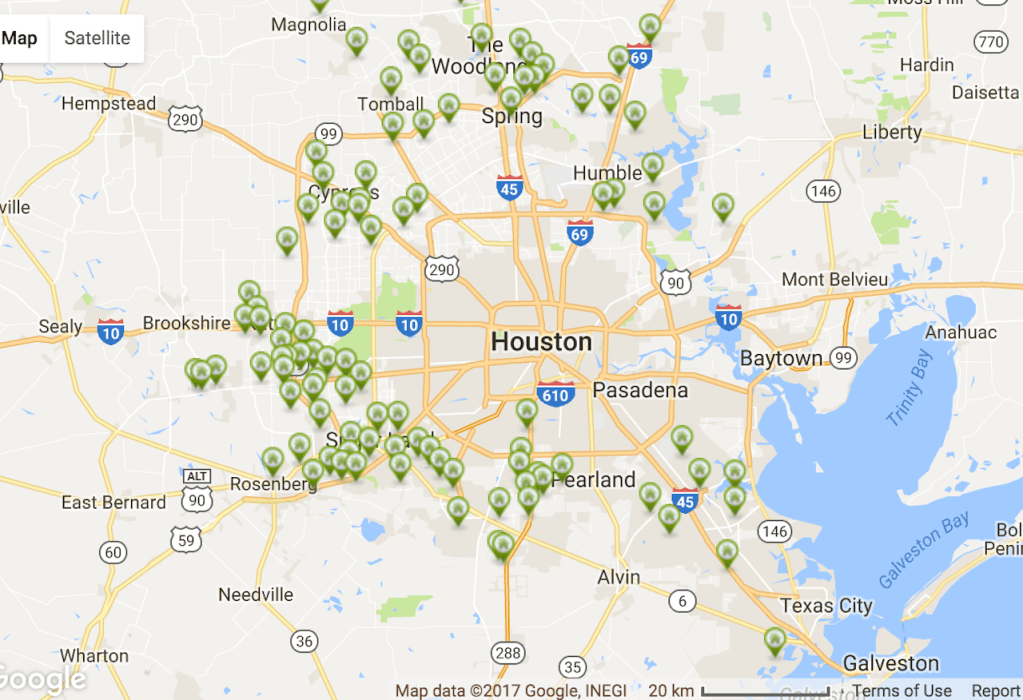
Trying to predict what life and work is going to be like for our home builder, apartment builders and owners, and developer friends in the Houston market–where masterplanned communities gird the market to the north, to the west, and to the south–is a fool’s task.
The important thing for the moment is for the home building and development and housing business community to do all it can to keep supporting health, safety, life and limb in Houston and those surrounding Texas towns and cities still trying to survive each next day.
Here’s a list of resources available to all of us to give what we can for those who are still enduring intense hardship and danger.
Meanwhile, here’s some analysis on near-term after-effects of the hurricane.
Marketwatch correspondent Andrea Riquier quotes BTIG home builder analyst Carl Reichardt on reasons to expect delays in deliveries and suppressed order trends in the market in the months ahead. Particularly worrisome is the dislocation of labor capacity as clean-up and recovery efforts trump new residential construction for the trades. Riquier writes:
Reichardt said. “Clean up and repair in [storm] affected areas will take time and resources that might otherwise be focused on new construction, especially as subcontractor labor is tight.”

Here are several other high-level comments Carl Reichardt shared yesterday with his investor clients on the impact of the storm on home builders’ in the Houston market:
- PresidentTrump has declared 18 south Texas counties as disaster areas, and Texas governor Abbot has named 36 additional counties as state disaster areas as of Sunday. Note that many counties under the state disaster area definition are in the San Antonio MSA. As of our Q2 2017 website count of communities by county for the 11 public builders we cover, the builders with the highest percentage of total store count in these counties are TMHC, KBH, MTH and LGIH, each with over 15% of total company-wide communities in the affected region. NVR has zero exposure to the market; both DHI (despite having what we believe is the region’s largest market share) and TOL have fewer than 5% of their aggregate store counts in these counties.
- The Houston metro new housing market is the nation’s largest by building permits (24,497 single-family permits pulled year-to-date through July), and had been seeing a bit of improvement based on our conversations with a number of builders and commentary on summer conference calls. As oil prices declined during 2014 and 2015, the market was one of the few with significant public builder presence that was suffering relative to the rest of the nation.
Shareholders, of course, took the moment as an opportunity to discount public home builders whose footprint exposure to the Houston market is noteworthy.
Here’s a note from Bloomberg:
The Bloomberg homebuilding index fell as much as 1.9 percent, led by Red Bank, New Jersey-based Hovnanian Enterprises Inc., which has 25 percent of its closings in Houston, according to Bloomberg Intelligence analyst Drew Reading. Hovnanian’s shares were down 5.4 percent at 2:30 p.m. New York time. LGI Homes Inc., Meritage Homes Corp., Beazer Homes USA Inc. and Taylor Morrison Home Corp., which have significant exposure to the market, also were among the worst performers.
It is too soon to predict that Houston, its construction labor force, and home building nationwide will not be able to respond resiliently in the wake of the storm.
Let’s keep our hearts, minds, pocketbooks, and efforts focused on the people who today can only hope to live through the next few days’ challenges. The wake of the storm sounds pretty promising to many who are still in its grip.