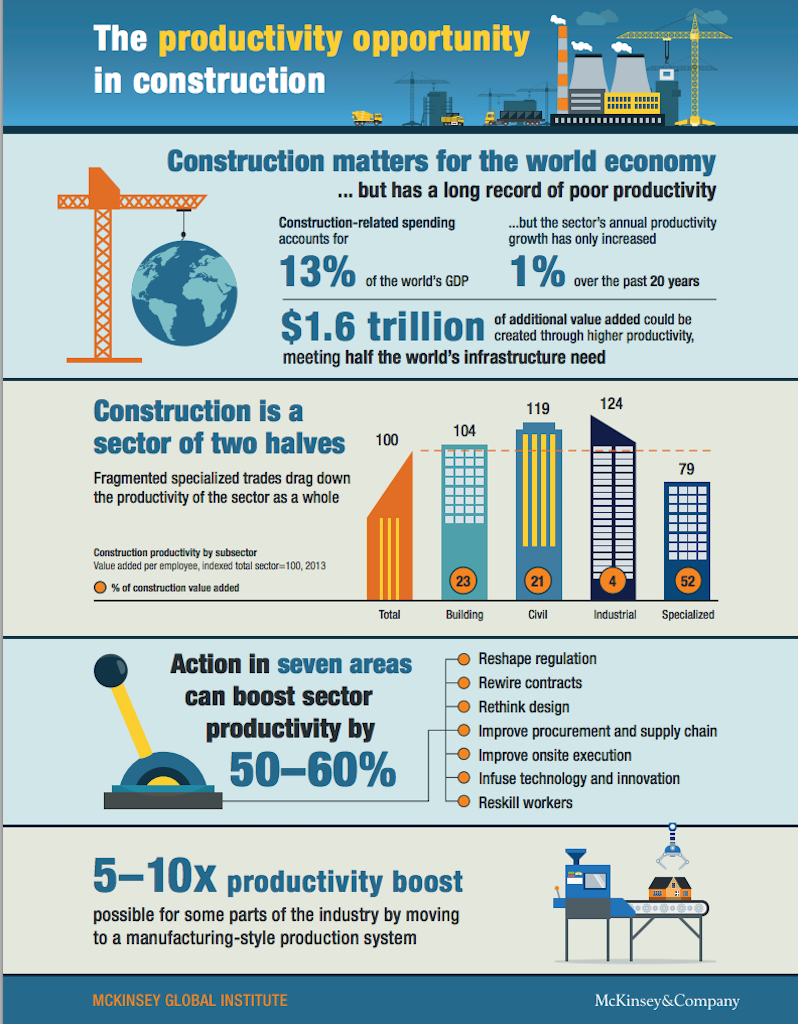
This study, which came out from McKinsey & Company in February of this this year, has gotten a tremendous amount of focus.
As it should.
The analysis zeroes in on “an intractable productivity problem” in the $10 trillion annual construction goods-and-services industry sector, a problem whose solutions might capture as much as $1.6 trillion per year in value boost, and a problem that bedevils housing, from mega-mulitfamily projects to the most miniscule of remodeling or replacement jobs.
This study is one of the reasons there’s so much talk of offsite fabrication processes in the same sentence as labor shortages, and that investment in a growing geographical network of pre-fabrication plants and capabilities may reach a tipping point in the next 12 to 36 months.
McKinsey’s authors might well have credited author and attorney Barry LePatner, whose “Broken Buildings, Busted Budgets: How to Fix America’s Trillion-Dollar Construction Industry,” laid out a pretty strong framework and an identical thesis for the McKinsey study, only LePatner did it a decade earlier.
Here’s a question for you.
First, look at the chart McKinsey analysts cite to illustrate construction’s woeful performance among other industry’s in profitability performance.
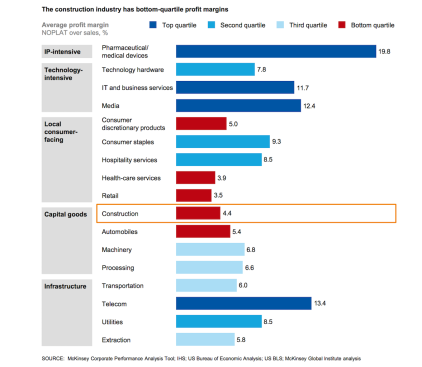
Source: McKinsey
Look, too at the comparison of construction productivity to other sectors since 1950.

Source: McKinsey
What jumps out, apart from the construction industry’s poor performance by comparison is this. There’s really no comparison. How many other business sectors consist of such a complex blend of industries, stakeholders, and bespoke conditions and specific locational issues as construction?
Construction, instead, might better be put on a similar scale to healthcare as a business sector, which as far as we can tell, has also defied progress in terms of productivity.
The point here is not to suggest that construction–including home and community building–isn’t in need of profound change, to take out waste, quality problems, unpredictability, cost overruns, delays, and broken trust.
Still, putting construction up against far less complex industries is a false frame of reference, and it sets impossible standards that are probably paralyzing.
My question to you is this. If you were to pick three industries that have the most to offer in terms of a path forward toward greater productivity, which three would you pick?
To aid in your thinking, why don’t we use the 27 industries Fortune uses as the basis of reference for its 100 Fastest Growing Companies list (By the way, big congratulations to Century Communities (26) and TRI Pointe Group (85) for making the 2017 list)?
Here’s that:
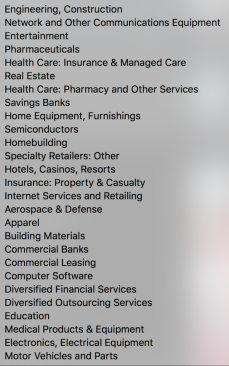
Source: Fortune 100 Fastest-Growing Companies list
Now, use the comments box below to tell me which industries serve as the 3 best examples of how housing construction can make progress on the productivity and profitability front.
If you provide a short explanation for why you choose the three you choose, it would be more helpful.
For instance, you might pick:
- Motor vehicles & parts: Why? Blend of personalization and scalability, due to combo of automation and consumer research.
- Internet services & retailing: Why? Use of big data to drive purchase behavior.
- Hotels, Casinos, Resorts: Why? Best of breed in one-to-one customer care.
Your turn below in the comments box.