No two millennials are alike, but floor plans need to be. So how can housing serve this population that will dominate the housing market in the next five years? Now that many millennials are established in jobs and forming families, their housing needs are reaching critical mass.
As lot prices increase and builders are building larger homes on the land to justify the prices, there is a gap between what this demographic needs and available inventory. As Mark Boud, chief economist at Metrostudy, pointed out during a session at the International Builders’ Show, demand is not weakening, but rather the available inventory is a mismatch with what the market demands.
Also contributing to the topic at IBS was Ali Wolf, manager of housing economics for Meyers Research. She reports that there are some affordable markets. Assuming 10% down and 33% of the buyer’s income allocated to housing, millennials can comfortably afford homes in cities like Houston, Austin, Cincinnati, and Orlando.
Where builders are missing the target for affordability is in markets such as Los Angeles and Denver. People actually are leaving those cities to find affordable property. Here you can see the millennial population growth in some cities nationwide.
| City | Millennial population growth from 2005-2015 |
| Charlotte | 31% |
| Houston | 17% |
| Austin | 16% |
| Seattle | 15% |
| Omaha | 14% |
| Nashville | 14% |
| Indianapolis | 13% |
| Tulsa | 11% |
| Orlando | 11% |
| Columbus | 10% |
Penny Arensdorf, vice president, consumer segmentation at Metrostudy, identifies three reasons why millennials are buying: they are moving up, they are starting families, and, finally, because they are savvy investors. Wolf agrees that as millennials have children they will make the move to homeownership; she reports that 74% of millennials with kids own and 26% continue to rent.
If they aren’t buying, here are the top reasons, according to Wolf:
| Top Reasons Buyers Are Not Buying |
|
| Can’t afford | 19% |
| Don’t know what city to settle down in | 17% |
| I can’t afford in the location I like | 15% |
| Student debt | 13% |
| No down payment | 11% |
But how long will it take them to start purchasing? Your strategy may depend on their change of heart. Wolf predicts that 30% of millennials will be ready to purchase in one to three years, and that 25% more will be purchasing in three to five years.
Millennials Time to Purchase | |
| 1-3 years | 30% |
| 3-5 years | 25% |
Taking stock of what they will be searching for, Wolf asked them if they would prefer a new or an existing home. She found that 39% are not likely to buy new, 29% are indifferent, and only 8% exclusively want new.
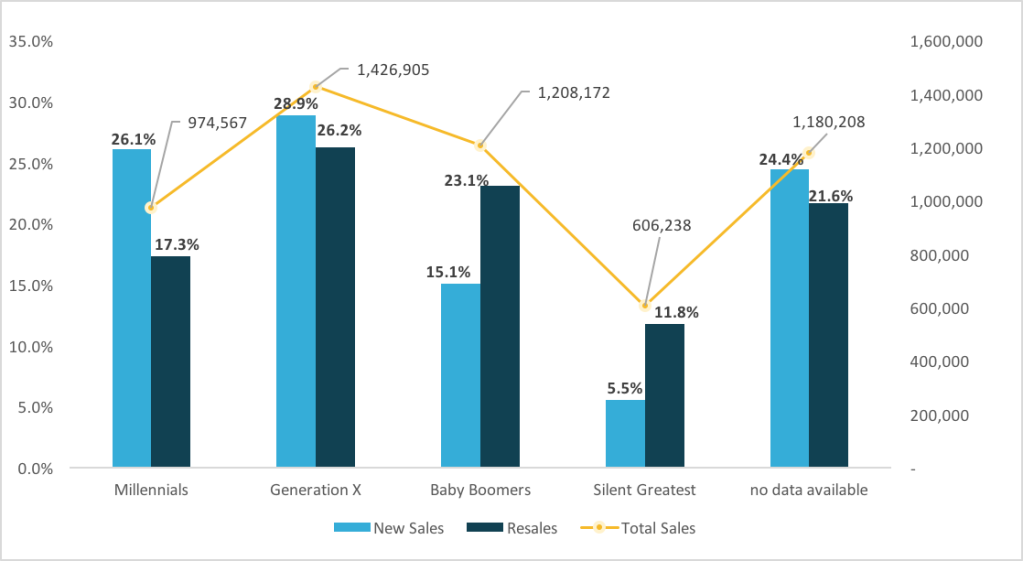
Here’s Metrostudy’s take on their share of the market in the coming years, which shows that millennials will come close to overcoming Generation X in terms of new-home sales. Plus, they will capture more than 17% of resales. Jonathan Dienhart, director, custom services and published research at Metrostudy, comes close to Wolf’s number by saying in 5 years, Millennials could account for as much as 46% of all new home buyers, standing for an estimated 1.7 million new home sales.
“If their share of resale activity continues, and we see an existing home sales rate of about 5 million units per year, the next 5 years could mean as many as 5.7 millennials buying resale homes,” Dienhart calculated. “Combined, that’s 7.4 million reasons to get to know this nascent home buying generation.”
Some millennials have been renting for years, living in developments with over-the-top, resort-style amenities that make it difficult to compete as a home builder. Telling these millennials to buy a home that they have to maintain that doesn’t offer granite countertops, a pet sitting service, and a 24-hour fitness center, can be a slap in the face.
But how do millennials really feel? Watch this panel that Paige Shipp, regional director, Dallas-Fort Worth for Metrostudy, hosted with four real-world millennials. Their insights prove the data from Meyers is right—that owning a home isn’t a necessity. But if it offers the right conveniences and fits into their lifestyle, then it will be an objective.
That said, is there a formula for activating this group of buyers? Arensdorf dissected the steps you should take to understand and market to this demographic. She advises starting by a informal interview of current millennial home buyers, which may even be some internal colleagues.
Another great resource is to follow your competitors to see how they are talking to millennials, especially the ones that have been successful. Wolf points out Dream Finders Homes in Florida, Texas, and Colorado; T Select by Toll Brothers, in Texas; and Express Homes by D.R. Horton as the benchmarks.
Arensdorf says that when millennials think about location, it’s a formula of like-minded diversity, areas to gather, and integration of social events, fitness, and fun. Fitness is a part of the millennial lifestyle more so than any other generation in the past. She also takes a look at their preferred home amenities, which include a right-sized house with an open floor plan containing a large well-equipped kitchen, no formal dining room, hardwood floors, integrated technology including powerful WiFi, energy-efficient features, and, in general, low-maintenance living.
Another very important fact is that millennials love to learn, which can certainly work to your advantage with the right plan and execution. You should take the time to teach them:
- how affordable homeownership can be;
- what qualifications are required to purchase a home;
- the value of a new home over a used home; and
- the value of homeownership as an investment.
Arensdorf shared that on average millennials can’t go 3 minutes without checking their smart devices, so that is the place to reach them. They spend 35 hours per week consuming media digitally, so your company should have the right presence on this stage. Any online information should direct them to your website, which must be optimized for mobile. It should be fast, easy to find, and include lots of images and videos. When deciding on a purchase, this group uses videos 70% of the time, Arensdorf states.
Your social strategy needs to get personal in a big way. Your social team should create a profile for every community, which may be time consuming but it is important to these buyers. Any sort of personalization is meaningful to them, and if you happen to find a brand ambassador online, talk to them and leverage their social content.
Regardless of where you are, millennials will be capturing a larger share of the housing market going forward. How are you going to prepare?