3D printing is no longer a novelty for the building and construction industry, which is using the technology to produce customized niche parts, enhance design flexibility, and save on construction time and cost, according to Lux Research.
3D printing is transforming a wide range of products from aerospace to consumer goods and now homes and other buildings are becoming part of the portfolio, says Jerrold Wang, Lux research associate and lead author of the report titled, “Exploring the Opportunity for 3D Printing in Building and Construction.” Builders face challenges to adopting the technology — such as developing the appropriate materials and meeting building codes — but can also explore 3D printing’s opportunities to save construction time and enable design flexibility, he says.
This report summarizes the ongoing activities of the leading companies in construction value chain in 3D printing. It also identifies 25 small innovative companies and provides a framework for large corporations to identify most suitable partners among these. Finally, the report evaluates the maturity of 3D printing technologies for different building applications, and advises clients on how to tweak their collaboration strategy based on the application and the partner company. Among its findings:
- Printer/ink innovators rank high. Of the 13 companies Lux Research evaluated in structural components, the top five were all developing printer and ink technology, and rank high in “technology originality.” Partnerships, like Contour Crafting’s pilot project with NASA, are also critical.
- Only two firms make the cut in non-structural components. Of the 12 candidates Lux Research evaluated in this segment, most were found weak in technology originality or at a very early stage in commercialization. Only two — LUXeXcel and Solaveil — possessed proprietary technologies as well as established products, partners and external funding.
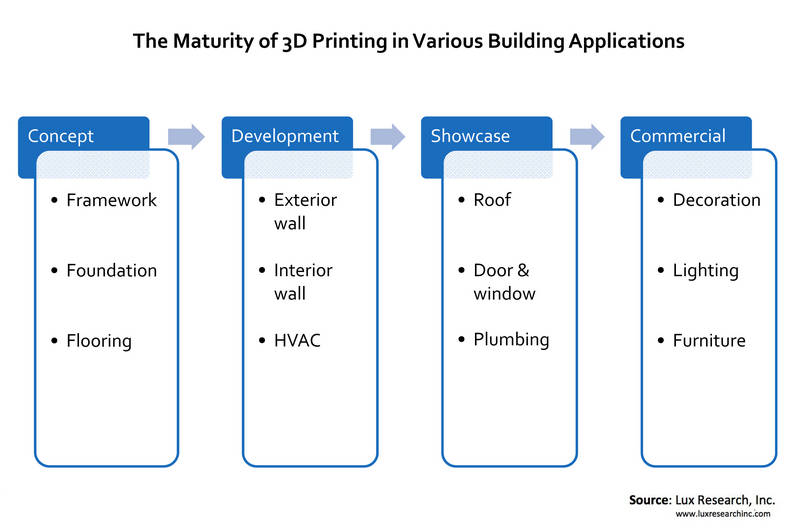
- Three building applications are most mature. Lux Research evaluated the maturity of 12 building application areas for 3D printing, using three criteria: desire for design flexibility, requirement for product accuracy, and material diversification. Only three areas — decoration, lighting, and furniture — were found commercially mature.
RELATED:
Ready to Learn 3D Printing?