Celebration Green Design & Build’s Waystone Farm project is competing in Energize Connecticut’s 2016 Zero Energy Challenge. This series follows the project through its construction process to meet the Challenge’s Jan. 31 deadline.
The Waystone Farm home will utilize Passive Home building principles to help it achieve net zero energy usage. The project team decided to use these principals because “homes built to Passive Home standards are extremely energy efficient, using 80 to 90 percent less energy, which reduces renewable technology demand,” says Bill Freeman, owner of Celebration.
A significant difference between a Passive House (PH)-inspired, zero energy home and a standard home is that a PH-inspired, zero energy house works as one system to achieve the goal of using approximately 90 percent less energy than a standard home. This difference in design and construction methods is inspired by the idea of “maximizing gains to minimize loses,” and begins with the home’s building envelope.
Most standard homes utilize framing methods devised in the 1940s: 2×4 studs, spaced 16” on center, with fiberglass insulation. In this wall assembly, studs compromise the envelope because they act as a thermal bridge, allowing heat to leak through the walls resulting in higher energy consumption, cost and less comfort for the homeowner.
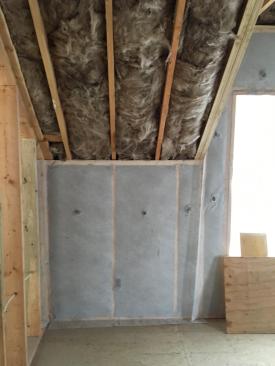
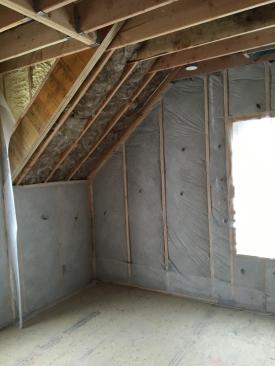
For Waystone Farm, Celebration Green Design & Build utilized thermal bridge-free double-wall construction, a 2×4 exterior wall coupled with a 2×4 interior wall, with a 5” gap between the two studs to minimize the heat transfer. To insulate the wall cavity, Celebration used a combination of 2” closed cell spray foam, which provides a high R-value per inch as well as excellent air sealing, followed by 10” of dense pack cellulose to achieve an R-value of 49.
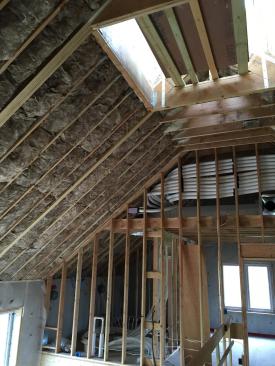
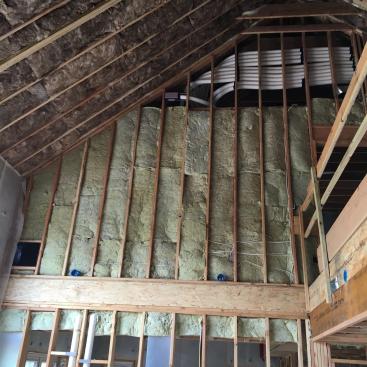
Project planners employed other combinations of closed cell spray foam and high-performance insulation as well. Since the homeowners wanted a root cellar in their basement, 9 1/2” TJI trusses spaced 16″ on center were used for the 1st floor to create a thermal barrier and insulated with 3” closed cell spray foam and R-23 fireproof mineral wool to achieve an R-value of 44. For the roof, the builder used 2 x 12” rafters spaced 16″ on center and insulated them with 3” closed cell spray foam and R-30 high-density fiberglass batts to achieve R-51.
“Regardless of how you heat or cool your home, the goal is to save 100% of the energy you create. When you start with an airtight building envelope and combine that with the relatively low cost of insulation, you can achieve tremendous energy efficiency and superb comfort,” says Freeman.