The McMansion phenomenon paved the path of home building in the U.S. for many decades, and it now leaves the nation in an unbalanced situation.
Today, the housing market needs innovation that addresses profit for builders and housing demand for buyers at all income levels. Jeff Handlin, president at Oread Capital and Development, studies the effects that suburbanization is having on certain markets, specifically in Denver.
“All we are doing is providing housing, and to do that we have to figure out where demand is manifested,” Handlin says. “That’s in lower home prices. So, how do you get to lower price points? You can choose to sell in the exurbs or you can say that you have to be more dense.”
The bottom line, says Handlin, is that suburbanization is born strictly out of economics.
With increasing housing demand and construction costs going up, there is more and more pressure to find affordable solutions. Land prices are becoming more formidable as well and builders have to take the same pieces of land in the right school district and the right utility district and slice it into smaller and smaller pieces.
“Densification in 2005 was due to land prices,” Handlin says. “Today, the pressure is from materials.”
The supply situation is different today than in 2005 because builders and developers are more constrained on what they want to densify. Most are only striking at opportunities that are located in an inner ring suburb or close to a strong job core. He points to the practice of creating surban neighborhoods, or first ring suburbs that are urbanizing.
Surban is a term trademarked by John Burns Real Estate Consulting Group, and it’s described by John Burns below:
Seemingly everywhere we go we see the wave of future growth, a blend of suburban and urban. We call it surban living. Urban areas abound with vibrant restaurants, public transportation, and plenty to do. But urban rents and home prices cut deeply into resident incomes. Urban schools tend to rank low, and crime tends to rank high. For all of these reasons, families tend to move to the suburbs.
Mature suburban areas took note of urban revitalization. City leaders redeveloped their downtowns or zoned an area for a vibrant mix of retail, housing, and sometimes jobs. Urban planners call these areas “mixed use,” but surban better describes the mix of urban and suburban living.
In an article on MarketWatch from December 2016, the firm describes the popularity of this concept:
“These developments are more than simply mixed-use,” said Danielle Leach, a senior consultant at John Burns Real Estate Consulting in Chicago, who as a single mom lives in such a community in St. Charles, Ill., with two teen boys. “Surban living is becoming a new way of life for many: where the blend of urban and suburban living provides the best of both worlds,” she said. With surban living, it’s possible to walk to work, like in a city, as well as enjoy pedestrian access to groceries, entertainment and youth- and sport-friendly parks—plus reliably strong public schools.
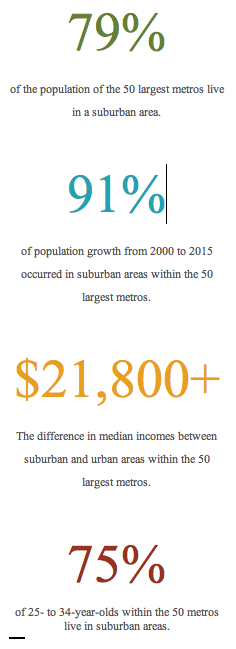
John Burns Consulting expects nearly 80% of residential growth to occur in suburban communities over the next 10 years—up from 71% from 2010 to 2015—compared with just 15% for urban areas through 2025. There’s a good case for moving to suburban markets, which are a good, profitable opportunity for builders.
Jeff Handlin will participate on a panel at HIVE with dean James Chung, president of Reach Advisors, to explore how data is being concentrated and assessed to make better, real-world, strategic decisions. Register now to be part of the discussion.
This story appears as it was originally published on our sister site, www.hiveforhousing.com.