Energy Rating Index
With the 2015 IECC comes the introduction of a new Energy Rating Index (ERI). The ERI provides flexibility for builders by allowing them to bring in a third-party rater, such as a Home Energy Rating System Rater (HERS Rater), to give the home a numerical score based on climate zone. Think of the ERI as the miles per gallon (MPG) rating on a car. The ERI allows a simple way for homebuyers to compare the energy efficiency of one house to another. The lower the number, the more energy efficient the home, with zero being a net zero home. On the opposite end, a home with an ERI of 100 is about as efficient as a home built to the 2006 IECC standard.
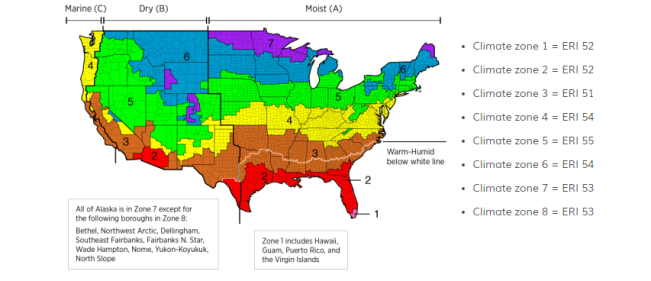
Under the ERI path, each home has a goal number based on the climate zone. (Climate zone map courtesy of the IECC)
The introduction of the ERI will be beneficial to builders because it’s beneficial to buyers, who are often very confused when evaluating the performance and energy efficiency of a home. One concept many consumers can understand is MPG. The higher the number, the better the gas mileage and the more money that stays in your pocket. The ERI will work the same way, only in the opposite direction. The lower the number, the more energy efficient the home and the less money you’re paying to utility companies.
Builders will benefit from this because they now have three compliance paths to choose from: the ERI compliance path, the prescriptive path, and the performance path. If builders choose the ERI path, which includes bringing in a third party rater, such as HERS Rater, then the home they built will receive an ERI score. Choosing this path will not only help a potential buyer understand how energy efficient a home is, but it could increase the likelihood of selling the home quickly.
A Caveat
While the ERI can make home buying decisions simpler, it also has the potential for builders to cut corners. The ERI path of compliance gives credit for installed high efficiency items that aren’t covered in the 2015 IECC. These items, such as solar panels, high efficiency HVAC systems, and appliances can compensate for decreased efficiency in the building envelope.
The ERI option only requires the building envelope of a home meet the 2009 IECC requirements, whereas other IECC compliance paths – the prescriptive path and the performance path – require the building envelope to meet the 2015 IECC requirements. This is where the problem lies. The ERI score could be based primarily on these high-efficiency items instead of the building envelope. When equipment wears out in the future, the homeowner might replace it with lower-efficiency equipment. This means the home would no longer meet the 2015 code as it originally did, but instead meet the 2009 code.
That being said, the ERI goals were set to avoid overall building efficiency issues. As long as those goal numbers aren’t increased in the 2015 code, then homeowners will be protected from unexpectedly high energy bills over the lifetime of their home. This is because a one-point increase in the ERI score means the home will be about one percent less efficient than a home built to the 2015 IECC.
Overall we believe this is a step in the right direction. It gives builders more options and new goals to aim for, and it gives home buyers an easier way to understand the energy efficiency of houses.