When Ethan Wong was growing up in Silicon Valley, his summer plans looked a little different from other kids. While many headed to sports camp, Wong went to science camp. That curiosity followed him through Harvard University, where he initially started a non-engineering path before realizing his passion.
“I was always exposed to tech,” he says. “I was a math nerd. I wanted to see what kind of world-changing technologies people were working on.”
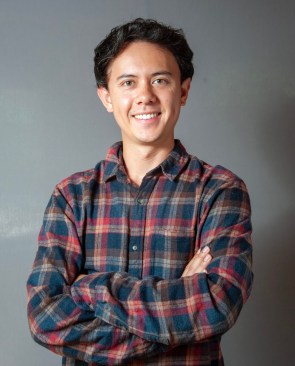
Courtesy of HiveASMBLD
Ethan Wong, inventor and co-CEO of HiveASMBLD
With interest in the world’s biggest problems – energy security, food security, nuclear disarmament – Wong gravitated toward the housing crisis. Wong decided to take time from college and jump into the work. In 2018, he reached out to the few 3D printing companies there were at the time and landed an opportunity with Austin-based ICON.
“The CEO, Jason Ballard, was an amazing salesman for the mission,” Wong says. “He made housing feel like a world-changing problem that could be solved through technology. Hearing him talk about the billions of people who need dignified homes—I was on board.”
The firsthand exposure to 3D printing and its potential gave Wong the push to bring his own ideas to life. After completing his degree, he founded a prefabrication company focused on modular, Lego-like building components that could be used in both traditional and printed construction.
Assembling a Plan
While Wong was working on his business, entrepreneur Tim Lankau was doing the same, experimenting with 3D-printed housing systems. Crossing paths, the two planned a vendor-customer relationship where Wong would sell his prefab panels to Lankau’s printing company, but their collaboration quickly grew into something larger.
“We realized we were trying to solve the same problem from different angles,” says Wong. “Eventually, we just said, ‘Why not merge and build a full system together?’”
Merging ideas, systems, and missions by the end of 2023, HiveASMBLD was officially born in January 2024. In the last nearly two years, co-CEOs Wong and Lankau have been focused on “the hard part.”
“There are plenty of companies that can print a house,” Wong says. “The challenge now is how to do it at scale consistently, cost-effectively, and in a way others can adopt.”
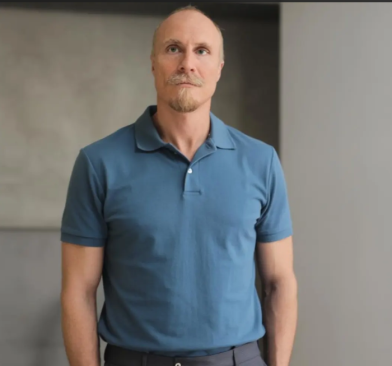
Courtesy of HiveASMBLD
Tim Lankau, founder and co-CEO of HiveASMBLD
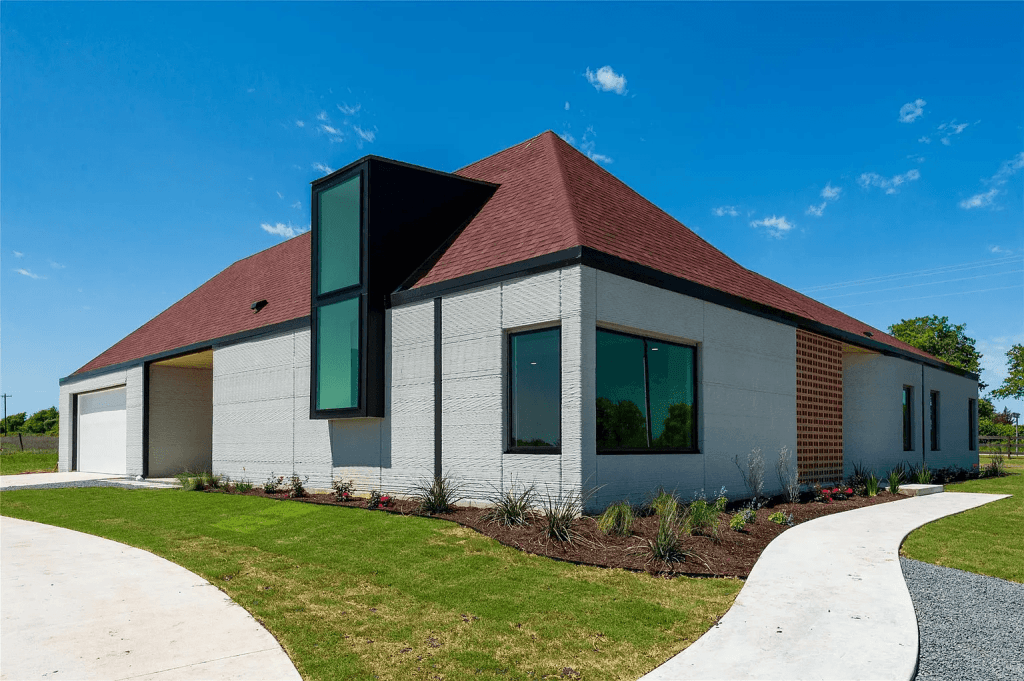
HiveASMBLD homes combine 3D-printed walls with prefabricated roofs and ceilings, allowing for faster, more resilient construction that can be easily replicated and customized with little additional cost. The ‘exterior shell’ HiveASMBLD delivers can be assembled on-site in four to six weeks for a 1,500 to 2,000 square foot home.
While the company has served as both general contractor and subcontractor on various projects, the duo hopes to become a source and teammate for traditional builders, allowing them to focus on finishing interiors.
“It’s the best of both worlds,” Wong says. “Our technology tackles the hardest, most labor-intensive part, and the builder gets to focus on what they do best, which is turning the house into a home.”
Lankau says, “The housing crisis and construction cost crisis are really the same problem. The only real way out is through technology and automation. That’s the path we’re on.”
Courtesy of HiveASMBLD
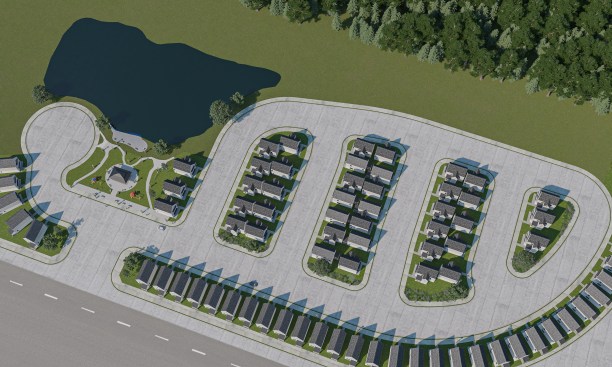
An aerial rendering of Zuri Gardens.
Projects and Partnerships
HiveASMBLD’s largest project is Zuri Gardens, an 80-home community being developed by Cole Klein Development in collaboration with the City of Houston. The 13-acre project, which is celebrating with a ribbon-cutting and the first house printing on November 13, is blending HiveASMBLD’s 3D printing with panelized construction technology supplied by LP Building Solutions and 3D printing materials from partner Eco Material Technologies.
“Eco Materials manufactures the mortar we designed together,” Lankau says. “They’ve been a crucial partner in making this work.”
Mixed on-site, the printing mortar, developed with a proprietary Pozzolanic cement, is carbon-friendly and sets in under 2 minutes to provide both time and cost savings.
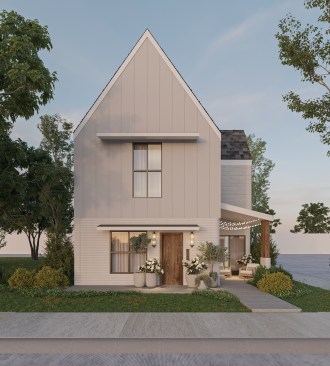
As Houston’s first 3D-printed hybrid home community, the homes will average 1,360 square feet with two bedrooms, two-and-a-half bedrooms, an office/flex space, and a covered patio. All are starting in the mid-$200,000s and will qualify for up to $125,000 in Houston’s down payment assistance, further boosting affordability. Currently, Zuri Gardens has an interest list of 650 people, says Vanessa Cole, co-founder of Cole Klein Builders.
Courtesy of HiveASMBLD
A rendering of a 3D-printed hybrid home at Zuri Gardens.
“HiveASMBLD and Cole Klein Development met around a shared belief that innovation should serve both people and the industry. Together, we saw an opportunity to create 80 3D-printed hybrid homes that are smarter, stronger, and more attainable, blending technology with purpose,” says Cole.
Zuri Gardens’ collaboration has also engaged college and high school students from around the area to design and learn about robotics, material science, and community development firsthand.
“Beyond the technology, Zuri Gardens showcases Houston’s resilience, transforming an area long defined by its challenges, into a hub of opportunity and design excellence,” Cole says. “It’s proof that when public and private sectors work together, we can build housing that uplifts people, strengthens neighborhoods, and sets a new standard for what’s possible in our city.”
Also in Texas, HiveASMBLD is working on Lumen Villas in Marfa, a nine-home community priced about $100,000 below the median for new construction in the area. While not officially “affordable housing,” the Marfa homes are designed to be attainable for locals, bridging the gap between innovation and accessibility.
Wong says, “The desert, the views, the art scene…it’s the perfect place to show what’s possible with modern, organic design.”
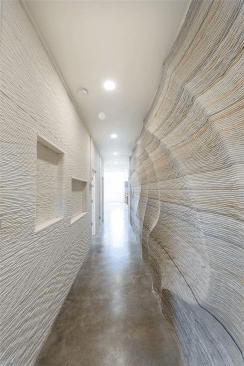
HiveASMBLD can also 3D print showers, kitchen cabinetry, shelving, and more, to maximize savings.
“Since we’re already on-site printing the home, why not print the shower,” Lankau says, as he sits on printed bench they’re testing for Zuri Gardens.
While HiveASMBLD also has several custom homes in the works across Texas, its first out-of-state project is underway. Wong and Lankau have teamed up with Habitat for Humanity, Virginia Tech, and printer manufacturer Tvasta to build five affordable homes in Virginia.
The Virginia homes are just the start of what’s next for tech-driven company.
Courtesy of HiveASMBLD
Scaling the System
At this time last year, HiveASMBLD was working on one house. Lankau believes their rapid growth path and desire to fix the industry’s cost disease are possible.
“There hasn’t been a truly disruptive technology in home building since the circular saw and the nail gun,” he says. “Every other industry has automated, especially manufacturing. Home construction hasn’t and that’s why costs keep going up.”
Wong says the path forward includes learning what traditional builders need in order to make the process smarter and more efficient for everyone involved.
“We’re learning what builders need to make this simple and repeatable. That’s how we scale.”
As the projects multiply across Texas and beyond, Wong and Lankau remain driven by the same mission that initiated their collaboration a few short years ago: to build better, faster, and more affordably using technology.
“The goal is to make housing that’s not just efficient, but accessible, sustainable, and human,” Wong says.