1. Net the Framing Cavities
Netting is stretched tight between…
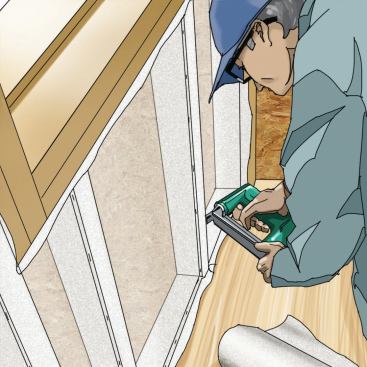
1. Net the Framing Cavities
Netting is stretched tight between framing members to minimize bulging of the cellulose. A pneumatic upholstery stapler—which continuously spits out fasteners as long as the trigger is depressed—speeds the job along but requires an experienced operator.
Harry Whitver
2. Blow the Cellulose
The hose nozzle is inserted into the net…
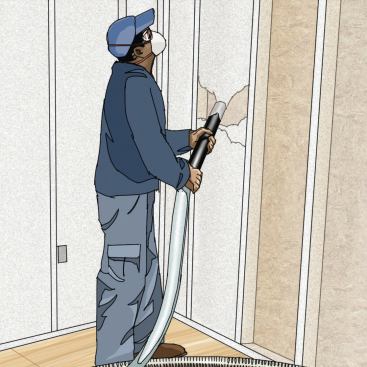
2. Blow the Cellulose
The hose nozzle is inserted into the netting, pushed to the bottom plate, and withdrawn as the cavity is filled. Once the cavity has been filled to the insertion point, the nozzle and hose are pushed to the top plate and
the rest of the cavity is filled from the top back to the middle.
Harry Whitver
3. Flatten the Surface
Take the time to compact the filled cavi…
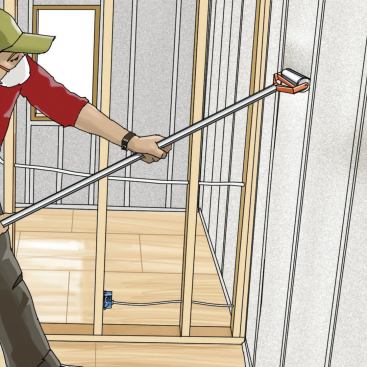
3. Flatten the Surface
Take the time to compact the filled cavities with an aluminum roller. If this step is omitted, any bulging of the netted insulation between studs will put pressure on the drywall, eventually causing the screws to pull through its paper facing. A quick pass of the hand is enough to confirm that the insulation lies flush with the framing.
Harry Whitver
4. Air-Seal Band Joists
Dense-pack is an effective air barrier,…
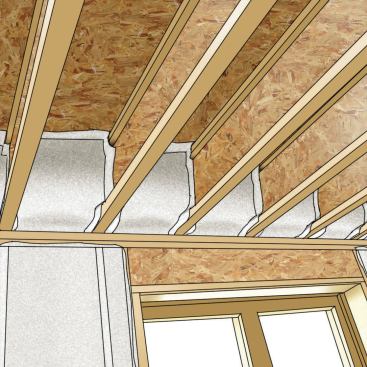
4. Air-Seal Band Joists
Dense-pack is an effective air barrier, and in the hands of a skilled installer it can be successful in areas that might otherwise call for spray foam. Here, netting has been carefully stapled between the joist ends and filled with cellulose to form insulating and air-sealing “pillows.”
Dense-pack cellulose is installed with a powerful truck-mounted blower that mixes the fiber with air and distributes it through a large-diameter hose. The same setup is used to blow loose-fill material into attics, but the technique differs: Instead of allowing the cellulose to pour out of the hose into open space, it’s forced into framing cavities under pressure, resulting in a firm, compact material that can’t settle and is highly resistant to air infiltration.
Some installers try to dense-pack closed cavities that contain existing fiberglass, but I find that this always leaves some voids. In that situation we’ll remove a 2-foot strip of drywall at the bottom or a strip of sheathing on the outside, pull out and discard the batts, and then net the opening before blowing the empty cavities.
Blowing dense-pack cellulose into closed cavities also is slowed by the need to seek out and fill every framing cavity, including oddly shaped or unexpected ones behind blocking or diagonal braces. A light touch is needed because trying to force in too much material in too little time can bow out existing drywall or plaster.
In new construction and gut retrofits, we staple non-woven polyester netting over the entire frame and blow the cellulose behind the netting, making it easy to inspect the material for voids. The permeable netting gives the air in the cavities an easy route of escape, making it possible to fill the cavities quickly.