This headline may have caught your attention the other day, as it did mine.
“Housing Market Labor Shortage Eases — Update.”
The story Tuesday followed a monthly Labor Department data release, the Job Openings and Labor Turnover Survey, which Robert Dietz, chief economist for the National Association of Home Builders tracks carefully as a proxy indicator for how inadequate the supply of skilled construction labor is compared with the demand for it. In this case, the measure of that demand is construction job openings, unfilled positions posted by construction employers. Dietz noted in his brief take on the JOLTS report:
The open position rate (job openings as a percent of total employment) for May came in at 2.2%. On a smoothed twelve-month moving average basis, the open position rate for the construction sector declined to a still elevated level of 2.6%.
The overall trend for open construction jobs has been increasing since the end of the Great Recession. This is consistent with survey data indicating that access to labor remains a top business challenge for builders. However, recent data indicate a slowing in the count of unfilled construction jobs, albeit at levels higher prior to 2016.
The author of the piece under that “… Labor Shortage Eases” headline, the Wall Street Journal’s Laura Kusisto is a pro, and she was digging for a story. Could the drop in job openings be a signal of an overall weakness in the residential market, particularly with a slowdown in newly permitted multifamily construction projects?
Could, as Rob Dietz is quoted as observing in Kusisto’s story, some builders and developers be putting some projects “on hold,” out of frustration, as a concession to the labor squeeze?
It might be noted that many government data reports are prone to noise, especially in month to month time frames.
This piece from The Denver Post staffer Erin Douglas is noteworthy, not only for the fact of the extensiveness and impact of residential construction’s skilled labor shortage both present and predicted, but that a number of builders and the Home Builders Association of Metro Denver have teamed up “on the ground” to do something about it.
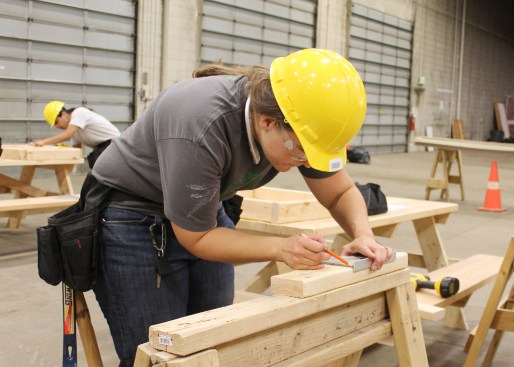
Courtesy CHBA
They–spurred by Oakwood Homes, which funded the BuildStong Education Foundation to fund the Colorado Homebuilding Academy–which we covered here in April. The course is an 8-week bootcamp aimed at teaching participants skills to kickstart careers in the construction trades.
Meanhwhile, it’s not just skilled labor that home building and residential development companies are looking for. Here’s real estate and construction recruitment consultancy Specialty Consultants Inc.‘s Top 10 Real Estate & Construction Executive Searches so far in 2017: