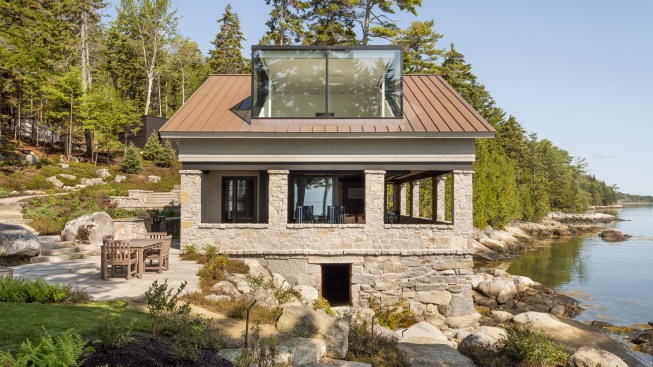
Sitting derelict for years in its current East Blue Hill, Maine, location, the abandoned 1919-built yacht club was moved to its home in 1946. With a mindset of restoring its historical memory yet modernizing its livability and structural integrity, Elliott Architects and Hewes & Co. were tasked with the project.
The project’s foundation, built partially on clay, was deteriorating and was never designed to comply with the floodplain regulations of present day. Needing reinforcement, the team removed the superstructure and deconstructed the structure’s club room piece by piece, each numbered and labeled. The chimney, somewhat a giant jigsaw puzzle, was also dismantled and carefully laid out for future re-assembly.
Trent Bell Photography
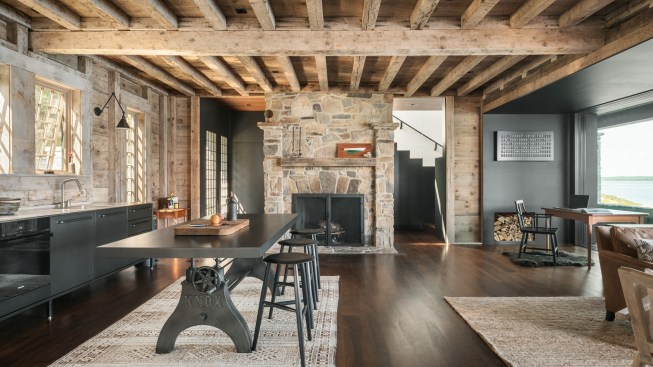
Once the foundation was reinforced and repointed, a steel and new wood superstructure was built in the exact shape and profile of the original. The club room was rebuilt including the chimney. “The process of rebuilding was slow and arduous. It required a great deal of coordination and patience. The craftsmanship and attention to detail by all engaged in this project is something that does not always come through in a photograph, particularly when the underlying foundation is concealed. Even the smallest detail was designed and executed to serve the larger goal,” says Corey Papadopoli, partner at Elliott Architects.
Project Details
Category: Custom Home 3,000 Square Feet or Less
Location: East Blue Hill, Maine
Architect: Elliott Architects
Builder: Hewes & Co.
Landscape: Richardson & Associates
Engineer: Thornton Tomasetti
Size: 2,064 square feet
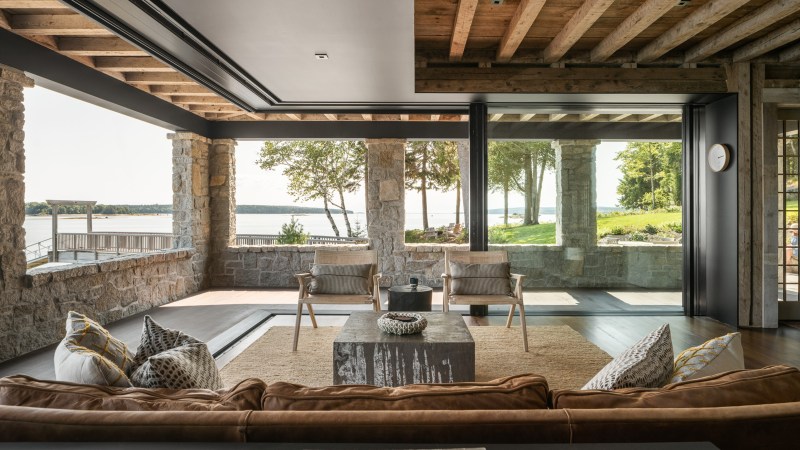
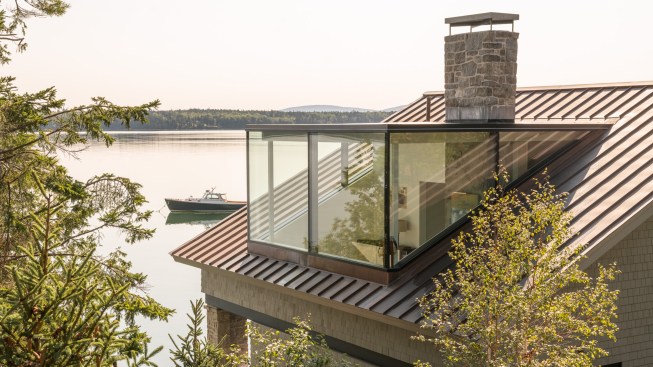
The new construction of the project, all kept within the existing footprint with a goal of being largely recessive, allowed for a new architectural language while respecting the greater community’s historical connection to the structure. A corner of the club room was removed to expand the living space onto the deck.
“This expansion was achieved with large sliding glass panels that opened at the corner, made possible by the new structural framework above. The removal of the exterior walls achieved two goals: it created a stronger connection to the environment beyond, and it allowed the interior space to expand onto the deck. When the doors are fully retracted the living room transforms into a covered porch and interior space is drawn outside,” Papadopoli adds.