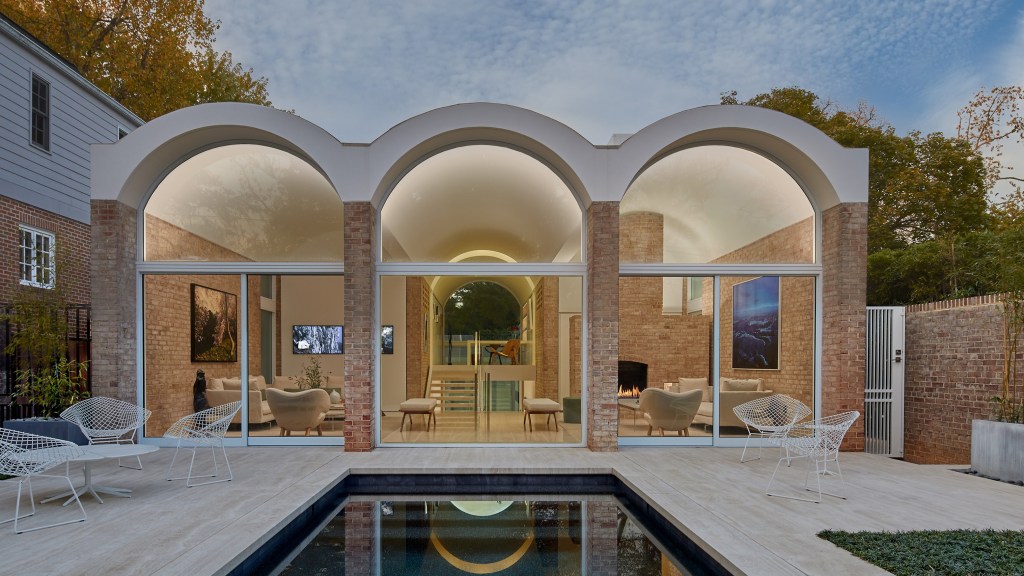
The Slayton House, designed by I.M. Pei in 1960, has seen many talented architects and builders renovate and update the space throughout the years. Listed on the National Register of Historic Places in 2008, architect Robert Gurney leaped at the opportunity to work on the International Style house known for its triple barrel vault roofline in the Cleveland Park neighborhood of Washington, D.C.
Anice Hoachlander
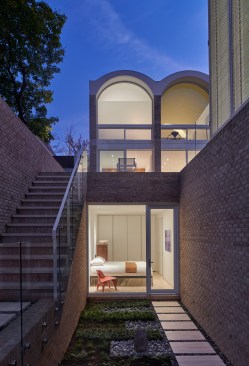
“To have the chance to work on this house was an incredible opportunity. Going into the project, my goal was to make it look like we did nothing. That being said, we did a significant amount of work by excavating the whole hill and basically built below the existing building,” says Gurney.
Equipped with Pei’s original drawings, the project team stripped the house back to its wood framing, brick walls, and concrete roof vaults, installed a structurally improved floor system, added 955 square feet to the main house through 420 below the existing dining room and 535 below a new rear terrace. The house’s new finishes were chosen with Pei’s original intentions and materials in mind, Gurney says.
Project Details
Category: Custom Home More Than 3,000 Square Feet
Location: Washington, D.C.
Architect: Robert M. Gurney Architect
Builder: Peterson & Collins
Structural Engineer: Cobb Architectural Engineers LLC
Interiors: Baron Gurney Interiors
Size: 4,754 square feet
New travertine flooring was installed through the house and continuing into the front courtyard while walnut and white lacquered millwork are consistent with the mid-century modern design. The existing brick and mortar were matched and continued seamlessly into the new, below grade spaces. The access to the drawings allowed restored items to match exactly the original details of the windows, doors, and door jambs, among other elements.
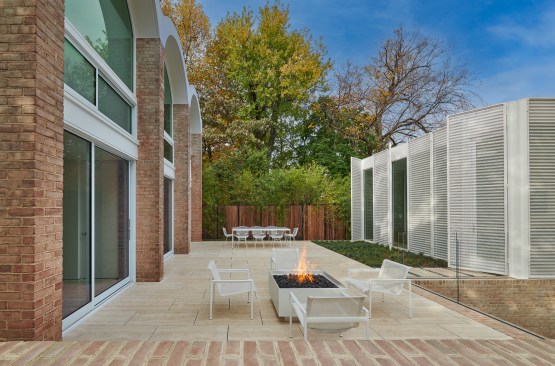
In the rear of the property, a two-story structure comprised of a garage and upper-level office were added advantageously using the site’s drop off in elevation from the ground floor to the rear alley. The new wood and glass accessory sits on a brick base that aligns with the finished floor of the house. “I thought about this building as a ‘non-building’,” Gurney says. “Tectonically, it is very different from the Pei building. I didn’t want it to pick up any of the language from the Pei building or compete with it.”
Anice Hoachlander
Perforated metal screens wrap the upper volume to modulate light and set it as a background to the Pei House.