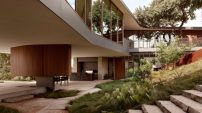
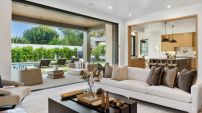
That task is very much on the mind of Martha’s Vineyard, Mass., architect Mark Hutker, a perennial design award winner who has also served as a Custom Home Design Awards judge. “There is clearly an increased awareness among jury members of seeking out the sustainable features of each project,” he says. But, for Hutker, the matter goes beyond merely tallying green brownie points. Architects who serve the custom home market now face a design agenda that includes minimizing energy consumption and shifting toward a sustainable use of other resources. “We all know how hard it is to achieve that agenda,” Hutker says, so judges who are also practicing architects have a keen interest in projects that do so in ways that are livable and beautiful as well as effective.
Greening residential architecture does not require reinventing the wheel, however. Hutker notes that good building design has always taken the environment as its starting point. For proper daylighting, solar gain, and ventilation, he says, “the simplest and most effective thing is to orient the house correctly,” the most fundamental act of architecture. “And if you’ve insulated really well,” he adds, you’re more than halfway home. But buildings that set the bar higher—by radically reducing energy use, producing energy on site, managing water consumption, and so on—while also working aesthetically, will earn extra points. Hutker recently served on a design award panel with a LEED-certified architect, whose expertise effectively enlarged the judging criteria to include sustainability. Lackluster aesthetics would disqualify any entry, Hutker says, but if an already good house also included green features, “it moved up.”
San Francisco architect Mary Griffin juried a design award program that offered a separate track for sustainable buildings. “You could enter a house in the sustainability category that maybe wouldn’t cut it” in the general pool, says Griffin, who approves of giving green practices this kind of boost as a way of bringing them into the mainstream. In what she views as the current period of transition, “It’s been a great thing.” Ultimately, though, she expects that such affirmative action efforts will become unnecessary. “Where we really want this thing to go is to meld,” she says, for architects “to become fluent in a set of [sustainable design] principles.”
In California, Griffin reports, the process is well under way. The state’s Title 24 regulations, a set of energy efficiency standards updated most recently in 2005, have presented architects with a new set of design problems against which to test their creative wits. In judging the results, Griffin says, “What I’m looking for is beautiful, intelligent design,” always a matter of defining problems and applying solutions. “And now there’s this additional layer: How do we incorporate photovoltaics?” As sustainability increasingly becomes standard practice, judges—and design award programs—will be able to take the incorporation of green features as a given and focus again primarily on the visual outcome.
In the meantime, though, architects like Henry Siegel are working to push the process forward. “I’ve been on a lot of design award juries, including the national AIA Honor Awards,” says Siegel. He also serves on the AIA Committee on the Environment, which conducts its own Top Ten Green Projects award program. It comes as little surprise, then, that Siegel takes a rather firm line on the matter of sustainability. Even in design awards, he says, “it’s not all about aesthetics; it’s about values. Sustainability is an important ethical value, and we need to acknowledge projects that make a significant effort in that direction. I’d be the last person to say that aesthetics are not important, but I’d be the first to say a building should be excluded if it represents the equivalent of a big SUV. There are some beautiful projects that should be eliminated.”
By the same token, Siegel recognizes that judging is a collaborative effort, to which judges bring their own standards and priorities. On sustainability as on other matters, he understands, he will have his say. But awards are granted by a consensus of the panel. In programs without a green track or specified sustainability criteria, the weight given to such considerations will vary according to the people involved. “It all depends on who your fellow jurors are,” Siegel says. With time, though, those subjective standards will move in a greener direction. “There is generally wider acceptance among younger practitioners that these are important values,” he says. Like Mary Griffin, Siegel notes the positive effect of California’s energy codes. But he expects that design award programs will continue to play an essential role in furthering the green performance of custom homes. “The building codes are going to change, but as the codes change the bar will be raised. Codes define the minimum standard. We’ll need to go further.”
That presents a challenge to anyone who would sponsor a design award program, but it is one that we at CUSTOM HOME welcome. As the time approaches for the 2009 Custom Home Design Awards, we will revisit the issue of sustainability in the way that we structure the program and in our choice of judges. But our conversations with architects make clear that green values are already influencing standards of architectural beauty. Looks may not be everything, but environmental responsibility in design and construction are looking better all the time.
Should sustainability influence design awards? Tell the editors of CUSTOM HOME what’s on your mind. Send your comments and questions to Bruce Snider at bsnider@hanleywood.com.