In the past generation, master baths have grown lavishly in both size and appointments.The most opulent now rival kitchens in lineal feet of countertop, and some give the living room a run for its money in square yardage of curtain fabric. But there are two sides to every coin. As upscale consumers embrace such body-conscious pursuits as yoga, custom bath design has come to reflect a leaner, more spa-like aesthetic. Pared-down in frills but not in function, these baths tend to favor deep, comfortable steeping tubs, plenty of elbow room in the shower, and the clean feeling of stone, ceramic, and glass surfaces.They balance the requirements of privacy with the psychological benefits of sunlight and offer a visual environment that revives without overstimulating. Perhaps more than any other room in a house, the bath is expected to improve one’s sense of physical well-being. A tall order, to be sure. But a glance at the master baths on the following pages will show just how far the state of this very specialized art has advanced.
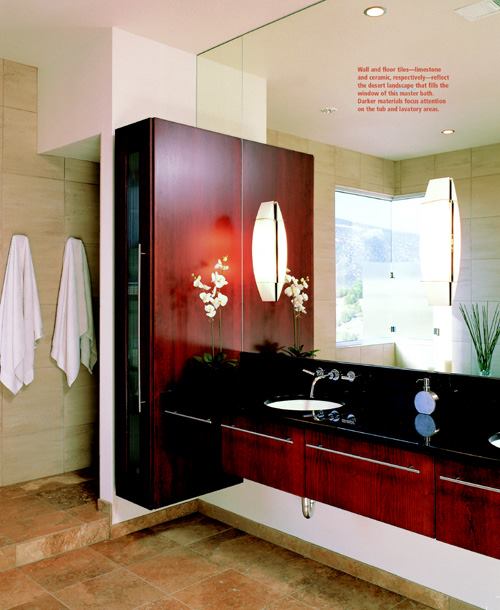
Desert Retreat Privacy is important in any bathroom, says Albuquerque, N.M., architect David Tinker. “But it is not always paramount. I like having the connection to the outside.” A case in point is this master bath, which enjoys a setting that Tinker found too compelling to hide. The view, a rolling high-desert landscape that stretches to the rugged wall of the Sandia Mountains, fills a corner window and serves as the room’s thematic centerpiece. Desert-color tiles—limestone and a slightly darker, stone-like ceramic—line the floor and walls. A spacious, orderly plan and clean, spare detailing reflect the quiet of the scene outside.
Wall and floor tiles—limestone and ceramic, respectively—reflect the desert landscape that fills the window of this master bath. Darker materials focus attention on the tub and lavatory areas. “I’m partial to the Zen look,” says Tinker, who worked here to reduce necessary amenities to their essential forms. Large mirrored areas and a floor that extends under the wall-hung sink cabinet increase the sense of volume. The shower’s cave-like recess provides privacy without a door and, Tinker points out, “all that glass to clean.” The result is a room that recedes rather than intrudes, focusing attention on the view. Against this visually quiet backdrop, Tinker used bolder materials—cherry cabinetry and dark granite—to accentuate the tub and sink areas. The tub’s position in the room, pulled away from the walls, further defines it as an independent element. The net effect is one of quiet intensity. Tinker notes, “It becomes almost a ceremonial space.” And if modesty interferes with the contemplative mood, there is a ready solution. A wall-hung screen of frosted glass unfolds to obscure the window’s lower half without blocking the distant ridgeline.
Project Credits: Builder/Interior designer: Suzanne Williams Designs, Albuquerque, N.M.; Architect: David Tinker, Albuquerque; Project size: 222 square feet; Construction cost: Withheld; Photographer: Kirk Gittings.
Resources: Bathtub surround/countertops: Rocky Mountain Stone; Plumbing fittings: Watermark; Plumbing fixtures: Kohler.
Clean Scene When architect Mark Jensen took the job of designing the interior architecture for this San Francisco infill home, the major partitions were already in place. But being stuck with a plain, rectangular box for the master bath did not stop Jensen from creating a room full of refreshing surprises. His boldest move was placing the tub smack in the middle of the plan. Skirted with marble mosaic tiles, its rounded form softens the angles of the room. A screening wall, also tiled in marble mosaic, cradles the tub in its curve and gives shape to the toilet and shower areas. A panel and door of laminated glass complete the toilet
A freestanding tub and the tiled wall that curves around it generate pleasingly angular volumes within a simple rectangular bathroom plan. Marble tile—in both 12-inch squares and mosaics—creates a clean, spa-like look. enclosure, providing privacy without inducing claustrophobia. Jensen took advantage of the master suite’s top-floor location by opening up much of the roof over the bath. A single rectangular skylight covers both the shower and toilet area. A second, slot-like shaft runs along the opposite wall, lighting not only the bath, ut also the adjacent hallway, which is separated from the bath by a set of laminated-glass sliding doors. For reasons of both practicality and perception, Jensen chose a palette of materials that he calls “clean and sanitary, and easy to keep that way.” Floors and walls are lined with 12-inch-square marble tiles. The sink base is finished in a slick white lacquer. Practical, too, are the tiled recesses thoughtfully located about the room (the lower niche in the shower wall is a place for a woman to rest a foot while shaving). It is with such small gifts that architects earn their keep.
Project Credits: Builder: Oliver & Co., Richmond, Calif.; Architect: Jensen & Macy Architects, San Francisco; Project size: 115 square feet; Construction cost: Withheld; Photographer: Sharon Risedorph.
Resources: Fittings: Kaldewei; Fixtures: Dornbracht; Hardware: Sugatsune; Lighting fixtures: Flos.
Balanced Approach Kitchen and bath designer Mary Jane Pappas has been in the business long enough to have seen tastes in custom baths swing to an extreme of opulence. “In the ’80s it got a little out of whack,” she says: Too much crown molding, too much floral drapery, too many upholstered chairs at m’lady’s dressing table. Today, she says with some relief, “I think we’re moving out of the overly embellished era.” In this Minneapolis master bath, Pappas was happy to further that trend. “The whole intent of the bathroom was to create a very tranquil space for two very active people.”
That calming influence begins with the symmetrical floor plan. A large soaking tub—no noisy jets—occupies center stage. A broad sill at the room’s bow window and two display counters provide ample space for art objects to contemplate while one steeps. Two additional counters put twin lavatory stations at opposite sides of the room. That separation is always a safe bet, Pappas says. “If you have two people whose behaviors around grooming are very different, it’s another area of friction.” Simple flush-face maple cabinets and maple flooring continue themes that run throughout the house. Two floor-to-ceiling frosted-glass doors face each other across the room, concealing mirror-image shower and toilet compartments. The aim throughout is balance, in both the design and its effect. After all, as Pappas notes, the world outside provides more than enough stimulation. “We’re all trying to relax.”
Project Credits: Builder: Emerald Builders, Minneapolis; Kitchen and bath designer: Pappas Custom Kitchen + Bath Design, Minneapolis; Interior designer: Enos & Co., Los Angeles; Project size: 147 square feet; Construction cost: Withheld; Photographer: Karen Melvin.
Resources: Fittings/fixtures: Kohler.
Art Installation
Exposed structure and elegant planes of stone, wood, and glass form the backdrop for this master bath in a renovated industrial building. Custom fittings in a neo-Buck Rogers style rise to the level of functional sculpture. David Papazian Rare is the bathroom so original that it generates its own lexicon. But in describing this master bath in a former industrial building converted to an art gallery with living quarters above, conventional terminology simply fails. The Cylinder, as architect Jeff Lamb calls it, is a freestanding shower custom-fabricated of bent glass panels with a spun stainless steel pan. Lamb placed the shower unit against an existing west-facing window reglazed with red glass. “It puts this red light into the whole space,” he says. “The shower becomes this lava tube.” Across the room stands the Orb, a steel-framed glass enclosure that holds both a conventional toilet and a wall-hung urinal and features a strip of frosted glass in its floor. When the lights are on in the gallery, Lamb says, “This whole shape is illuminated from below.” In another corner a stainless steel water tank with retro-modern temperature gauges stands on a steel-and-glass pedestal. A flat-screen TV hangs from a bracket above. Lamb places these eccentrically contemporary objects against a backdrop of rich natural materials—floors and one wall of Mexican travertine tiles, a floating panel of maple at another wall, cabinets of kaya mahogany—and celebrates the building’s industrial heritage by exposing its original brick walls and iron structural columns. To heighten the contrast between old and new, Lamb says, “Everything is pulled away from the wall and is freestanding.” That theme is carried through even to the sinks, which rest on the heavy glass counter like oversize salad bowls. Made of cast glass with a dusty patina, the sinks share another distinction: “They’re one of the few things in here that are off the rack.”
Project Credits: Builder: Don Tankersley Construction, Portland, Ore.; Architect: Lamb Design Studios, Portland; Project size: 160 square feet; Construction cost: Withheld; Photographer: David Papazian.
Resources: Cabinets: Woodcraft; Ceramic tile: Intrepid Marble; Countertops/glass doors, panels, and shutters/mirrors: Benson Industries; Electronic control system: Lutron; Hardware: Fergus Kannel, and Formed Objects; Plumbing fixtures: Alchemie, Grohe, and Toto; Stone: Ann Sacks.
Essential Matter Stringently reductionist in form, this Seattle master bath derives its quiet richness from a subtle combination of materials and the play of light on its surfaces. Floor-to-ceiling doors open the bath to the bedroom, increasing the sense of volume in both spaces (opposite, below). In designing his own house, Seattle architect George Suyama took the opportunity to explore a simple idea—a very simple idea. “The premise of this house was to make every gesture, every move in this house as simple as possible,” he says. “We kept distilling and distilling.” The results are clearly evident in the master bath, which demonstrates just how little geometry it really takes to satisfy that room’s functional requirements. The sink is a box on a shelf; the tub is a box in the floor; the shower is, well, a box. The simplicity of form heightens the presence of the materials—concrete, plaster, and stainless steel. As Suyama says of his approach to baths in general, “It’s all about the experience of light and water.”
Located a half-story below the house’s main level, the bedroom suite deliberately plays with the division between sleeping and bathing areas. The two rooms share a continuous ceiling, with two floor-to-ceiling frosted glass doors for privacy. The shower is accessible directly from the bedroom and also from the bath area, via stepping stones submerged in the tub.And while the arrangement represents something of an experiment, it rests on an underpinning of hardheaded practicality. The soaking tub and shower pan are integral with the concrete floor, and the in-floor hydronic heating runs under both. The cement plaster walls in the shower are sealed, “so we can take a shower in that space without worrying about it.”
Project Credits: Builder: Crocker Construction, Seattle; Architect: Suyama Peterson Deguchi, Seattle; Project size: 200 square feet; Construction cost: Withheld; Photographer: Claudio Santini.
Resources: Acrylic cement walls: Dan Daniliucci; Concrete sink: Vern Glover; Faucets: Vola; Heated towel bar: Myson; Sliding glass doors: Fleetwood.
East Meets West Frosted glass filters the light that enters this Asian-influenced master bath. Tiles of slate and matte black ceramic contrast dramatically with the box-like wooden soaking tub, which occupies a corner of the walk-through shower (opposite). Chicago architect Brad Lynch does not design a lot of fancy bathrooms. “Spending tens of thousands of dollars on gadgetry and tons of square footage isn’t necessarily where most of our clients want to go,” he says. “For us, it’s economy: Get in and get out, but make it comfortable.” That no-nonsense approach, though, can yield deceptively rich results. Free of columns and curlicues, this master bath nevertheless raises the everyday matters of personal hygiene to a distinctly higher plane. The effect derives as much from what Lynch kept out of the room as from what he put into it. The plan is simple and rectilinear; planes intersect crisply, without trim; exterior light is filtered through panels and doors of frosted glass. Against the matte surfaces of slate and black mosaic tile, the maple sink base and wooden soaking tub radiate a warm glow.
The clients had lived for some time in Asia and returned with an affection for soaking tubs, and this one is the soul of elegant simplicity. “It’s essentially a wooden box,” Lynch says. Resting on short legs inside a generous walk-through shower, the tub has its own filling tap and handshower, and drains through a simple plugged hole into the shower pan.
Project Credits: Builder: Lerchen Residential Builders, Indianapolis; Architect: Brininstool + Lynch, Chicago; Project size: 300 square feet; Construction cost: $175 a square foot; Photographer: Christopher Barrett, Hedrich Blessing.
Resources: Japanese soaking tub: Oregon Hinoki Products; Plumbing fittings: Grohe; Plumbing fixtures: Kohler; Slate: Vermont Slate; Tile: Dal-Tile.