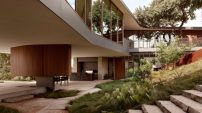
In an Idaho mountain town, a new project shows that going prefab doesn’t have to mean sacrificing unique design or high performance.
The Overlook Residences, a partnership between Idaho-based developer Altruist and Canadian manufacturer CABN, uses a net-zero ready, cross-laminated timber (CLT) building envelope to create homes with a classic high-West aesthetic.
The project challenges the old notion of prefab as a one-size-fits-all solution, positioning it instead as a collaborative tool for builders that helps them build more homes, faster.
A New Kind of Prefab
Prefab still carries a reputation for boxy, modular homes with limited design flexibility. Jackson Wyatt, founder and CEO of CABN, said his company offers a different approach.
“We consider ourselves the builder’s prefab. It’s off-site panel construction,” Wyatt said. “We work with builders who have their own vision, and we bring our panelization, our energy efficiency, and our materials to the equation.”
At the Overlook Residences, the American high west design aesthetic was driven by the developer, drawing inspiration from historic barns, ranches, and log cabins. CABN then translated that vision into its Core Technology™, a fully engineered, zero-carbon building envelope. “We brought our build-ups and our insight on the manufacturing and efficiency side, and we worked closely together to blend the two,” Wyatt said. “Their build went up extremely quick, and it’s going to be absolutely stunning.”
From Factory to Frame
The system’s high performance starts on the factory floor. “Our buildings are off less than a millimeter dimensionally,” Wyatt explained. “By having an engineered, CNC-standard product, we can control the full envelope and the air tightness, removing the human variable that can reduce efficiency on-site.”
The consistency of factory-made panels also reduces errors and delays once materials arrive on-site. Since the panels are produced indoors, weather is less of a factor, and builders can move quickly from delivery to framing without costly downtime.
At CABN’s facility, panels for a 2,000-square-foot home can be cut, shipped, and assembled into an airtight envelope in less than a week. “Not only is that a shorter labor time with less waste and risk of injury, but it also creates a 365-day-a-year building season,” Wyatt said. “That’s a huge advantage in a climate like Idaho’s.”
The Business Case for Builders
Despite the benefits, Wyatt understands why some builders remain skeptical. “If you’re a builder, well, that’s what you do. You build,” he said. “Plugging in a house can feel more like an install and logistics.”
He frames their prefab system not as a replacement, but as a tool for growth. “We’ve found the builders who really get excited about it know it enables them to build more,” Wyatt said. “Instead of building three to four custom homes a year, they’re building 10.”
Scott Charney, market manager for mass timber at Quality Buildings, has worked with CABN and said the system shows clear advantages. “The process was cleaner, more precise, and faster than traditional building,” Charney said. “We’re looking forward to our next project with CABN.
Prefab also changes the math on quality versus cost. The controlled factory environment produces consistent panels with fewer errors, while shorter build times reduce labor costs. For builders, that combination means higher margins. For buyers, it means a home that performs better without a premium price tag.
“We want to make sure that we can make something sustainable without forgetting that people need to live in a house at a reasonable cost,” Wyatt said.