Architect David Freeland wanted the client's law books and photo…
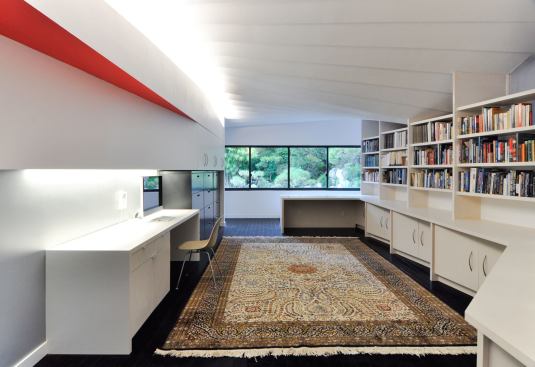
Architect David Freeland wanted the client's law books and photography to be artfully displayed as well as neatly stored. He used canted shelves and an angled ceiling to provide interest in the monochromatic space.
Nils Timm
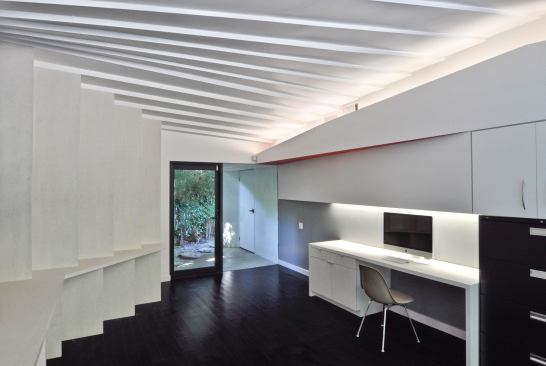
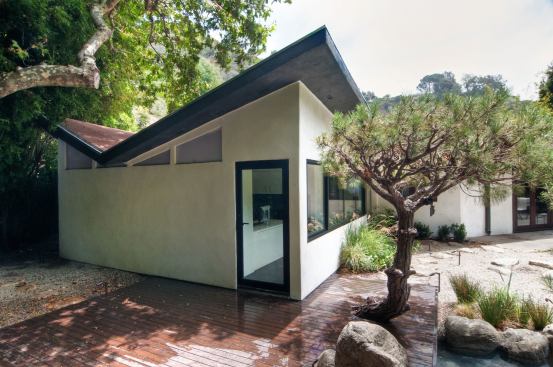
Builder David Bond eventually had to frame this undulating roof …
Builder David Bond eventually had to frame this undulating roof himself. “We usually can cut every rafter the same, but here every rafter had to be cut with four different angles to make it work,” he explains. “The biggest challenge was making the tails of every rafter line up with a straight fascia board.”
Nils Timm
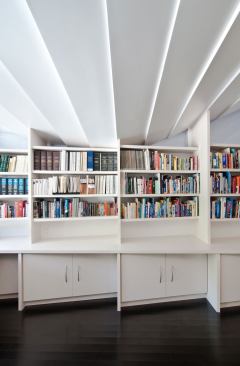
Bond adds that the complexities didn’t end with the unique raf…
Bond adds that the complexities didn’t end with the unique rafters. Both the plywood and finish drywall sheets had to be cut to fit and slightly bent to give the effect of a curved surface. “You get this perceived sloping effect like there’s a curvature,” he says, “but there’s really not a curve anywhere.”
Nils Timm
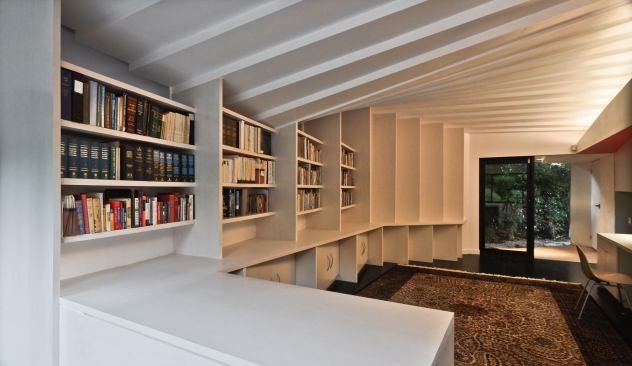
Segmenting the shelves creates an automatic organizational mecha…
Segmenting the shelves creates an automatic organizational mechanism for sorting the books into different categories within the four-foot sections.
Nils Timm
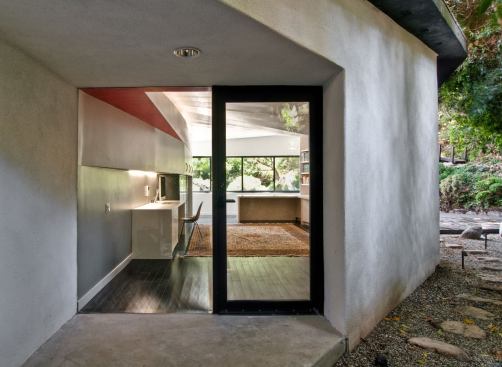
A second egress connects to the back gardens. The library's dark…
A second egress connects to the back gardens. The library's dark bamboo floors fit with the Asian-inspired landscpaing.
Nils Timm
The library/office has exterior access so that clients for the h…
The library/office has exterior access so that clients for the homeowner's legal practice don't have to walk through private areas of the house.
Paul Ryan-Goff
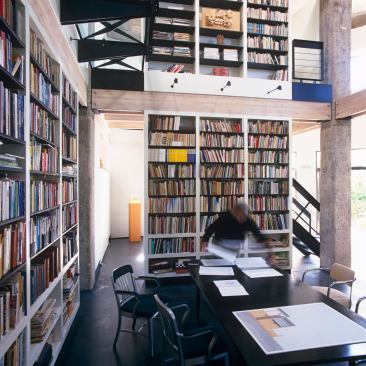
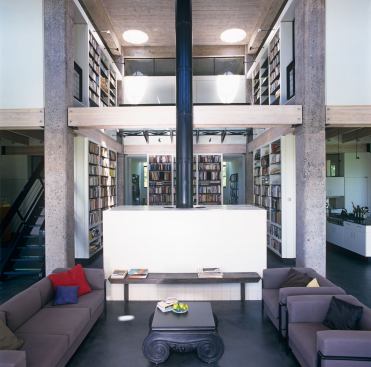
A two-story home library is the central space in this water towe…
A two-story home library is the central space in this water tower cum residence.
Paul Ryan-Goff
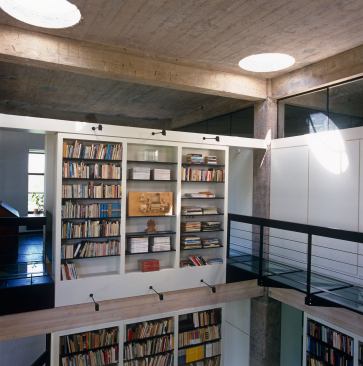
De Bretteville eventually added slender glass walkways that tie …
De Bretteville eventually added slender glass walkways that tie into the main balcony for easier access to upper shelves.
Paul Ryan-Goff
Four existing circular skylights flood the library with natural …
Four existing circular skylights flood the library with natural daylight while industrial task lights illuminate the stacks at night.
Paul Ryan-Goff
The bookshelves float between existing concrete columns forming …
The bookshelves float between existing concrete columns forming the only rectilinear space within the water tower's curved walls.
Brian Vanden Brink
This home library doubles as a meditation space, so minimal furn…
This home library doubles as a meditation space, so minimal furniture and abundant sunlight are key to the serene atmosphere.
Brian Vanden Brink
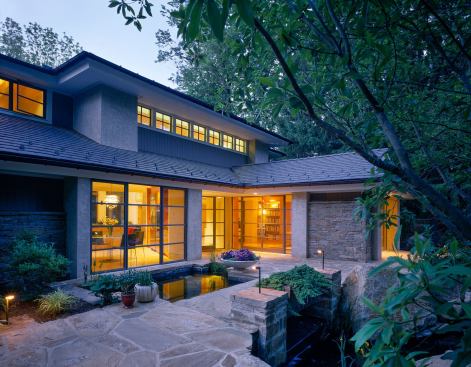
Triple sets of steel framed glass doors link the room to surroun…
Triple sets of steel framed glass doors link the room to surrounding gardens on three sides.
Brian Vanden Brink
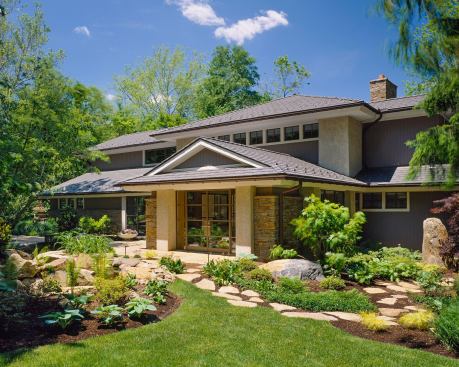
The "away room" as architect Mike Ruegamer likes to call it, jut…
The "away room" as architect Mike Ruegamer likes to call it, juts out into the gardens with only a single connection to the rest of the house.
Brian Vanden Brink
Despite the popularity of e-readers, residential builders and designers aren’t reporting a decline in clients wanting home libraries. In fact, some even theorize that libraries may be more in demand because quiet space offers welcome counterpoint to popular open living. And while fewer print books are being bought, homeowners are reluctant to give up existing collections. Housing those books in a dedicated room allows opportunities for multipurpose spaces such as libraries that double as offices, meditation rooms, or studios. Even if it’s just some shelves and a comfortable window seat, architect Mike Ruegamer says most of his clients want a room just to get away.
Tower Tale: Bookshelves serve as spatial organizers. A decommissioned water tower in a tony residential district overlooking New Haven, Conn., struck architect Peter de Bretteville and his wife, Sheila—who teaches art at nearby Yale University—as an ideal spot for their new home.
Inside the 18-inch-thick concrete walls, four structural columns span 28 feet from floor to ceiling. De Bretteville used those existing columns as an organizing mechanism for arranging living spaces within the 50-foot-diameter circular structure. Instead of filling the space between columns with walls, two stories of bookshelves serve as organizational partitions as well as a library and home office. The soaring library stands in a place of honor and is the only rectilinear space within the curved walls. The shelves house more than 500 linear feet of books for the professorial couple. Structural wood beams span the 16 feet from column-to-column and provide stability for the shelving system. This allows for gaps between the shelves and columns so natural light can flow into the library.
Tower Tale:Architect: Peter de Bretteville Architect, Hamden, Conn.; Structural Engineer: Vladimir Tussman, New Haven, Conn.; Mechanical Engineer: Scorbati and Associates, New Haven; Room Size: 64 square feet
Legal Binding:In a home office, shelving doubles as an architectural detail. A lawyer who works from home wanted a library/office that was physically attached to the house but felt separate. He needed room to store his law books, meet with clients, and concentrate on cases. In his spare time, the homeowner has a passion for photography and travel, so he also wanted space to display his photos. Architect David Freeland designed an addition at the end of the single-story house that juts out into Japanese-style gardens.
Four-foot-wide bays set at symmetrical angles are filled with shelves and cabinets. Further breaking down the scale of the room, a canted ceiling changes directions every 16 inches. Each rafter was cut and placed at a different angle with twisted drywall panels and plywood filling the space between. Builder David Bond, who collaborates frequently with Freeland, says “it was the most difficult roof I’ve ever built.” Bond adds that it also was one of his favorite projects because the former framer actually climbed up and framed the roof himself. “The series of offsets breaks down the light,” Freeland explains, “but it was created mainly because we didn’t want a monolithic wall of books. It also gives the space more of a “personal, residential feel and became an organizational device,” adds Freeland, because sections are organized by subject matter.
Legal Binding:Architect: Freeland Buck, Los Angeles; Builder: A Grade Construction, Pasadena, Calif.; Cabinetmaker: European Elegance Woodworking, Van Nuys, Calif.; Room Size: 380 square feet
Open Book: Creating a light-filled library isn’t an oxymoron. “I designed these corner shelves to fit right up to the door frames and give a clean rhythmic aesthetic of alternating bookcase, doors, bookcases, doors, etc., to the entire room,” says architect Mike Ruegamer to describe how he turned the typical ratio of bookshelves-to-glazing found in most home libraries upside down. The result is a light-filled space for reading and meditation. Approximately 140 linear feet of shelves fill the room’s corners to prevent direct sunlight from damaging books. Ruegamer treats home library design like closets: “I count the footage of books they have and ask what kind of expansion they anticipate—the exact same way we do dressing rooms.”
Natural maple for the shelving, ceiling, and floors further brightens the room. The ceiling plane is low to create a more intimate feel, but an exposed roofline ties in with the double-height ceilings found in other public spaces throughout the house. Surrounded on three sides by gardens, the room connects to the outdoors through glass doors and windows with steel divides that emphasize the horizontal lines created by bookshelves. The translucent walls let natural light in during the day, while at night the room softly illuminates the landscaping. As in all of the libraries he designs, Ruegamer speced three types of artificial lighting. “We always do different treatments to highlight the books,” he explains, “plus provide ambient lighting and task lights for reading.”