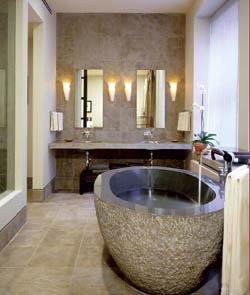
What’s the latest way to add glamour to a master bath? More designers, manufacturers, and homeowners are turning to the tub to make this room a standout. Freestanding tubs in exotic materials and sculptural shapes are redefining how this bathroom stalwart should look and are giving it more presence. But the size and bulk of some of these bathing beauties require careful planning and installation. The two master baths featured here are cases in point.
The 2,500-pound granite bathtub in this New York City master bath was lifted by crane through a sixth-story window in a 19th-century multifamily building. “We had to jump through hoops to make it work,” says architect Alex Harrow. Prior to the big hoist, floors were gutted down to the terra-cotta arches that frame the building. Then a reinforced, lightweight concrete slab was poured to support the egg-shaped tub without affecting the ceiling of the residence directly below. Sculpted from a single piece of black granite with a hammered exterior that contrasts with the polished bathing well, the piece sits grandly in the corner of the room. Adjacent shoji screens open the bath to the entire master suite because, Harrow says, “it’s nice to be in a big space while you’re taking a bath.”
This 10-foot-by-15-foot bathroom also acts as a bridge between the master bedroom and dressing room/closets in its new Austin, Texas, home. By arranging all of the bath fixtures along one wall as stand-alone objects, architect Hobson Crow, AIA, was able to create an unobstructed corridor. As the homeowners move from the bedroom toward the dressing area, they pass by symmetrical vanities flanking a minimalist tub, and farther along the path are frameless glass doors leading to the shower and toilet room. Despite limited space, Crow opted for a freestanding tub with a standpipe floor fixture. Crow doesn’t often use freestanding tubs in his designs, but he felt that this beautiful, well-crafted piece served the aesthetic purpose of maintaining an open, airy feeling as well as the functional mandate of creating two separate zones for the clients. Making the most of great views, the tub sits under a large window overlooking a courtyard and opposite glass doors that lead to a small terrace. The use of pale, reflective materials like recycled glass tile, white marble, and stainless steel provide “watery, light-filled contrast” to the wood-lined bedroom and dressing area. “The whole point was to make everything seem to float away from the walls,” says Crow.
Top Photo: Builder: US Interiors, New York City; Architect: Freyer Collaborative Architects, New York City; Structural engineer: Gleit Engineering Group, New York City; Photographer: Eduard Hueber. Resources: Stone mason: Stone Forest. Bottom Photo:Builder: J. Pinnelli Company, Austin, Texas, Architect: Hobson Crow Architects, Austin; Photographer: Paul Bardaigjy. Resources: Cabinets: Boffi; Plumbing fittings: Duravit; Plumbing fixtures: Dornbracht; Windows: Hope’s.